What if the most effective school cleaning plan was shaped less by a standard checklist and more by how each space is used? Choosing cleaning services for schools UK can raise practical questions: which tasks belong in the plan, when can they be completed, and how can standards be checked without interrupting lessons?
Those concerns are understandable. Classrooms, washrooms, corridors and dining areas have different cleaning needs, while access changes across the school day and term calendar. A clear schedule sets out what is cleaned, how often and when more intensive work can take place. Agreed quality checks then help the school review whether the service is working as intended.
This guide explains what school cleaning services may cover, how routines can reflect different spaces and school schedules, and what to clarify when assessing a provider’s plan. UF Cleaning provides education cleaning as part of its commercial services, with flexible scheduling and real-time quality monitoring through the Taskbe platform. Use the guidance to assess provision and identify the questions that matter for your school.
Key Takeaways
- Use a clear scope to distinguish routine cleaning from periodic tasks and work that needs separate agreement.
- When assessing cleaning services for schools UK, map each task to the spaces it serves and when those areas are accessible.
- Plan term-time and holiday routines around school use, access requirements and work that can be scheduled during quieter periods.
- Agree practical arrangements for school contacts, restricted areas, keys and schedule changes to help limit disruption.
- Review service records and observations against the agreed specification to see where provision meets needs and where it may need adjustment.
What do UK school cleaning services usually cover?
School cleaning services are planned tasks for educational premises, organised around how different areas are used and when they can be accessed. A plan may cover classrooms, washrooms, corridors, dining spaces and staff areas, with the precise scope shaped by the building, daily routines and agreed responsibilities. Cleaning services for schools UK should be specified for the site, rather than assumed to follow one standard checklist.
Cleanliness in education settings is about more than appearance. The history of school hygiene reflects its broader connection with public health and learning environments. A practical service plan translates that context into defined tasks, timings and checks.
Which routine tasks may form part of a school cleaning plan?
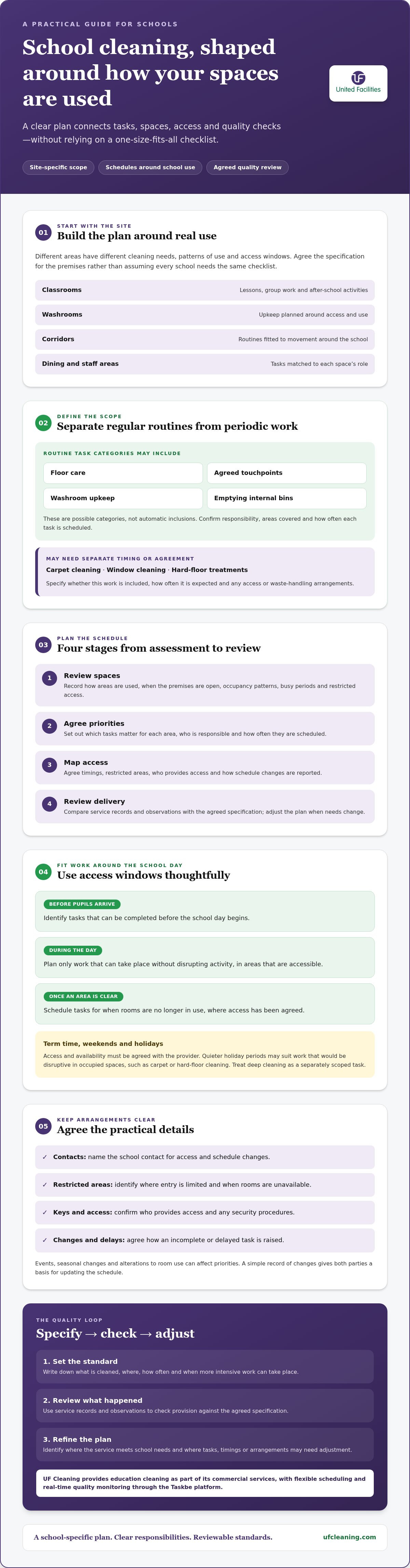
Routine work may include floor care, cleaning agreed touchpoints, washroom upkeep and emptying internal bins. These are possible task categories, not automatic inclusions. The school and provider should confirm who is responsible for each task, which areas it covers and how often it is scheduled.
Keep regular routines distinct from periodic work. Carpet cleaning, window cleaning and hard-floor treatments may need separate timings, equipment or access arrangements. The specification should state whether these tasks are included, how often they are expected and whether they require a separate agreement. Clarify waste responsibilities too, including whether the scope covers internal bin emptying or other handling.
How does school cleaning differ from general commercial cleaning?
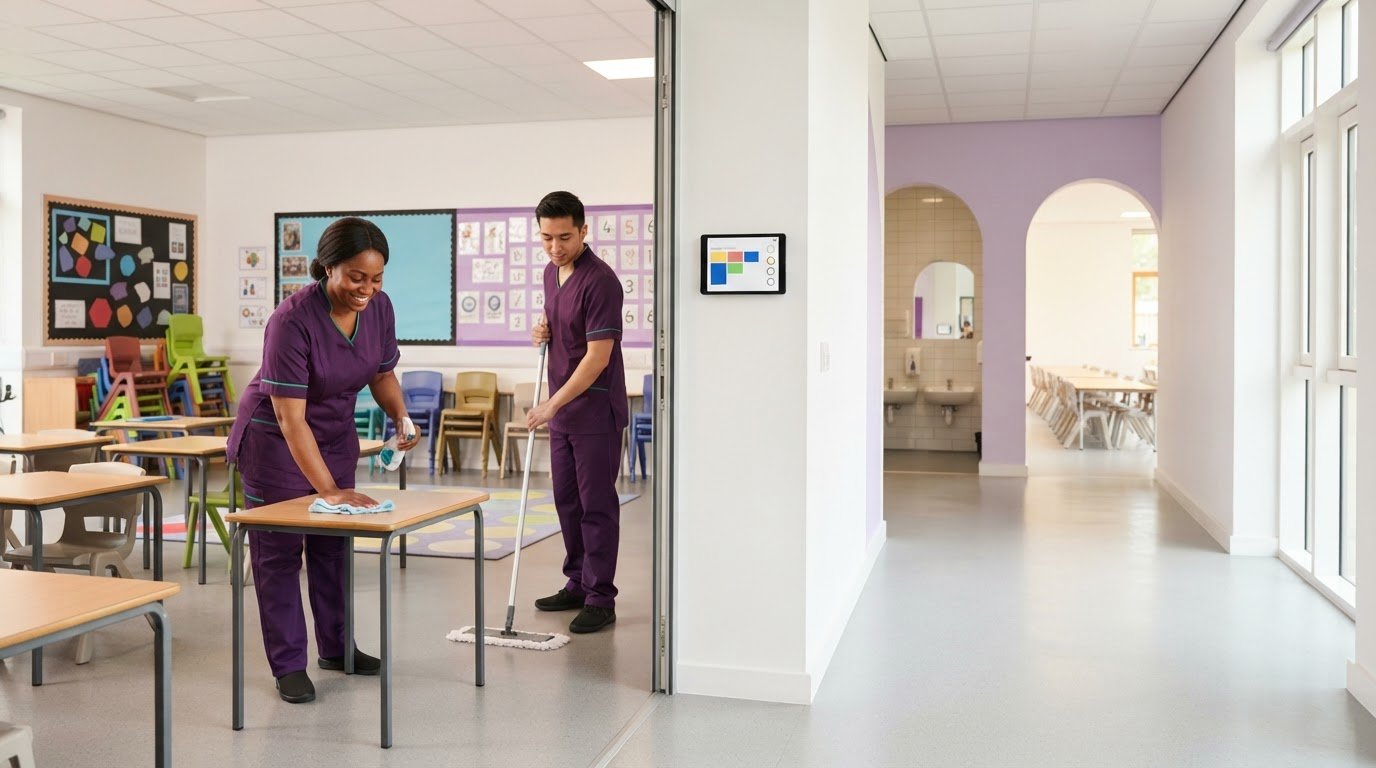
Schools bring together pupils, staff and visitors, and spaces can change function throughout the day. A classroom may be used for lessons, group work or an after-school activity, while dining areas and washrooms have their own periods of heavier use. These patterns affect which tasks take priority and when a room is available.
Planning must also account for access and school operations. Agree timings, restricted areas and the staff contact for schedule changes, then make responsibilities clear for both the cleaning team and the school. This helps prevent uncertainty over rooms in use or tasks that need to wait.
No two premises need an identical specification. A smaller school and a larger site may differ in layout, facilities and access windows, so the agreed plan should reflect actual use. UF Cleaning provides education cleaning as part of its commercial services. Confirm any school-specific tasks and arrangements when reviewing the proposed scope.
How are school cleaning schedules planned around term time?
A workable schedule starts with how the school operates, not with a fixed list of hours. When planning cleaning services for schools UK, the school and provider can work through four stages: review spaces, agree priorities, map access, then review delivery. This helps fit planned work around lessons, daily routines and periods when rooms are unavailable.
What should a school assess before agreeing a cleaning schedule?
Record how each area is used, when the premises are open and where access is restricted. Note busy periods, occupancy patterns and spaces that need particular attention. The school can then distinguish tasks to complete before pupils arrive, those that can be done during the day without disrupting activity, and those better scheduled once an area is clear.
Agree priorities and responsibilities in writing. The official DfE health and safety advice can help schools consider their wider health and safety arrangements. The cleaning schedule should also specify practical details, such as who provides access, who reports a change and how an incomplete or delayed task is raised.
Build in a review point. Events, seasonal changes and alterations to room use can affect access or priorities. A simple record of these changes gives both parties a clear basis for updating the schedule instead of relying on informal assumptions.
How can cleaning arrangements adapt during school holidays?
Term-time routines, weekends and school holidays offer different access conditions, but availability must be agreed with the provider rather than assumed. During term time, a plan may prioritise regular tasks around room use and agreed access windows. If weekend access is being considered, confirm opening arrangements, security procedures and any limits on which areas can be entered.
Quieter holiday periods may make it easier to plan work that would be disruptive in occupied spaces, such as carpet or hard-floor cleaning. Deep cleaning can also be considered, but should be treated as a separately scoped task, with the areas, work, timing and responsibilities confirmed in advance.
Before each holiday period, confirm dates, authorised access, school contacts and how schedule changes will be communicated. UF Cleaning provides education cleaning and flexible schedules. Schools can review its education cleaning provision when considering their requirements.
How should cleaning needs differ between school areas?
A useful school cleaning specification connects each task to the way a space is used, its level of occupancy and the times it can be accessed. The Workplace (Health, Safety and Welfare) Regulations provide guidance on workplace conditions, including cleanliness and welfare facilities. A school’s cleaning plan should translate its site requirements into clear, practical responsibilities.
Cleaning priorities vary with use, occupancy and access, so one schedule may not suit every area. The table below can help schools identify what to discuss when reviewing cleaning services for schools UK. Task frequency should follow the school’s assessment and the agreed service specification, rather than a universal timetable.
| Area | Use and cleaning priorities | Access considerations |
|---|---|---|
| Classrooms | Consider floors, accessible surfaces and furniture, taking account of layout and room activities. | Plan around lessons, room changes and any equipment or surfaces that need special handling. |
| Washrooms | Agree a distinct task list for sanitary areas, sinks, floors and replenishment responsibilities where included. | Identify suitable access between periods of use without obstructing pupils or staff. |
| Dining areas | Set out priorities for floors, tables and other agreed surfaces in spaces used for meals. | Coordinate cleaning with meal service, room use and any food-related procedures set by the school. |
| Corridors | Consider floor care and accessible touchpoints along busy routes. | Choose access windows that avoid peak movement and maintain clear routes. |
| Reception spaces | Focus on visible floors, surfaces and agreed touchpoints in visitor-facing areas. | Coordinate with reception staff and visitor access arrangements. |
| Staff areas | Agree tasks for shared surfaces and floors, taking account of the room’s specific use. | Confirm access with staff and clarify any areas or items outside the scope. |
What cleaning considerations apply to classrooms and shared areas?
In classrooms, furniture density, floor finishes and changing room use can affect what is practical within an agreed visit. A clear specification can identify accessible surfaces and note any areas that require staff preparation. Corridors and other shared spaces have different constraints: movement can be continuous, so consider access windows and safe routes alongside the task itself.
How do washrooms and dining areas need to be considered?
These spaces benefit from distinct task lists because their use, surfaces and access patterns differ from teaching areas. Schools can agree what is checked, how concerns are reported and who to contact if a task cannot be completed or an issue needs attention. This creates a consistent route for review without assuming every school needs the same frequency or scope.
Can school cleaning take place without disrupting lessons?
Yes. Disruption can be reduced when timings, access and communication are agreed around the school’s daily routine. A cleaning plan should make clear which spaces are available, when work can take place and who to contact if a lesson, event or access restriction changes the arrangements. This gives the school and cleaning provider a shared reference point instead of relying on assumptions.
Before work begins, agree site-specific risk controls and how the school’s own procedures apply. Safeguarding arrangements can vary by setting and role, so clarify expectations with the school rather than assuming one check or process applies universally. Practical coordination is part of defining suitable cleaning services for schools UK.
What should schools agree before cleaners work on site?
Confirm arrangements for arrival, sign-in, access and communication, including who can authorise entry and report a change. This checklist can help:
- School contact: Name the person to speak to about daily access or urgent schedule changes.
- Restricted areas: Identify rooms or zones that need permission, are out of scope or must remain inaccessible at particular times.
- Keys and entry: Agree how keys or access devices are issued, used and returned.
- Changing routines: Set out how closures, events, room changes or delays will be communicated and recorded.
- School procedures: Confirm applicable site and safeguarding arrangements with the school before access is granted.
These details help cleaners work around lessons and school activity, while giving staff a clear route to flag an issue. Review them when routines or access requirements change.
How can cleaning products and equipment be managed responsibly?
Ask how product names, use instructions and storage arrangements will be communicated. Agree where equipment can be placed so it does not obstruct pupils, staff or visitors. Work areas and equipment should be managed in line with the school’s site procedures, with access restrictions clarified before tasks begin.
COSHH, the Control of Substances Hazardous to Health framework, concerns assessing and controlling risks from hazardous substances, including cleaning products. Schools and providers should check current Health and Safety Executive COSHH guidance and agree how relevant instructions and controls apply to the planned work. Specific arrangements depend on the products, tasks and site.
UF Cleaning provides education cleaning and flexible schedules. Information about its education cleaning arrangements can help schools consider how a plan might fit their routines.
How can schools review cleaning quality and choose next steps?
A useful review compares what happens on site with what the service specification says should happen. Rather than relying on general impressions, check agreed task records alongside observations from the areas covered. This can show whether a concern relates to the cleaning itself, the timing, access, or a difference between written responsibilities and day-to-day expectations.
For cleaning services for schools UK, a consistent review can cover four areas:
- Scope: Are the agreed tasks and areas clearly defined, including exclusions or separately arranged work?
- Schedule: Do planned timings and frequencies reflect how spaces are used and when they are accessible?
- Communication: Is there a named contact for concerns, changes and follow-up, with a clear route for raising issues?
- Monitoring: What records or checks are available, who reviews them, and how are actions tracked?
Agree how concerns will be recorded, who assesses them and when the plan will be reviewed. If a task is repeatedly missed because a room is unavailable, for example, the response may involve clarifying access arrangements as well as reviewing delivery. A named contact and defined follow-up process help turn observations into practical adjustments.
What questions help assess an education cleaning provider?
Ask how the provider would tailor tasks to the school’s spaces and operating schedule. Clarify how staffing and supplies are handled under the agreement, how service changes are approved, and what information is recorded during quality checks. Ask how concerns are investigated and resolved, and what evidence of follow-up the school can expect. Clear answers make it easier to compare proposals on more than broad quality statements.
How can a school begin reviewing its current arrangements?
Start with the documents and experience already available. Record current tasks, timings, access arrangements and recurring concerns, then compare them with the written scope. Note where expectations differ, such as an area assumed to be included but not listed, or a scheduled task that regularly conflicts with room use. This gives the school a defined set of priorities before discussing changes or inviting a provider to review requirements.
UF Cleaning provides education cleaning and uses the Taskbe platform for real-time quality monitoring. Once your priorities are clear, you can review UF Cleaning’s education cleaning service and ask how its proposed scope, schedule and monitoring would relate to your school’s requirements.
Build a cleaning plan your school can review with confidence
A strong school cleaning arrangement starts with a clearly agreed scope: which tasks apply to each area, when those spaces are accessible, and how responsibilities are recorded. Reviewing service records alongside observations can help identify whether gaps relate to the schedule, access or the agreed specification, giving the school a practical basis for discussion and adjustment.
These principles make cleaning services for schools UK easier to assess. Priorities should reflect how the premises are used, while communication routes and quality checks should be clear enough to support consistent review. The right plan is one that fits the school’s requirements and can be revisited as they change.
UF Cleaning provides education cleaning across the UK and has served organisations since 2010. Its real-time quality monitoring is provided through the Taskbe platform, supporting visibility of delivery within an agreed service plan. With clear priorities and an open review process, schools can assess whether the proposed provision fits their needs.
To discuss an education cleaning plan for your school, contact UF Cleaning.
Frequently Asked Questions
What do school cleaning services usually include?
School cleaning services can include floor care, agreed surface and touchpoint cleaning, washroom upkeep and internal bin emptying. The precise scope depends on the premises and service agreement, so confirm which areas and tasks are covered, who is responsible and how often work is scheduled. Periodic carpet, window or hard-floor work may need to be specified separately. A written task list helps prevent assumptions about what cleaning services for schools UK will include.
How often should a school be cleaned?
There’s no single frequency that suits every school. A schedule should reflect how rooms are used, occupancy, access and the school’s priorities. For example, a frequently used washroom may need a different routine from a staff room with more limited use. Agree the frequency for each task and area, then review it if room use, school routines or observed conditions change.
Can school cleaners work during the school day?
Yes, cleaning can be planned during the school day where timings, tasks and access arrangements are agreed with the school. Work may be scheduled in available areas, with other tasks placed around lessons or busy periods. Confirm restricted areas, the school contact for changes, and how equipment and work areas will be managed around pupils, staff and visitors. Specific arrangements depend on the site and agreed plan.
Are eco-friendly cleaning products suitable for schools?
They may be suitable, but suitability depends on the cleaning task, surfaces, product instructions and the school’s requirements. Ask which products are proposed, how instructions are communicated, and how use and storage are managed. The school and provider should also clarify applicable risk controls. UF Cleaning states that it uses eco-friendly products, but schools should confirm which products and arrangements apply to their proposed service.
What should a school check before appointing a cleaning provider?
Review the written scope, task frequencies, access arrangements and responsibilities before making a decision. Ask how staffing and supplies are managed under the agreement, how quality checks are recorded, and who handles concerns or schedule changes. Clarify what safeguarding and site procedures apply to contractor access, rather than assuming one process fits every school. Compare proposals against your priorities and confirm any exclusions or separately scoped work.
Can school cleaning schedules change during holidays?
Yes, schedules can be adjusted for school holidays if the school and provider agree the arrangements in advance. Confirm dates, access, priority areas, responsibilities and how changes will be communicated. Quieter periods may provide an opportunity to plan periodic work, such as carpet or hard-floor cleaning, but deep cleaning should not be assumed to be included. Check the agreed scope and arrange any additional tasks separately where required.