When comparing commercial carpet cleaning services, the most intensive method is not always the best choice for a busy workplace. The right approach depends on the carpet’s fibres, construction and condition, the type of soiling, and how soon the area needs to be available again. Ask providers to explain why their proposed method suits your carpet and site, rather than relying on a general promise to deep-clean.
Carpets need to be refreshed without creating unnecessary disruption for staff, guests, learners or visitors. Drying arrangements, access to busy areas and product suitability all matter alongside the visible result.
This guide explains how hot water extraction, encapsulation and other low-moisture approaches differ, and what to discuss with a provider before work is planned. It also covers how to organise cleaning around your premises and compare proposals, including questions about carpet assessment, scheduling, risk assessments, COSHH information and quality checks. With those details clear, you can choose a process and plan that fit your site’s needs.
Key Takeaways
- For commercial carpet cleaning london, assess the carpet’s fibres, construction and soiling before deciding which cleaning approach may suit it.
- Compare hot water extraction, low-moisture cleaning and encapsulation against manufacturer guidance and your premises’ operational needs.
- Use a consistent checklist covering carpeted areas, access, scheduling and service scope when reviewing written proposals.
- Plan the work from an initial site survey through to a post-service review. Consider phasing the work to coordinate with occupied areas.
- Give potential providers clear details about premises use, carpet concerns and access needs so they can propose a suitable process and working plan.
What commercial carpet cleaning involves and when businesses need it
Commercial carpet cleaning is planned professional cleaning for carpeted business premises. It addresses needs beyond routine vacuuming and prompt spill response. The scope and timing should reflect the carpet’s condition and how each area is used, rather than follow a universal timetable.
For organisations searching for commercial carpet cleaning london, the same practical considerations apply as for businesses elsewhere in the UK: how much traffic an area receives, what types of soiling occur and how the premises operate. A clear definition helps when comparing services: commercial carpet cleaning is scheduled care for carpeted business areas, planned around site use, visible soiling and carpet condition.
How commercial carpet care differs from daily maintenance
Routine vacuuming removes loose dirt from accessible surfaces, while prompt attention to spills can help prevent them becoming more difficult to address. Periodic professional cleaning is a separate part of a carpet-care plan. The process should be agreed for the areas and conditions identified, rather than assumed to be covered by daily tasks. The range of carpet cleaning methods varies, so consider the selected approach alongside the carpet and site requirements.
Planning helps businesses identify where and when work may be needed instead of applying the same interval across every room. A lightly used meeting room and a frequently crossed entrance may show different patterns of wear and soiling, so their care needs may differ.
Which premises and carpet areas may need a planned service?
Offices, hotels, education settings, retail premises and event venues all have carpeted spaces that may benefit from planned attention. Relevant factors include the type and volume of activity, whether food or drink is present, the likelihood of spills and how long areas can be made accessible for cleaning.
Entrances and corridors often experience more footfall than quieter rooms, so visible marks or tracked-in dirt may appear there sooner. In a hotel, guest rooms and shared areas have distinct patterns of use. In an education setting, corridors and teaching spaces may also be used differently. These examples are prompts for assessing individual areas, not a fixed schedule or a claim that every site needs the same service.
Start by noting where soiling occurs, how often spills need attention and whether particular rooms have access constraints. This gives a provider more useful information than a general request for a clean and helps the proposed work reflect how the premises are used.
Commercial carpet-cleaning methods: how the main approaches differ
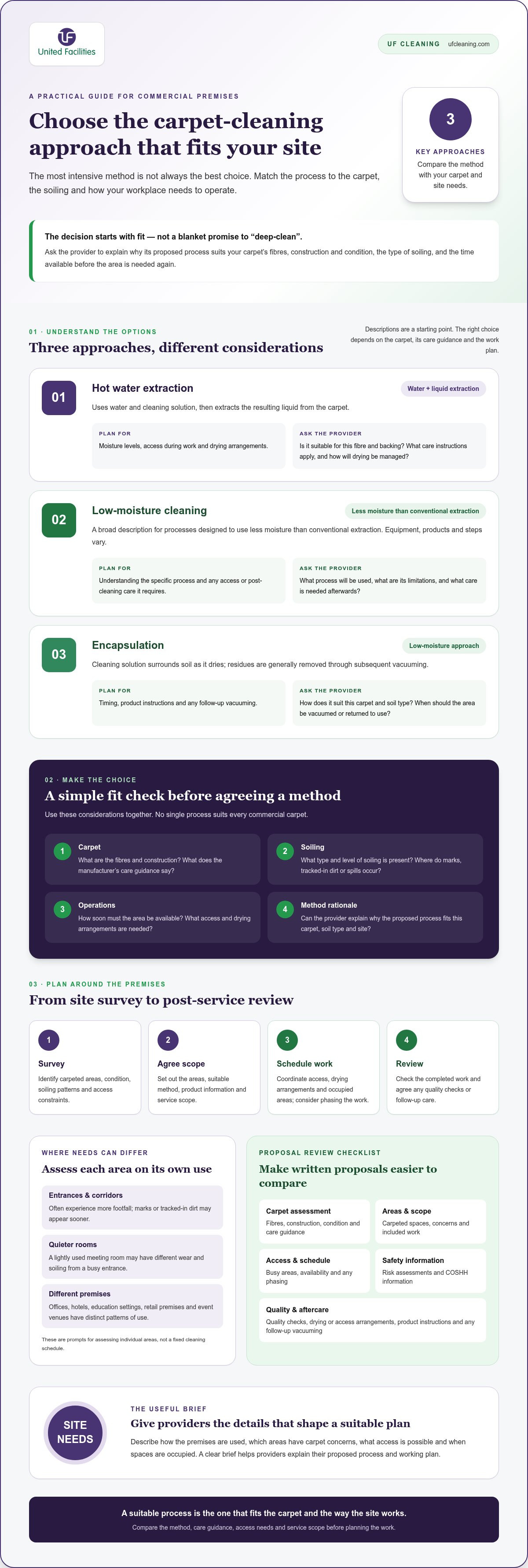
No single process suits every commercial carpet. Hot water extraction, low-moisture cleaning and encapsulation differ in their use of moisture and how they address soil. The right choice depends on the carpet’s fibre and construction, the type and level of soiling, and the manufacturer’s care guidance. Treat method descriptions as a starting point, then ask the provider why the proposed process fits your site.
| Approach | Typical application | Operational considerations | Questions to ask |
|---|---|---|---|
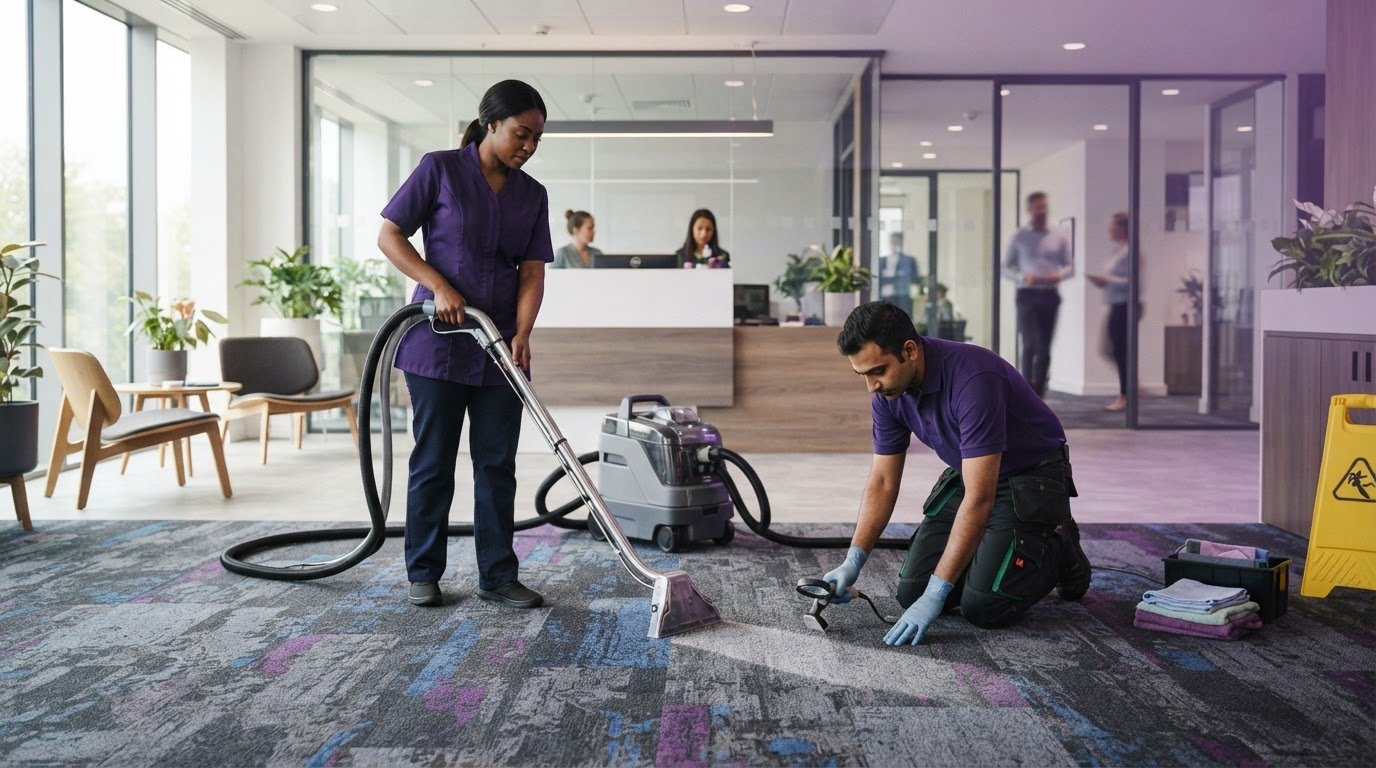
| Hot water extraction | Uses water and cleaning solution, then extracts the resulting liquid from the carpet. | Moisture levels, access during work and drying arrangements need planning. | Is it suitable for this carpet’s fibre and backing? What care instructions apply, and how will drying be managed? |
| Low-moisture cleaning | A broad description for processes designed to use less moisture than conventional extraction. | Equipment, products and steps vary, so ask the provider to explain the proposed process. | What process will be used, what are its limitations, and what access or post-cleaning care is required? |
| Encapsulation | A low-moisture approach in which cleaning solution surrounds soil as it dries, with residues generally removed through subsequent vacuuming. | Agree timing, product instructions and any follow-up vacuuming with the provider. | How does the process suit this carpet and soil type? When should the area be vacuumed or returned to use? |
When might hot water extraction be considered?
Extraction may be proposed where the carpet and its care instructions are compatible with a process that uses water and recovers the liquid. Do not select it simply because it sounds more intensive. Discuss the carpet’s fibre, construction and condition first, then agree how furniture, access and drying will be handled. The provider should explain any limitations before work begins.
How do low-moisture and encapsulation approaches compare?
Low-moisture describes a general category, while encapsulation is one particular approach within it. Neither label alone confirms the likely result or how soon a space can be used again. Ask about the specific equipment and products, expected moisture, suitability for the identified soil, any restrictions and the post-cleaning routine. Check technical guidance against reliable industry resources and the carpet manufacturer’s instructions. The National Carpet Cleaners Association is one UK industry resource to consult when assessing professional carpet-care information.
Before agreeing a method, ask for a site-specific explanation rather than relying on broad claims. UF Cleaning provides commercial carpet cleaning services. Businesses can use the same questions to clarify whether a proposed approach matches their carpet and operational requirements.
How to compare commercial carpet-cleaning options for your premises
A useful proposal explains not only what work is included, but why the recommended process fits the carpet and the way the premises operate. Compare providers against the same criteria so a polished general description does not obscure differences in site assessment, access arrangements, service scope or quality checks.
Method selection should follow a site assessment, because carpet construction, condition, soiling and operational requirements vary from one area to another. Use this principle to check whether recommendations are based on your premises or simply on a standard service description.
What should a provider assess before recommending a method?
Ask how the provider will identify the carpet’s construction and condition, and how they will map areas of concern such as traffic marks, spills or localised soiling. The recommendation should account for how each space is used and when it can be accessed. A clear proposal will also explain preparation, furniture or access requirements, drying arrangements and any limitations that could affect the work.
For a fair comparison, give each provider the same information: carpeted areas, known fibre or manufacturer guidance, problem locations, site use and operating constraints. Ask them to distinguish confirmed details from anything that still needs checking before the service is agreed.
Which service and quality details should buyers compare?
Look beyond the method name. Check that each written proposal describes the areas covered, the work included, the proposed schedule, site communication and how completion will be reviewed. The industry cleaning standards can provide another reference point when considering the process and level of detail a provider describes.
- Scope: Are all requested carpeted areas listed, including any exclusions?
- Scheduling and access: Does the proposal explain how work will fit around site activity and who needs to coordinate entry?
- Products and precautions: Which products are proposed, and how will their use and relevant information be managed on site?
- Quality and feedback: How will completed areas be checked, and how will missed areas or follow-up concerns be recorded and addressed?
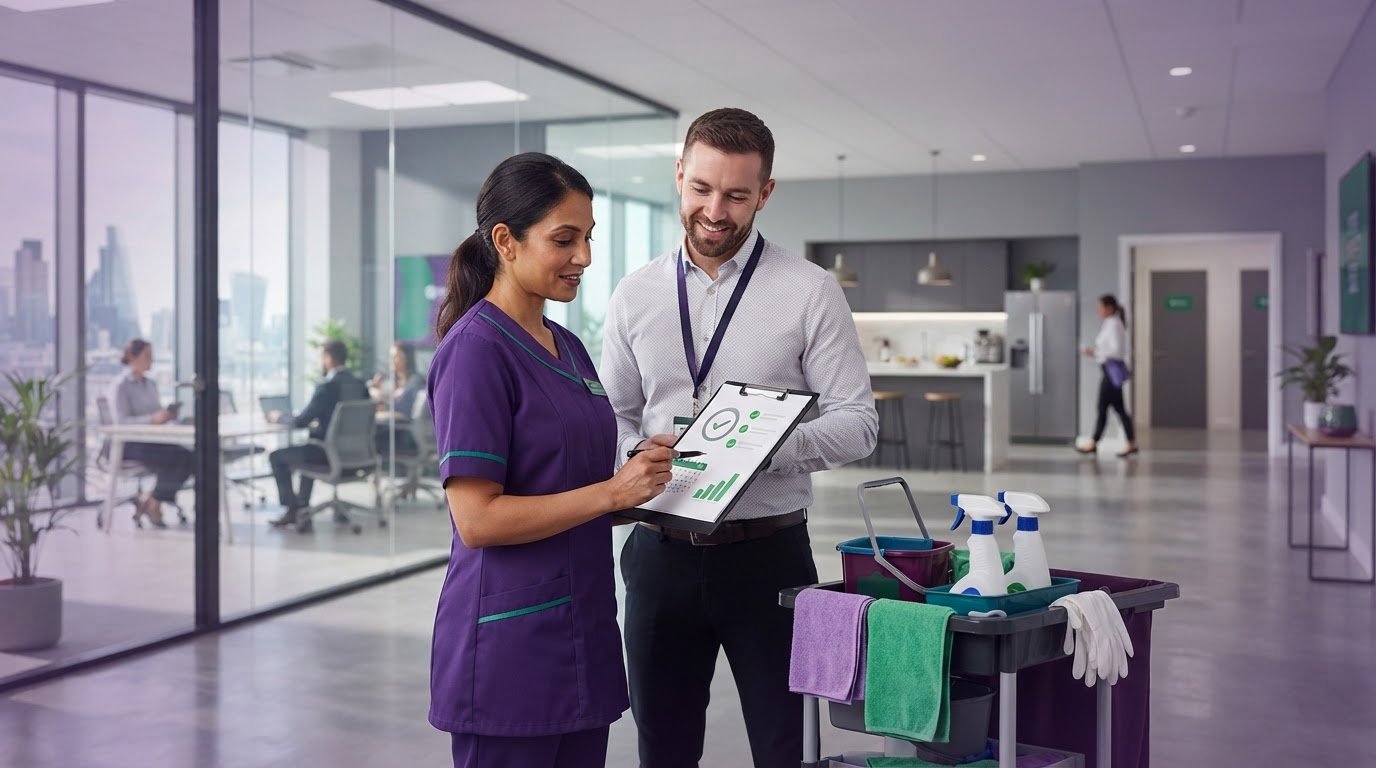
Specific answers matter. A provider that describes its oversight process gives you a clearer basis for agreeing expectations. UF Cleaning uses Taskbe to support real-time quality controls. This is one example of the kind of quality-check process buyers may wish to discuss when comparing providers.
Before selecting an option, compare proposals side by side and note any remaining assumptions. Confirm the chosen process, scope, access plan and review arrangements in writing so everyone involved understands what has been agreed.
How to plan commercial carpet cleaning with minimal disruption
Good coordination starts before equipment arrives. A site survey, agreed access arrangements and clear communication help facilities teams plan around occupied areas, although disruption depends on the premises and the work required. Whether you are arranging commercial carpet cleaning london or work elsewhere in the UK, confirm the proposed schedule and re-entry guidance directly with the provider rather than relying on a standard assumption.
What should facilities teams arrange before the clean?
Turn the site survey into practical arrangements, with responsibilities agreed between the site contact and provider.
- Survey the site. Identify carpeted areas, priority concerns, access restrictions and any known spills to raise in advance.
- Agree the work plan. Confirm the areas included, proposed process, access windows and whether work can be phased so unaffected spaces remain available where practical.
- Prepare each area. Decide who will move furniture and other items, and agree how sensitive equipment or restricted zones will be managed. Do not assume the provider will move items unless this is confirmed.
- Communicate the arrangements. Tell relevant staff, guests, learners or site contacts which spaces will be affected and what access instructions they need to follow.
- Review after completion. Check the agreed areas, record observations and discuss any follow-up concerns with the provider.
How should teams review the work afterwards?
Compare the completed work with the agreed scope and note any areas that need attention. Ask the provider to confirm care guidance, ventilation needs and re-entry instructions for the specific process used. Use these details to plan access rather than relying on a general estimate of when a space will be ready.
Keep feedback with the service scope and site arrangements. This gives facilities teams a useful basis for future scheduling and service reviews, particularly when different areas have different access needs.
Planning checklist:
- Priority carpeted areas and known spill concerns are documented.
- Access restrictions, furniture responsibilities and equipment precautions are agreed.
- Phasing, access windows and staff or visitor communications are confirmed.
- Drying, ventilation and re-entry guidance will be obtained from the provider.
- A named contact will check the agreed areas and record feedback.
UF Cleaning provides commercial carpet cleaning for organisations across the UK. Discuss your commercial carpet cleaning requirements and the access arrangements for your premises.
Choosing a commercial carpet-cleaning partner and agreeing next steps
A well-matched provider should connect four parts of the service: a site assessment, a method suited to the carpet, an operational plan that reflects how the premises are used, and a clear way to review the work. Compare proposals by the reasoning and detail they provide, not by broad descriptions alone. The same framework can help organisations assess commercial carpet cleaning services across the UK.
What information helps a provider scope the work?
Give each provider a consistent picture of the site so recommendations can be compared fairly. Include approximate carpeted areas, premises use, usage patterns and known problem locations, such as recurring spills or visible soiling. If you know the carpet’s fibre or have manufacturer care instructions, share those details too.
Describe access conditions and operational constraints, including any areas that must remain available and your preferred work windows. Treat these as preferences to discuss, not assumptions about a provider’s availability. Ask the provider to confirm the proposed process, areas included, preparation required and any further information or inspection needed before the scope can be agreed.
How can UF Cleaning support commercial carpet-care planning?
UF Cleaning provides commercial carpet cleaning as part of its wider facilities services for organisations across the UK and has served organisations since 2010. Its service context includes eco-friendly products, real-time quality controls supported by Taskbe and 24/7 operational support. Discuss product preferences, how quality checks are recorded and what operational support means for your requirements. These details do not establish which cleaning method is right for a particular carpet.
Before proceeding, confirm the recommended method and its suitability for your carpet, along with the scope, access arrangements and review process. A provider should explain what is known, what still needs checking and how the agreed plan will be communicated.
If you are ready to discuss your premises and requirements, contact UF Cleaning about commercial carpet cleaning. Sharing the areas involved, how they are used and any access constraints can help start a focused conversation about the service you need.
Make your next carpet-care decision with confidence
Choose a cleaning approach by starting with the carpet: its construction, condition and soiling should inform the method, while access and drying arrangements shape the operational plan. A site-specific assessment and clear written scope make providers easier to compare than broad claims alone.
Whether you are reviewing commercial carpet cleaning london options or planning care for premises elsewhere in the UK, agree how the work will be coordinated and reviewed before it begins. UF Cleaning has served organisations since 2010. Its service context includes eco-friendly products, real-time quality controls supported by Taskbe and 24/7 operational support. Discuss the proposed process and site requirements directly to understand how these elements may fit your needs.
For a considered next step, request a free quote from UF Cleaning and share your carpeted areas, concerns and access requirements. A clear brief can help you move towards a plan informed by your premises and practical for the people who use them.
Frequently Asked Questions
What is commercial carpet cleaning?
Commercial carpet cleaning is planned professional care for carpeted areas in workplaces and other business premises. Unlike routine vacuuming, it uses a process selected to address accumulated soil or particular cleaning needs. The right approach depends on the carpet’s construction and condition, how the space is used and site requirements. Before work begins, ask the provider to explain the proposed process, preparation needs, access arrangements and drying considerations.
How often should commercial carpets be professionally cleaned?
There is no single cleaning frequency that suits every premises. Footfall, carpet type, visible soiling, spills and how each area is used all influence the schedule. For example, a frequently used entrance may need attention sooner than a lightly used meeting room. Ask a provider to assess the site and recommend a practical plan, then review it against observed carpet condition and feedback rather than relying on a fixed timetable alone.
Which commercial carpet-cleaning method is best?
The most suitable method depends on the carpet’s fibre and construction, the soiling, site conditions and available care instructions. Hot water extraction, low-moisture cleaning and encapsulation are approaches a provider may discuss, but none is right for every carpet. If you are comparing commercial carpet cleaning london options, ask each provider why its recommendation suits your specific areas, what limitations apply and how the process affects access and drying arrangements.
How long does commercial carpet take to dry after cleaning?
Drying time varies with the cleaning process, carpet construction, moisture used, ventilation and conditions in the building. A provider should explain the drying considerations for the proposed work rather than make an unsupported guarantee. Before the service, agree how access will be managed and how staff or visitors will be informed about any restrictions. Follow the provider’s drying and re-entry instructions before allowing normal use to resume.
Can commercial carpet cleaning take place whilst a building is occupied?
It may be possible to plan cleaning in an occupied building, depending on access, the selected process and the site’s operational needs. Discuss preferred work windows, priority areas, phased cleaning and communication with the provider in advance. Ask which areas may need temporary access restrictions and how drying or re-entry guidance will be shared. Confirm the agreed plan with the people responsible for site operations and those using affected spaces.
What should I ask a commercial carpet-cleaning provider?
Ask how the provider assesses carpet type and condition, why it recommends a particular process and what preparation is required. Clarify the areas included, access arrangements, drying considerations, products and quality checks. Find out how feedback or concerns are recorded and addressed, and discuss how the plan can accommodate your operating requirements. Clear written proposals make it easier to judge site suitability than general service descriptions alone.
Are eco-friendly products suitable for commercial carpet cleaning?
Suitability depends on the carpet, the cleaning task and the product instructions. Ask which products a provider proposes, how they will be used and whether there are site-specific considerations to address. An environmental description alone does not confirm that a product suits every material or setting. UF Cleaning offers eco-friendly products. Discuss the proposed products and process with the provider to check how they align with your premises and carpet-care requirements.