
What if the lowest-priced cleaning bid isn’t the best fit for your premises? When requirements are vague, supplier responses are difficult to compare and important differences in service quality, scheduling and sustainability can be missed. A clear commercial cleaning contract tender template UK organisations can adapt turns site-specific needs into measurable, comparable commitments.
This guide explains what to include in your specification and invitation to tender, from areas and task frequencies to service standards and response formats. You’ll learn how to set fair evaluation criteria that balance quality, operational fit, sustainability and price, then take the process from preparing the tender pack through to mobilisation and quality checks. The aim is a workable service plan that reflects how your premises are used and sets clear expectations for your organisation and the cleaning team.
Key Takeaways
- Adapt a commercial cleaning contract tender template UK organisations can use to specify site details, tasks, frequencies, access and consumables.
- Use a consistent response format to compare supplier bids against your premises’ needs.
- Build an evaluation matrix covering methodology, staffing, quality controls, mobilisation, sustainability and commercial responses.
- Follow a clear process for issuing the tender, managing clarifications, evaluating submissions and preparing for mobilisation.
- Translate tender priorities into a scheduled service, with quality monitoring such as UF Cleaning’s real-time Taskbe platform.
Commercial cleaning contract tender template UK: define the need before inviting bids
If you’re commissioning commercial cleaning, start by describing what your premises need. A well-prepared commercial cleaning contract tender template uk gives prospective suppliers a consistent account of the work and a clear format for explaining how they would deliver it. This helps buyers compare proposals and reduces the chance that essential details are left open to interpretation.
A clear cleaning scope describes the premises, tasks, frequencies and service outcomes in enough detail for suppliers to prepare comparable responses. It forms the foundation of the tender pack: the documents that explain the requirement, tell suppliers how to respond and set out how submissions will be evaluated.
An invitation to tender (ITT) asks suppliers to submit proposals against that requirement. It is not the signed service agreement. Keep the operational specification focused on what needs cleaning and how the service will be assessed, with legal terms and contract conditions set out separately. This is practical drafting guidance, not legal advice.
Set the site context and service outcomes
Describe how the building operates, not just its floor area. Include its use, occupancy patterns, operating hours and access arrangements, such as entry procedures or restricted areas. Suppliers need this context to plan a workable cleaning method and schedule.
List the spaces and surfaces in scope. A site profile might cover offices, meeting rooms, reception areas, washrooms, kitchens, corridors and shared spaces, as well as floors, desks, touchpoints and internal glass where relevant. General background on the breadth of commercial cleaning can help frame the activities involved, but the tender must define the work required at your premises.
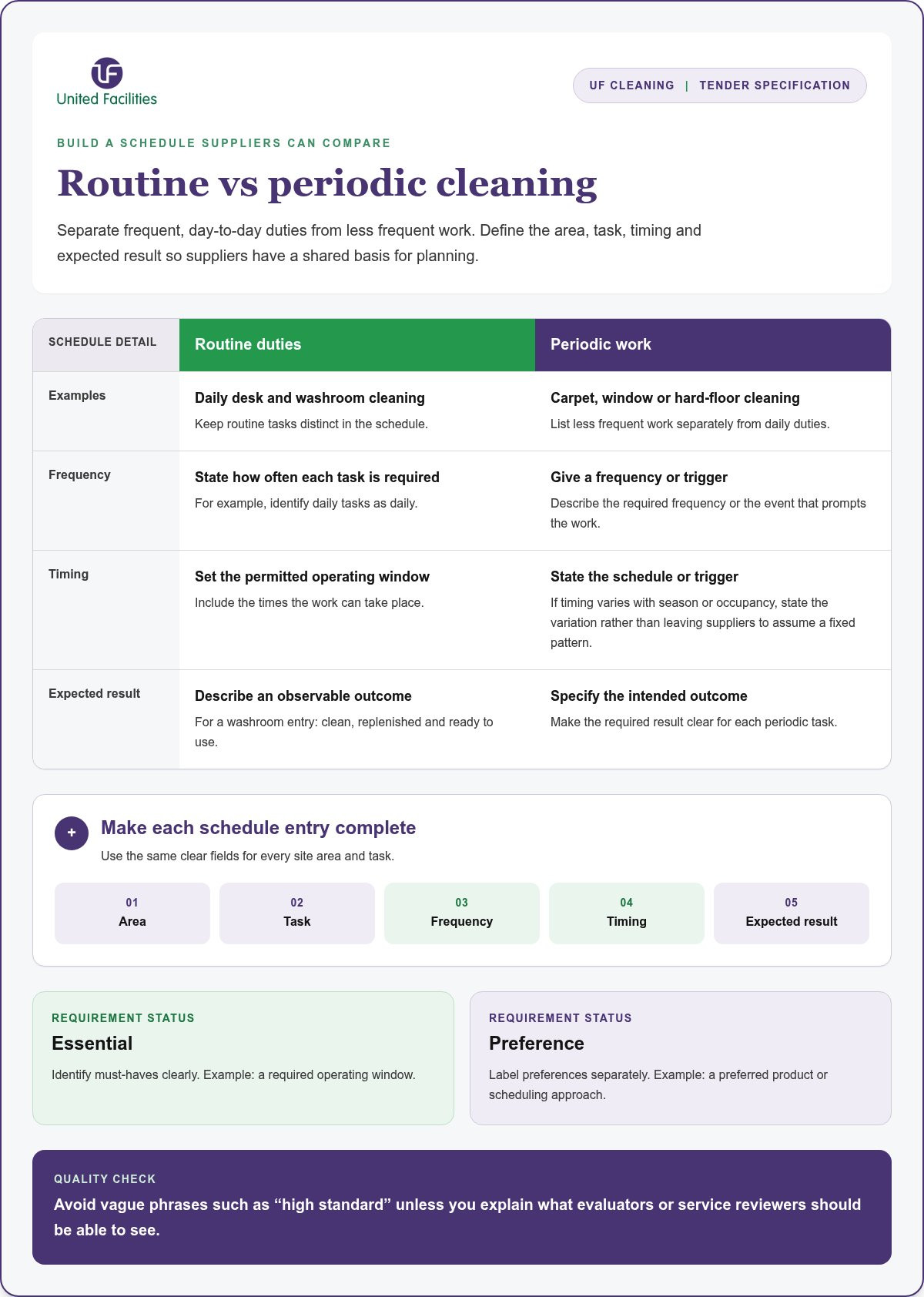
Describe outcomes in observable terms. For example, specify that washrooms should be clean and replenished, floors free of visible debris, and meeting rooms ready to use. Avoid broad phrases such as “high standard” unless you explain what evaluators or service reviewers should be able to see.
Decide what belongs in the tender pack
Use separate, clearly labelled documents or sections so suppliers can find the requirements and respond in a consistent format. A practical pack can include:
- Overview: the organisation, site and purpose of the requirement.
- Specification: areas, tasks, service priorities and required outcomes.
- Service schedule: task frequency, operating windows and access details.
- Response form: prompts for suppliers to describe their proposed approach.
- Evaluation criteria: the measures used to assess submissions.
Mark which requirements are essential and which are preferences. For example, set out a required operating window separately from a preferred product or scheduling approach. This makes it easier for suppliers to respond accurately instead of guessing what is mandatory. Keep the proposed agreement’s commercial and legal conditions separate from the cleaning specification. A clear structure makes the pack easier to complete, assess and refine before issue.
What to include in a commercial cleaning tender template
A useful template gives every supplier the same description of the work and the same structure for presenting a response. Keep prompts direct, tailor them to the site and ask for relevant evidence rather than general claims that are hard to assess. Each requirement should be specific enough for suppliers to explain how they will meet it and what evidence they can provide.
These headings offer a practical starting point for a commercial cleaning contract tender template uk buyers can adapt:
- Site profile: “Describe the premises, principal uses, occupancy patterns, operating hours and site-specific considerations.”
- Service scope: “List each area and surface to be cleaned, including washrooms, shared spaces and any specialist cleaning tasks.”
- Frequency and operating windows: “State how often each task is required and the permitted times for the work.”
- Access and consumables: “Set out access arrangements and identify which cleaning products, materials or washroom consumables the service must provide.”
- Supplier response: “Explain your methodology, staffing model, supervision arrangements, mobilisation approach and proposed service reporting.”
Draft the cleaning specification and service schedule
Build a schedule by site and area, with columns for the task, frequency, timing and expected result. For example, a washroom entry could specify floor and surface cleaning, a daily frequency, an agreed operating window and the expected state: clean, replenished and ready to use. This format makes gaps easier to spot and gives suppliers a shared basis for planning.
Separate routine duties from periodic work. Don’t bury daily desk and washroom cleaning among less frequent carpet, window or hard-floor cleaning. For each periodic task, describe the area, required frequency or trigger, and intended outcome. If needs vary with the season or occupancy, state the variation rather than leaving suppliers to assume a fixed pattern.
Include a straightforward process for recording changes. Ask suppliers how they would log a missed task, an agreed omission or an exceptional request, who would receive the update, and how any follow-up action would be reported. This helps distinguish a one-off change from a permanent adjustment to the schedule.
Request evidence that relates to the requirement
Use prompts that invite practical explanations. Ask suppliers to describe relevant experience, how they would organise work across the listed areas and how supervisors would oversee delivery. Request examples of quality checks, how they identify and correct shortcomings, and what information their service reports would provide. Focus on the connection between the proposed method and your specification.
For sustainability, request relevant information about products and working practices, such as how the supplier selects cleaning products or manages their use. Keep the question proportionate to your priorities and avoid requesting a claim or standard you have not defined. UF Cleaning provides recurring commercial cleaning services shaped around site requirements, with flexible schedules and eco-friendly products.
How to compare commercial cleaning tender responses fairly
A fair comparison starts before bids arrive. Decide which requirements matter most, how they will be weighted and what evidence supports each score. Include the approach in the tender documents and follow any procurement rules that apply to your organisation. This gives evaluators a consistent framework and helps suppliers understand how their proposals will be assessed.
Price matters, but the lowest offer may not be the strongest operational fit. A schedule that does not reflect site use, or a quality-control plan that makes performance difficult to assess, may not meet your stated needs. Assess value against the specification, not price in isolation.
Build an evaluation matrix around the specification
Link every scored criterion to a requirement in the tender pack. Set the weightings and scoring definitions before reviewing submissions, then use the same scale and evidence expectations for every bid. Keep pass-or-fail checks for mandatory requirements separate from scored quality criteria. This avoids confusing basic compliance with a judgement about service quality.
A simple scale might run from 0 to 3: 0 means no relevant evidence, 1 means a limited response, 2 means a clear response that meets the requirement, and 3 means a detailed, well-supported response. Define these descriptions in advance and apply them consistently.
- Service methodology: Evidence sought: an approach matched to the tasks and areas. Score: __. Evaluator notes: __.
- Staffing and supervision: Evidence sought: the proposed staffing model, responsibilities and supervision arrangements. Score: __. Evaluator notes: __.
- Quality controls and reporting: Evidence sought: examples of checks, corrective action and service reports. Score: __. Evaluator notes: __.
- Mobilisation: Evidence sought: a proposed plan for preparing and starting the service. Score: __. Evaluator notes: __.
- Sustainability: Evidence sought: relevant information on products and working practices, as requested in the specification. Score: __. Evaluator notes: __.
- Commercial response: Evidence sought: a complete response in the requested format, assessed against your stated commercial criteria. Score: __. Evaluator notes: __.
Assess service quality and value in context
Check whether each proposed schedule fits the site’s operating patterns, access windows and hygiene priorities. The response should explain how the stated tasks would be organised in practice, rather than rely on broad assurances.
Consider whether the proposed monitoring and reporting would make performance visible. Examples of checks, how issues are recorded and how corrective action is tracked can help evaluators judge whether the approach is practical. Apply the same scrutiny to environmental or social value responses: score them only against relevant stated criteria and record the evidence behind each assessment.
For a commercial cleaning contract tender template uk buyers can adapt, include the matrix alongside the specification and response form. Consistent criteria, evidence-based notes and pre-agreed weightings make the final comparison easier to explain and document.
Issue the tender and move from evaluation to mobilisation
Once the specification and evaluation approach are ready, manage the process with clear instructions and traceable decisions. Publication routes and process requirements depend on the buyer and procurement context, so verify current rules and relevant organisational procedures before issuing the tender. This is particularly important for public procurement, where requirements may differ from those for a private-sector purchase.
Process summary: finalise the tender documents, publish the opportunity or invite suppliers, manage clarifications consistently, evaluate against the stated criteria, notify bidders and prepare the service handover.
- Finalise the pack. Check that the specification, response form, evaluation criteria, submission instructions and relevant contract documents align. Make deadlines and the submission method clear.
- Publish or invite. Use the route appropriate to your organisation and procurement context. Verify applicable publication requirements or procedural rules before issue.
- Manage clarifications. Set a single documented route for questions, record each query and response, and share material updates with all relevant bidders through the stated process.
- Evaluate and record. Follow the published criteria, retain evidence-based scoring notes and document the basis for decisions.
- Notify and prepare. Communicate the outcome through the appropriate process, then coordinate mobilisation milestones with the appointed supplier.
Manage questions, submissions and evaluation records
State where submissions must be received, the deadline and how clarification questions should be raised. Record questions and answers. If a response changes or clarifies the requirement, distribute the update consistently through the stated process rather than relying on informal conversations that could leave suppliers with different information.
During evaluation, connect each judgement to the published criterion and evidence in the submission. Notes such as “the proposed schedule addresses the stated access window” are more useful than unsupported impressions. Retain the scoring record in line with your organisation’s process.
Plan the service handover before contract start
Mobilisation bridges a successful tender and a workable cleaning service. Agree key milestones, site familiarisation, access information and communication responsibilities before the start. Confirm how the final cleaning schedule will be shared and how service issues, missed tasks and corrective actions will be recorded and followed up after launch.
If a contract change may involve workforce-transfer considerations or other legal questions, obtain appropriate specialist review rather than assuming how the rules apply. Keep that review distinct from operational planning, while allowing enough time for relevant decisions to inform the handover.
A well-managed tender should lead to a service that can be scheduled and monitored against the requirements set out at the outset. UF Cleaning provides recurring commercial cleaning tailored to site priorities, with experience serving organisations since 2010. The service planning approach can turn the specification into a practical schedule and clear operating arrangements.
Turn the tender requirements into dependable cleaning delivery with UF Cleaning
A well-defined tender creates value when its requirements carry through into the service. UF Cleaning works with organisations across the UK, drawing on experience serving them since 2010 to shape recurring commercial cleaning around each premises’ stated priorities. The result is a practical schedule with responsibilities and service priorities aligned to how the building is used.
For buyers using a commercial cleaning contract tender template uk, the next step is to translate the specification into clear operational arrangements. If the tender prioritises washroom presentation, for example, reflect that priority in the service schedule and quality monitoring. Flexible schedules allow the service plan to be tailored to site needs and operating patterns, rather than applied as a one-size-fits-all package.
Match the service model to the organisation
Recurring office cleaning can be arranged around the organisation’s requirements, with tasks and timing shaped by the premises and operating schedule. The service scope can also include housekeeping or specialist cleaning such as hard-floor, carpet or window cleaning where relevant to the tender. Setting priorities clearly helps bring routine duties and specialist tasks together in a coherent plan.
The tender’s area schedule and stated outcomes provide a useful basis for planning. A site with shared spaces and washrooms may have different priorities from one where floor care is prominent. UF Cleaning tailors its service approach to the scope, so the agreed schedule reflects the buyer’s requirements and how the site functions.
Make quality and ongoing support visible
Monitoring helps make service activity more visible once delivery begins. UF Cleaning uses the Taskbe platform for real-time quality monitoring, supporting oversight of recurring cleaning. The platform is a delivery tool, not a legal requirement; its value is in connecting service monitoring to the priorities set for the premises.
Eco-friendly products are available as a service option, so environmental priorities in the tender can inform the cleaning approach. UF Cleaning also provides 24/7 operational support and flexible schedules for recurring services. Together, these elements help translate the tender scope into scheduled delivery and ongoing attention to the stated priorities, without treating every building as if it had identical needs.
If your organisation is preparing a new cleaning requirement or refining an existing specification, share its priorities, site needs and service scope with UF Cleaning to receive a tailored quotation. Request a free commercial cleaning quote.
Put your cleaning brief into action
Treat the tender as the start of an ongoing service relationship, not the end of a procurement exercise. Once a supplier is appointed, keep your organisation’s priorities visible in service discussions and revisit them if site use or requirements change. This helps the original brief remain a practical reference as the cleaning arrangement develops.
Your commercial cleaning contract tender template uk can also provide a clear starting point for discussing the service you need. UF Cleaning uses your stated requirements to shape a recurring cleaning proposal around your premises and priorities.
To take the next step, request a free quote for your commercial cleaning requirements. A clear brief helps set the direction for a considered proposal and a service plan suited to your organisation.
Frequently Asked Questions
What should a commercial cleaning tender template include in the UK?
A commercial cleaning contract tender template UK buyers can adapt should cover the site profile, cleaning specification, task schedule, supplier response instructions, evaluation criteria and relevant contract information. Add document control details, such as a version date and named buyer contact, so suppliers can identify the current pack and direct procedural questions appropriately. Keep operational requirements distinct from agreement terms, and ensure each document refers to the same scope.
How do I write a cleaning specification for a tender?
Describe each area, the task required, how often it must be completed, the permitted service window and the expected result. Use precise actions, such as vacuuming carpeted meeting rooms or replenishing washroom supplies, rather than relying on phrases such as “good standard”. If access or building use limits when work can take place, state that alongside the task so suppliers can plan a realistic method.
How should I evaluate commercial cleaning tender responses?
Set the criteria and scoring method before opening submissions, then assess each response against the same evidence expectations. Separate mandatory checks, such as providing every required document, from scored judgements about the proposed service. Record why each score was awarded, referring to evidence in the bid rather than general impressions. If evaluators disagree, use the published definitions to discuss the difference and document the agreed assessment.
Can I use the same cleaning tender template for every building?
You can reuse the document structure, response form and scoring framework, but adapt the site-specific content. An office, education setting and event venue may differ in occupancy patterns, access arrangements, priority areas and service windows. Review the scope for each building before issuing the pack, including any changes in how spaces are used. This keeps the template familiar while giving suppliers enough detail to propose a relevant service.
What is the difference between an invitation to tender and a cleaning contract?
An invitation to tender is the buyer’s request for proposals, setting out the requirement and how suppliers should respond. The cleaning contract is the agreement made after the procurement process, describing the parties’ service and commercial commitments. The tender response may inform the agreed service, but it is not a substitute for reviewing the final agreement. Have contract terms reviewed through the appropriate organisational process.
How do I compare cleaning bids fairly if their proposed schedules differ?
Compare each schedule against the same stated requirements and outcomes, rather than treating different task timings as automatically equivalent. Map proposed tasks, frequencies and service windows to your specification, then note any gaps or variations. Apply the scoring approach published in the tender and distinguish an alternative method from an omitted requirement. If clarification is permitted, ask questions consistently and assess any resulting information under the same rules.
What happens after a commercial cleaning tender is awarded?
After award, the buyer and appointed supplier prepare for the service start. Planning typically includes becoming familiar with the site, arranging access, agreeing the working schedule and confirming who handles operational communication. Set out how service concerns will be raised and recorded, and how follow-up actions will be reviewed. Once cleaning is underway, use the agreed review process to assess performance and discuss schedule changes if site needs develop.