The lowest cleaning quote may not represent the best value if tasks, quality controls or mobilisation details are unclear. A practical commercial cleaning procurement checklist turns site needs into a clear specification, so you can compare proposals on consistent terms and assess how the service will be delivered.
Procurement can feel difficult when requirements vary across buildings, working patterns and priorities. This guide sets out a repeatable checklist to help you define cleaning needs, assess scope and oversight, and plan a smooth transition from appointment to ongoing service.
Work through the key stages, from documenting site use and service priorities to reviewing delivery controls, reporting and mobilisation arrangements. Tailored schedules and real-time quality controls, such as those available through UF Cleaning’s Taskbe platform, can support consistent service. The aim is to give you a practical framework for making an informed decision and managing the relationship beyond the tender.
Key Takeaways
- Use a commercial cleaning procurement checklist to assign decision-making responsibilities and make requirements easier to compare.
- Map the site, tasks, frequencies and constraints so the specification reflects how each space is used.
- Assess proposals against the written scope, including workforce planning, supervision, continuity and reporting.
- Use a like-for-like comparison matrix to identify exclusions and assumptions that can make a low headline price misleading.
- Plan handover, mobilisation and review responsibilities to establish a clear basis for ongoing service oversight.
Commercial cleaning procurement checklist: define the outcome before the service
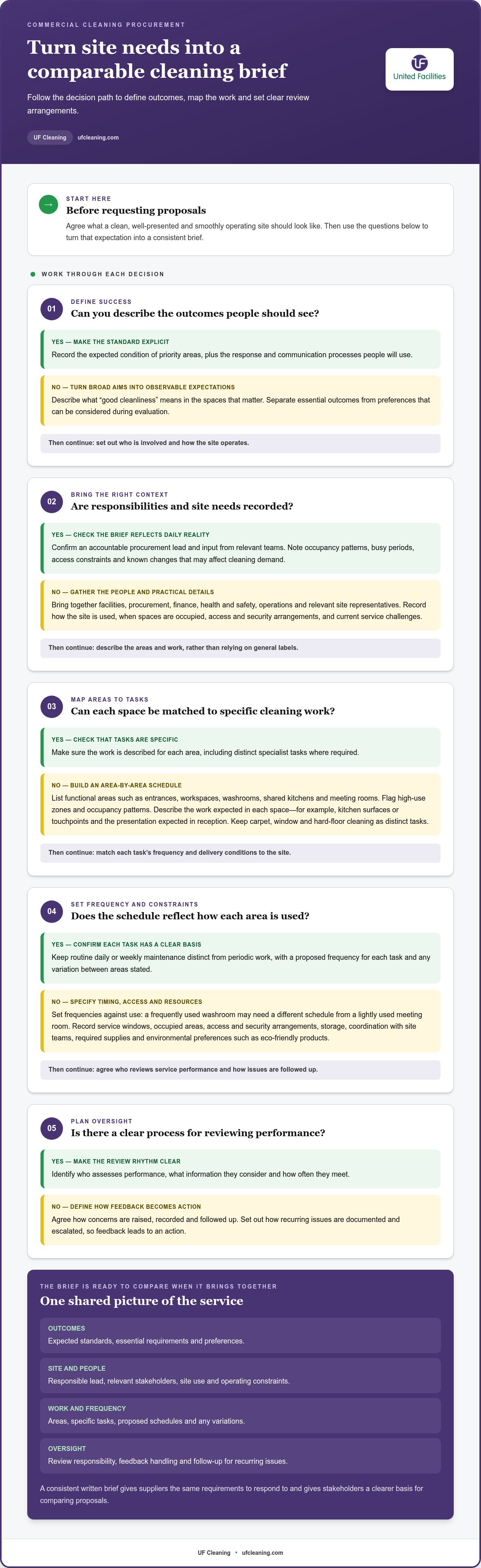
Before requesting proposals, agree what a clean, well-presented and smoothly operating site should look like. A commercial cleaning procurement checklist turns that expectation into a consistent brief, helping suppliers respond to the same requirements and making proposals easier to compare.
- Appoint an accountable lead to coordinate procurement and gather decisions.
- Bring the right stakeholders together, including facilities, procurement, finance, health and safety, operations and relevant site representatives.
- Record how the site operates, including occupancy patterns, busy periods, access constraints and known changes that could affect cleaning demand.
- Describe the intended outcomes, then separate essential requirements from preferences that can be considered during evaluation.
- Agree how performance will be reviewed, including who considers feedback and how recurring issues are addressed.
Which stakeholders and site needs belong in the checklist?
Each stakeholder sees a different part of the requirement. Facilities teams can identify cleaning priorities and current service challenges. Finance can clarify budget parameters, procurement can maintain a fair and consistent process, and health and safety representatives can flag relevant site considerations. Operations and site representatives add practical knowledge about access, security arrangements and the rhythm of daily activity.
Describe the building’s use in concrete terms. Note which areas have heavier footfall, when spaces are occupied, where presentation matters most and whether cleaning could interrupt work, learning, customer visits or production. Record current pain points, such as inconsistent attention to shared areas or service times that do not match site use. These details help shape a brief around the actual environment, rather than assumptions based on floor area alone.
For context, Commercial cleaning covers a broad range of work, methods and equipment. Make clear which outcomes and areas matter at your site instead of relying on a general description of the service.
How should procurement define success?
Translate broad aims into expectations that people can observe and discuss consistently. “Good cleanliness” is open to interpretation. A clear description of the expected condition of priority areas, along with agreed response and communication processes, gives stakeholders a more useful basis for review. Define what dependable presentation means in the spaces that matter and how concerns should be raised, recorded and followed up.
Separate non-negotiable outcomes from preferences. Consistent hygiene, dependable presentation and minimal disruption may be essential, whilst the timing or sequence of certain tasks could be considered during proposal evaluation. Record the service hours and occupancy patterns that shape these priorities, along with planned changes such as a change in building use or working patterns. This gives bidders a stable baseline and helps prevent different assumptions from being hidden in their responses.
Set a review rhythm before the service begins. Identify who will assess performance, what information they will consider and how often they will meet. Agree how repeated issues will be documented and escalated, so feedback leads to an action rather than a general expression of dissatisfaction.
In short: outcome-led procurement buys an agreed standard of cleanliness, continuity and communication for a particular site, not simply a set number of cleaning hours. Clear outcomes create a more meaningful basis for comparing the service approach behind each proposal.
Build a commercial cleaning specification that reflects the site
Once the desired outcomes are clear, describe the building and the work required. A well-prepared commercial cleaning procurement checklist connects each area to its tasks, frequency and operating conditions, so proposals address the same practical service needs.
- Map the site. List the building’s functional areas, such as entrances, workspaces, washrooms, shared kitchens and meeting rooms. Note high-use zones and occupancy patterns, including periods when spaces are busy or unoccupied. A floor plan or area schedule can help bidders understand how the site is organised without relying on assumptions.
- Define tasks by area. Describe the work expected in each space rather than using broad labels such as “general cleaning”. For example, specify which surfaces or touchpoints need attention in a shared kitchen and what presentation is expected in reception. Include specialist requirements, such as carpet, window or hard-floor cleaning, as distinct tasks.
- Set frequencies against use. Separate routine daily or weekly maintenance from periodic work. A frequently used washroom may need a different schedule from a lightly used meeting room; carpet or hard-floor work may follow a separate planned frequency. State the proposed frequency for each task and explain any variation between areas.
- Record constraints and resources. Set out service windows, occupied areas, access and security arrangements, storage provisions, and any coordination needed with site teams. Note restrictions that could affect task order or access. Describe required supplies and environmental preferences, such as the use of eco-friendly products, without adding technical standards or certification requirements that the site has not specified.
- Confirm exceptions and review points. Identify seasonal demand, planned changes in building use or areas requiring attention only in particular circumstances. Record how the scope will be reviewed if occupancy, priorities or site arrangements change, so the specification remains useful as operations evolve.
What site information should a cleaning specification capture?
Make the document specific enough to guide delivery, but straightforward to maintain. For each area, record its function, typical use, busy periods, access conditions and relevant cleaning tasks. Include practical details such as where supplies can be stored and how cleaning should be coordinated around occupied spaces. These particulars connect procurement decisions to recurring service delivery and help prevent important assumptions from being left unstated.
How should tasks and frequencies be documented?
An area-by-area schedule is a practical format: name the space, list routine tasks, set their proposed frequency, then record periodic work and exceptions separately. Base the schedule on actual use and expected presentation, rather than applying the same frequency to every room. Include a review point for significant changes in demand, so the scope can be refined through an agreed process rather than informal, inconsistent requests.
A precise scope makes service proposals easier to compare because each response can be assessed against the same areas, tasks, frequencies and operating constraints. Tailored schedules can reflect a site’s priorities; UF Cleaning shapes its commercial cleaning schedules around site use and service needs.
Assess commercial cleaning capability, quality controls and resilience
A detailed specification sets the standard. Next, assess how service delivery will be organised and monitored in practice. Use the commercial cleaning procurement checklist to compare proposals against the published requirements, rather than relying on broad claims about experience or quality. Look for a clear connection between the site’s needs and the proposed workforce planning, supervision, communication and continuity arrangements.
Consider how the service would operate during a typical week and when circumstances change. A credible delivery plan should explain how tasks are assigned, how supervision relates to the site and how cleaning teams communicate with the client’s nominated contacts. For example, a change to access arrangements or a temporary shift in building use should have a defined route for communication and a review of its effect on the schedule.
Which service delivery controls should procurement assess?
Quality controls should make delivery visible and provide a practical route from identifying an issue to addressing it. Assess whether the proposed approach records scheduled tasks, inspections, reported concerns and corrective actions, and whether those records can be reviewed consistently. Clarify who is responsible for each stage: logging an issue, assigning follow-up, confirming action and reviewing whether a recurring problem needs a wider change.
Agree reporting frequency and performance review arrangements before appointment. The format should help stakeholders see completed checks, open issues and patterns over time, rather than offering only a general statement of satisfaction. UF Cleaning uses the Taskbe platform for real-time quality controls. This is one example of how technology can support visibility, but it does not replace clear responsibilities and follow-up.
Standards and frameworks can inform evaluation, but they should not be treated as proof of every aspect of site delivery. BICSc guidance, ISO 9001 quality management and ISO 14001 environmental management may offer useful reference points where relevant. Check their current applicability to the procurement and distinguish between a framework used to inform an approach and a certification claim. A reference alone does not demonstrate performance at your site.
How can procurement account for safety and continuity?
Include site-specific safety procedures, access controls and relevant COSHH considerations in the delivery assessment. The proposal should show how these practical requirements fit into task planning and communication, without leaving responsibilities implicit. For areas with access restrictions or operational sensitivities, consider how the team’s working arrangements will account for them.
Continuity matters in a recurring service. Assess how workforce planning addresses absence, schedule changes and operational disruption, and how updates are communicated to the people responsible for the site. Consider whether TUPE may be relevant to the procurement and refer its applicability for appropriate review. Record the assumptions behind workforce arrangements so they can be addressed during procurement and mobilisation.
A useful assessment connects the specification to delivery evidence: who plans the work, who supervises it, how quality is recorded and how disruption or recurring issues are managed. This gives stakeholders a more grounded view of capability and resilience than generic assurances alone.
Compare cleaning proposals on total operational value, not headline price
When proposals arrive, assess them against the same written scope and priorities. A lower headline price may look attractive, but it could reflect a narrower service, different assumptions or exclusions rather than better operational value. A structured comparison makes those differences visible before they influence the decision.
What belongs in a like-for-like proposal comparison?
Build a matrix with one row for each evaluation area and one column for each proposal. Record what is included, assumed and excluded, using the same terms throughout. This helps reviewers distinguish a genuine difference in approach from a gap in the information provided.
- Scope and frequency: Compare tasks by area, their stated frequency, service windows and any specialist work against the specification.
- Staffing approach: Note how the proposed workforce and supervision relate to the site’s requirements, without treating a general description as evidence of delivery.
- Supplies: Record what supplies are included and any environmental preferences addressed, such as the use of eco-friendly products.
- Oversight and reporting: Compare inspection arrangements, quality records, issue escalation, reporting frequency and ownership of corrective actions.
- Assumptions and exclusions: Highlight qualifications, omitted areas, dependencies and any matters that could alter the proposed scope.
Before scoring, separate mandatory requirements from weighted preferences. Assess mandatory items consistently against the published specification. Preferences, such as a particular reporting format or added flexibility, can receive a defined weighting based on organisational priorities. Use a consistent scoring scale, explain what each score represents and record a short reason for every assessment. This creates an auditable decision trail and helps stakeholders understand why a proposal ranks as it does.
How can buyers judge value without relying on price alone?
Consider the relationship between the proposed resources, the documented scope and the outcomes expected at the site. Does the schedule fit operating patterns? Is quality made visible through meaningful controls? Do the communication and continuity arrangements suit the environment? A proposal that clearly addresses these elements may offer a stronger operational fit than one with a lower headline figure but less clearly defined coverage.
Include sustainability, communication and service flexibility where they matter to your organisation, and score them against stated priorities rather than general impressions. For example, assess whether the proposal explains how its approach reflects the site’s environmental preferences or how schedule changes are handled. Do not reward polished language on its own. Look for a clear connection between each stated commitment and the scope, oversight or reporting arrangements described.
The commercial cleaning procurement checklist should support a balanced decision. Compare coverage, transparency, quality visibility and suitability alongside the financial proposal, while keeping mandatory requirements distinct from preferences. This gives the selection team a reasoned basis for choosing a service approach that can be managed over time.
UF Cleaning can shape a cleaning schedule around your site’s requirements through its tailored cleaning service.
Complete the procurement checklist with mobilisation and ongoing oversight
Appointment is the start of service delivery, not the end of procurement. To carry the agreed scope into day-to-day operations, complete your commercial cleaning procurement checklist with a structured handover, clear responsibilities and a plan for reviewing performance. This gives everyone a shared reference as the service begins and site needs change.
What should a cleaning service mobilisation plan cover?
Before the first scheduled service, make sure the people responsible for the site and service delivery have the same operational information. A practical handover should cover:
- Contacts and communication: Name the client-side and service-side contacts, how routine updates will be shared and how urgent operational issues should be raised.
- Site information and access: Provide relevant site priorities, access arrangements, security procedures, storage details and information about occupied or restricted areas.
- Schedules and responsibilities: Confirm the agreed task schedule, service windows, reporting format and who is responsible for sharing updates if site arrangements change.
- Initial review: Set a first review point to discuss how the schedule works in practice, note any issues and agree appropriate adjustments.
A clear handover helps prevent small gaps, such as an access change not reaching the right contact, from becoming repeated service problems. Keep the agreed scope and reporting responsibilities accessible to relevant stakeholders, so feedback can be compared with the service that was appointed.
How should ongoing cleaning performance be reviewed?
Use regular operational discussions to review agreed measures, inspection findings, recurring issues and completed corrective actions. Look at patterns as well as individual concerns: repeated issues in one area may indicate that the schedule, task expectations or communication process needs attention. Record decisions, assign responsibility for follow-up and revisit the outcome at the next review.
Keep the review connected to how the site is operating. A change in occupancy, priorities or access can affect whether the existing schedule remains appropriate, so agree how such changes will be raised and considered. Contract-specific matters, including how scope, responsibilities and reporting are documented, should also be reviewed during appointment and ongoing management.
UF Cleaning provides commercial cleaning services across the UK, with schedules tailored to site requirements and eco-friendly products. The business has served organisations since 2010 and uses the Taskbe platform for real-time quality controls. Its 24/7 operational support complements the controls and communication arrangements established for each site.
With appointment, handover and review built into the process, procurement can lead to a well-managed working relationship rather than a specification that sits unused. UF Cleaning’s commercial cleaning services are tailored to site requirements.
Make your next procurement decision a lasting foundation
A cleaning arrangement should continue to serve the site as its needs evolve. Treat the commercial cleaning procurement checklist as a working reference, returning to it when priorities shift, operations change or a review identifies an opportunity to refine the service. This keeps the original intent connected to everyday delivery, rather than leaving the specification as a document used only during tendering.
The next step is to turn your priorities into a tailored service discussion. UF Cleaning supports organisations across the UK with commercial cleaning, using tailored schedules, eco-friendly products, real-time quality controls through Taskbe and 24/7 operational support. A considered approach to procurement and ongoing oversight can help you build a service relationship around your site’s requirements and develop it with confidence.
Request a tailored commercial cleaning quote and take the next step towards a dependable cleaning partnership.
Frequently Asked Questions
What should a commercial cleaning procurement checklist include?
A commercial cleaning procurement checklist should cover the decision process as well as the service requirement. Include a named procurement lead, stakeholder responsibilities, site information, required outcomes, evaluation criteria and planned handover actions. Add a record of unresolved questions, with an owner and due date for each. This keeps decisions visible and helps prevent important details from being lost between the initial brief, proposal review and appointment.
How do you write a specification for commercial cleaning services?
Write the specification in plain, observable terms, organised by site area and task. For example, instead of “keep meeting rooms tidy”, identify the surfaces and touchpoints to be cleaned and describe the expected condition after service. Include the site’s operating pattern and any access limitations that affect delivery. Ask someone unfamiliar with the building to review the document. If they can understand what is required, suppliers are more likely to interpret it consistently.
How can organisations compare commercial cleaning proposals fairly?
Issue the same brief and response format to every bidder, then assess proposals against the same criteria. If a proposal uses different terminology or combines tasks, map its response back to the requested areas and record any ambiguity in a clarification log. Give each reviewer the agreed scoring guidance before evaluation begins, and document the evidence behind their scores. This makes it easier to distinguish substantiated differences from personal preference.
Should commercial cleaning procurement focus on the lowest price?
No. Consider price alongside the coverage and delivery arrangements set out in each proposal. A lower figure may reflect a different interpretation of the scope, so assess whether required work, staffing approach and oversight are clearly described before comparing financial offers. If a proposal leaves a material assumption unresolved, record it and seek the same clarification through the procurement process. This supports a decision based on suitability and transparency, not headline price alone.
What documents should be prepared before a cleaning tender?
Prepare the current site plan or area schedule, a list of cleaning tasks, operating hours, known access instructions and relevant site guidance. If available, include previous inspection records, recurring issue logs and information about planned building changes, as these can explain the context behind the requirement. Keep sensitive access information controlled, sharing it through the appropriate procurement channel. A single, clearly versioned tender pack helps all bidders work from the same information.
How can a business monitor cleaning quality after appointing a provider?
Use a consistent inspection record that identifies the area checked, the agreed standard, any issue found and its follow-up status. Record whether a concern is isolated or has appeared repeatedly, then review patterns with the service lead. Pair inspection findings with feedback from relevant site users, while keeping subjective comments distinct from observable checks. This creates a practical evidence base for deciding whether an adjustment or further review is appropriate.
What should a commercial cleaning mobilisation plan cover?
A mobilisation plan should turn the agreed service into clear start-up actions, owners and dates. Include the handover of site information, named contacts, access arrangements, schedule communication and the reporting process. It can also explain how changes are shared before service begins, such as a temporarily unavailable area or revised site instructions. Arrange an early operational review to capture practical lessons, confirm outstanding actions and support a smooth transition into routine delivery.