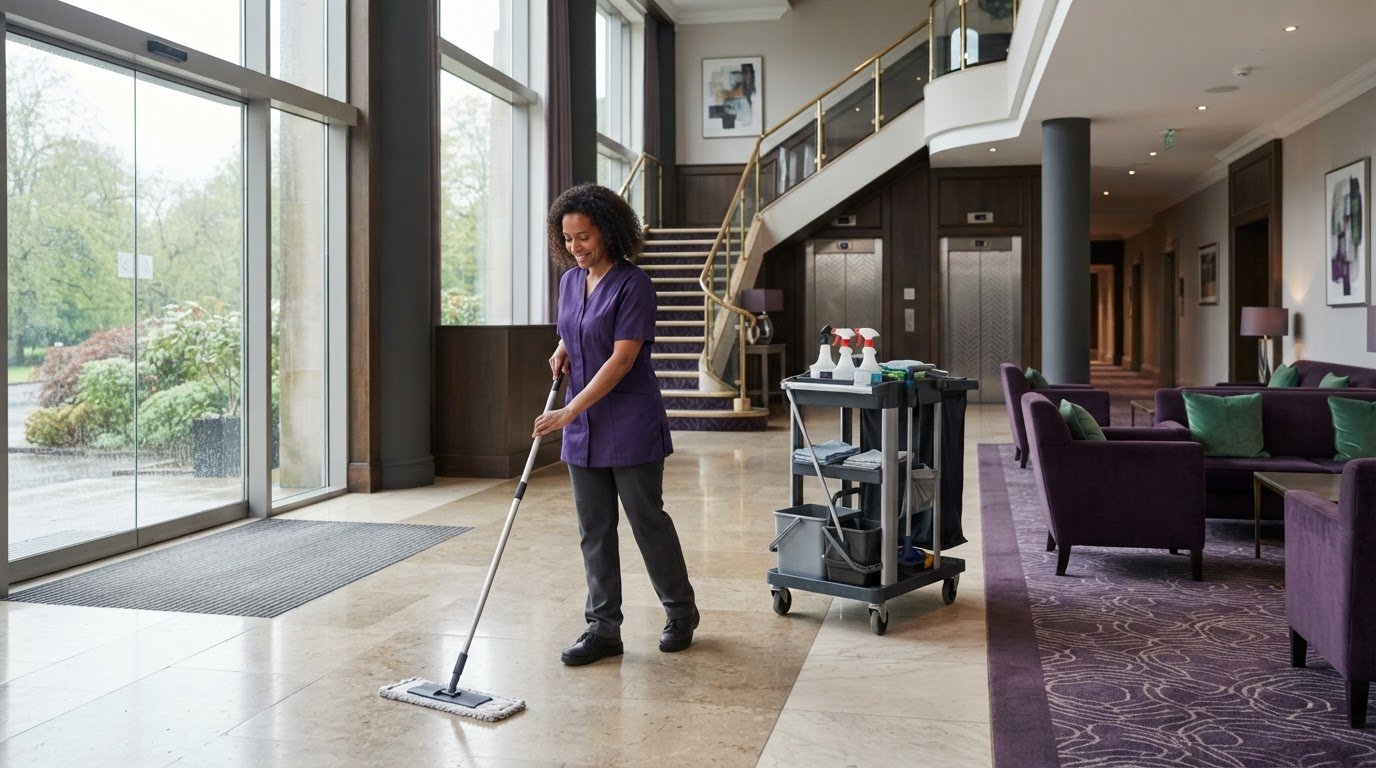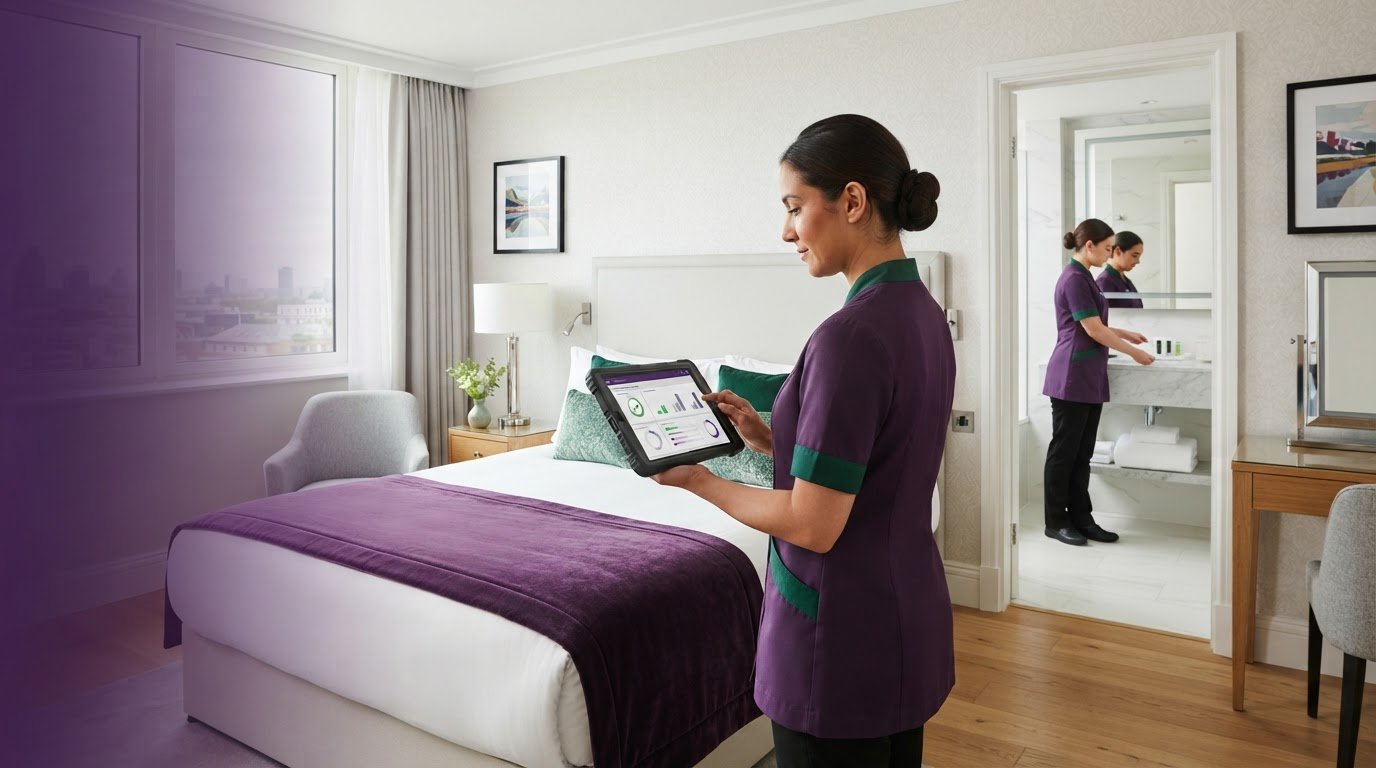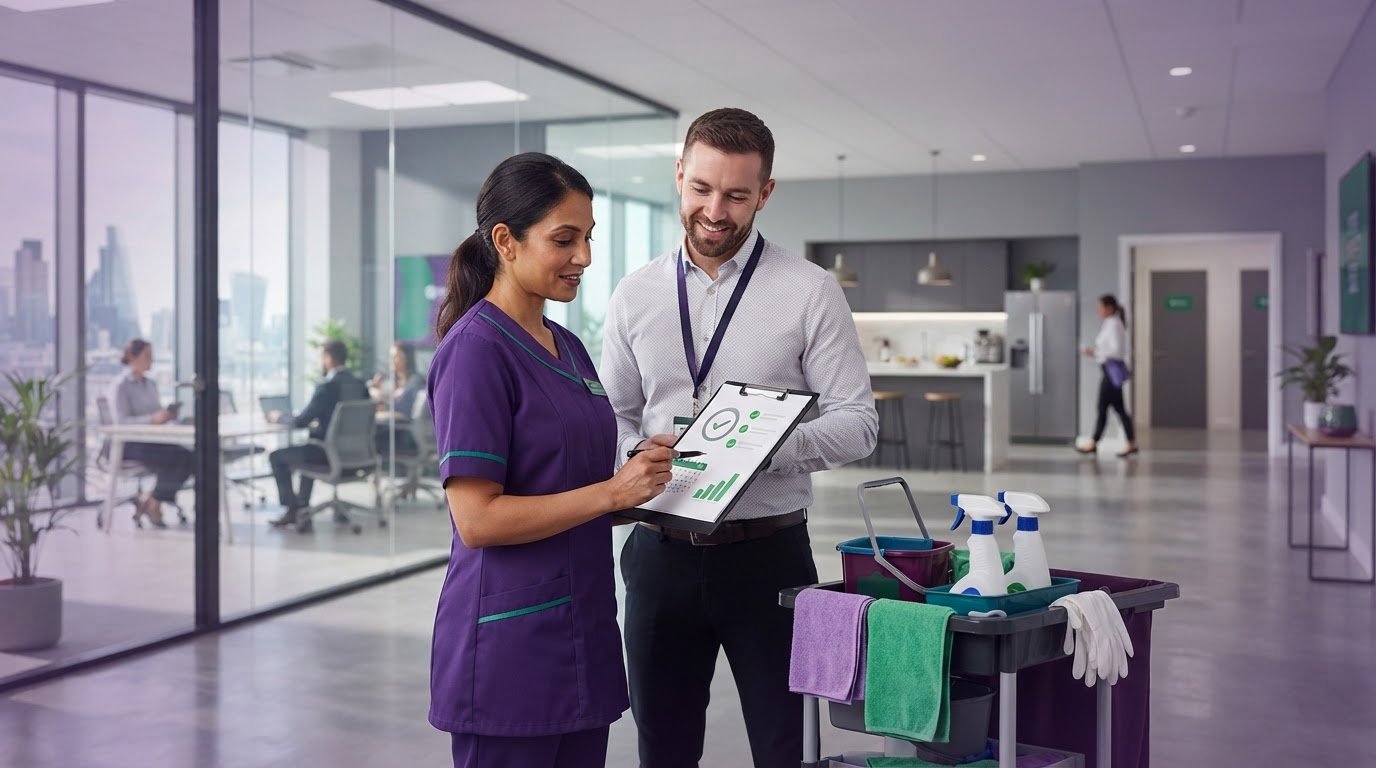
A cleaning provider’s years in operation matter most when they translate into dependable support for the realities of your facilities. For organisations searching “commercial cleaning since 2010”, the practical question is what that experience means for their own requirements. Since 2010, UF Cleaning has supported organisations across the UK, pairing adaptable services with real-time quality monitoring through the Taskbe platform.
It’s reasonable to look beyond broad service claims. Different workplaces need different cleaning routines, and consistency depends on clear oversight as well as a suitable scope of work. UF Cleaning’s approach brings these considerations together, with flexible schedules and services spanning offices, hotels, retail, industrial and manufacturing sites, education settings, and events and venues.
This article explores UF Cleaning’s background, service areas and operating approach, including how Taskbe supports quality control and where eco-friendly products fit into its work. It also outlines the details to prepare when requesting a tailored quotation, so you can relate the available support to your facilities, priorities and operating schedule.
Key Takeaways
- See how commercial cleaning since 2010 London connects UF Cleaning’s experience with an adaptable, nationally focused service approach.
- Understand how flexible schedules and Taskbe real-time monitoring support service organisation and quality oversight.
- Match your facility type, from offices and hotels to education, retail, industrial and event venues, with relevant cleaning services.
- Distinguish recurring maintenance from specialist floor, carpet and window cleaning when considering the scope your site needs.
- Prepare details about your facilities, areas, schedule and specialist requirements to support a more tailored quotation discussion.
Commercial cleaning since 2010: the experience behind UF Cleaning
UF Cleaning has served organisations since 2010, building its work around commercial cleaning and related facilities support. Its service context is national: the company works with organisations across the United Kingdom, rather than defining its experience by a single town or region. For facilities buyers searching for commercial cleaning since 2010 London, that history offers a starting point for understanding the business behind the service, not a guarantee of a particular result.
UF Cleaning has supported organisations across the UK since 2010, with commercial cleaning shaped around the requirements of different facilities.
Commercial cleaning covers a broad range of working environments and service needs. A general overview of commercial cleaning helps explain that wider context, while the practical requirements of a particular site depend on how its spaces are used. An office, hotel, education setting or industrial facility may each call for a different combination of routine cleaning and specialist attention.
What does ‘commercial cleaning since 2010’ tell a facilities buyer?
The date marks UF Cleaning’s stated service history. It indicates that the company has been operating in this field since 2010, but it should be read as context rather than as evidence of specific client numbers, milestones or performance outcomes.
For a facilities buyer, longevity can still be relevant. Supporting organisations over time means working within a sector where requirements vary by site, schedule and the areas being maintained. A buyer can use that background to frame a more useful conversation: what does the building need, how often are tasks required, and which parts of the environment need particular attention? Those details matter more than the date alone when considering how support could fit a facility.
A UK-wide service context for different organisations
UF Cleaning’s stated coverage extends across the United Kingdom. Its work relates to organisational environments such as offices, hospitality settings, retail premises, education facilities, industrial and manufacturing sites, and event venues. This breadth helps place the company’s experience in a national commercial context without making geography the defining feature of the service.
Instead, the starting point is the organisation’s own requirements. Two sites in the same sector may have different layouts, patterns of use and cleaning priorities; organisations in different sectors may share similar needs for regular upkeep or specialist floor, carpet and window cleaning. Describing the facility and its priorities therefore gives the discussion a practical focus.
For a buyer assessing commercial cleaning support, UF Cleaning’s history since 2010 is useful background. It establishes the length of the company’s operating experience and the types of organisations its work serves, while leaving room to consider the specific scope and schedule that a facility requires.
How UF Cleaning organises commercial cleaning and quality oversight
Reliable commercial cleaning depends on more than a task list. The schedule needs to fit the way a site operates, while oversight helps keep service delivery visible. UF Cleaning describes a flexible approach, supported by real-time quality monitoring through Taskbe, eco-friendly products and 24/7 operational support. Together, these elements provide a practical framework for organising cleaning around an organisation’s requirements.
UF Cleaning brings planned schedules, real-time quality monitoring and ongoing operational support together to help organisations manage their cleaning requirements.
Flexible schedules for operational continuity
Cleaning can be arranged around the schedule an organisation requires, taking account of how spaces are used and when cleaning activity best fits alongside normal operations. A busy shared area, for example, may need a different routine from a less frequently used space. Setting out priorities and operating patterns helps shape a schedule that supports the site without treating every facility as if it works in the same way.
Timing is part of the service design, not a minor logistical detail. A well-considered plan can distinguish regular upkeep from tasks that need to be coordinated with the facility’s use. Organisations can identify which areas need attention most often, which activities should be planned less frequently, and where operational constraints matter. UF Cleaning’s flexible scheduling approach allows these requirements to inform the cleaning arrangement, without assuming a single timetable suits every site.
Real-time quality controls through Taskbe
UF Cleaning uses Taskbe for real-time quality monitoring. This gives quality oversight a defined role within service delivery, supporting visibility as cleaning work is carried out. Monitoring helps connect the agreed cleaning plan with the work taking place, rather than leaving oversight as a general promise. It offers a clear operational point of reference for maintaining attention to service standards.
The practical value of monitoring is that it can support a more informed view of delivery. Facilities teams can consider service arrangements alongside the site’s priorities and discuss any changes as requirements evolve. Taskbe is the stated platform behind UF Cleaning’s real-time quality controls; no particular dashboard, reporting fields or client-access features are implied. The focus is on monitoring as part of the operating approach.
UF Cleaning also states that it uses eco-friendly products and provides 24/7 operational support. These are distinct parts of its model: product choice informs how cleaning is carried out, while operational support provides a point of assistance for service-related matters. The company’s approach can therefore be discussed in terms of schedule, monitoring, products and support, rather than relying on a broad claim about cleanliness alone.
For a broader explanation of the commercial cleaning sector and its scope, ISSA: The Worldwide Cleaning Industry Association provides useful context. For a facilities buyer searching “commercial cleaning since 2010 London”, the operational questions remain specific: how should cleaning fit the site’s schedule, and how will service delivery be monitored?
Organisations considering how these elements could suit their own facilities can explore UF Cleaning’s commercial cleaning support as they define their requirements.
Which commercial cleaning services support different facility types?
Commercial facilities share a need for well-maintained spaces, but the work involved depends on how each site is used. UF Cleaning’s service categories cover offices, hospitality, education, retail, industrial and manufacturing settings, and event venues. The table offers a starting point for matching a facility with relevant support; the precise scope can then reflect its areas, usage and operating schedule.
| Facility type | Relevant UF Cleaning service categories |
|---|---|
| Offices | Office cleaning; hard floor, carpet and window cleaning |
| Hotels and hospitality | Housekeeping; hotel management |
| Education settings | Education cleaning |
| Retail premises | Retail cleaning |
| Industrial and manufacturing sites | Industrial and manufacturing cleaning |
| Event venues | Events and venues cleaning |
Commercial cleaning for workplaces and public-facing environments
Office, retail and education cleaning each relate to distinct patterns of site use. An office may prioritise work areas and shared spaces, while a retail environment needs a plan informed by customer footfall and the areas in regular use. In education settings, the facility’s layout and operating schedule help shape the cleaning scope. These examples illustrate planning considerations, not fixed specifications.
Specialist categories can complement ongoing cleaning where relevant. Office hard floor cleaning, along with carpet and window cleaning, addresses particular surfaces or areas within a facility. For buyers searching commercial cleaning since 2010 London, the useful comparison is how each service category relates to the actual site, rather than assuming that every workplace needs the same package.
Hospitality, industrial and event venue support
Hospitality support has its own categories: housekeeping and hotel management are distinct from general commercial cleaning. Industrial and manufacturing cleaning is also a separate service area, reflecting the needs of those facility types. For event venues, cleaning can be considered in relation to the venue’s requirements and event timings, with the scope shaped around how the space is used.
Thinking by facility type helps organisations describe what they need without over-specifying the method. A venue, for example, can identify the areas to be maintained and when they are in use; an industrial site can outline its relevant spaces and cleaning priorities. UF Cleaning can tailor service discussions to those requirements.
Safety expectations also depend on jurisdiction and workplace context. The US-based OSHA overview of the cleaning industry provides information about cleaning-related workplace hazards and safety in the United States; it is not UK regulatory guidance. For UK facilities, the service discussion should stay grounded in the organisation’s own site requirements and applicable local procedures.
This overview is a guide to service categories, not a detailed specification for each sector. Once you identify the facility type, consider which areas need routine attention and whether specialist floor, carpet or window cleaning is relevant. That gives a clearer basis for considering how different services could work together, without assuming a single scope will suit every building.
How UF Cleaning’s service model can fit your organisation
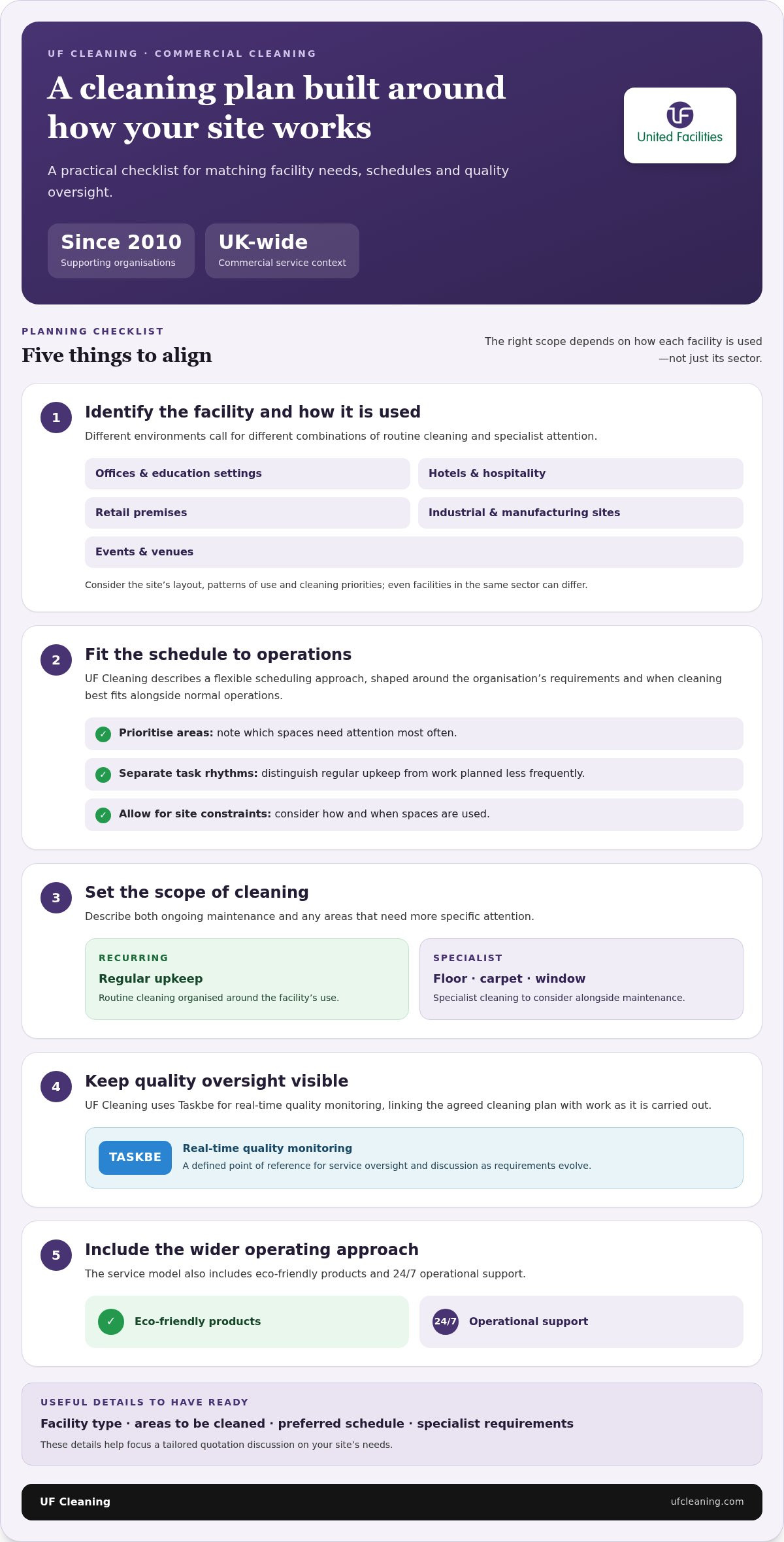
A suitable cleaning arrangement starts with the relationship between a site’s use, its schedule and the work required. Recurring maintenance can help keep regularly used areas in order, whilst specialist cleaning addresses particular surfaces or needs that may arise less often. UF Cleaning tailors service discussions to these practical requirements, rather than assuming each organisation needs the same scope.
- Office or education facility: Consider how frequently shared areas and work spaces are used, then identify the regular cleaning pattern and any hard floor, carpet or window requirements.
- Retail environment: Relate the schedule to customer footfall and the areas in regular use, distinguishing ongoing cleaning from specific floor or window work.
- Hotel or hospitality setting: Housekeeping and hotel management can sit alongside cleaning requirements, with the scope shaped around the facility’s needs.
- Industrial or manufacturing site: Start with the facility type and relevant areas to frame the industrial and manufacturing cleaning scope.
- Event venue: Consider the venue’s ongoing needs separately from cleaning planned around scheduled functions.
Matching cleaning arrangements to site use
Daily or weekly maintenance can be considered in relation to how an organisation uses its spaces and the upkeep those areas require. A frequently used shared space may call for a different routine from a room used occasionally. These are planning examples, not fixed packages: UF Cleaning can shape the service discussion around the facility’s operating pattern, priorities and areas of focus.
Recurring maintenance or specialist cleaning?
Recurring cleaning supports ongoing upkeep, while specialist work can focus on particular tasks such as carpet, window or hard floor cleaning. The two can complement one another, rather than being treated as alternatives. Event-specific cleaning is another distinct requirement: its planning can take account of scheduled functions and the venue’s needs, alongside any regular maintenance arrangement.
To prepare for a tailored discussion, note the facility type, the areas requiring attention, the preferred daily or weekly schedule, and any specialist tasks. This gives a clearer basis for distinguishing routine work from occasional projects and considering where services such as housekeeping or event support may fit. Organisations searching for commercial cleaning since 2010 London can use the same practical framework to assess how a service model relates to their own requirements.
Discuss your organisation’s cleaning requirements with UF Cleaning to explore a tailored service arrangement.
Discuss commercial cleaning requirements and request a tailored quotation
A useful quotation discussion begins with a clear picture of the facility and the work it needs. You don’t need to prepare a formal specification; a concise outline of the site, its operating pattern and its priorities can help UF Cleaning shape the conversation around your organisation. If your search is for commercial cleaning since 2010 London, these practical details help connect that experience with the requirements of your own premises.
Information to prepare before discussing your requirements
Before requesting a quotation, consider the following points. Approximate details are a helpful starting point, and you can explain where requirements vary across different areas or sites.
- Facility type: Describe the setting, such as an office, hotel, education facility, retail premises, industrial site or event venue.
- Areas and approximate scope: Note the spaces that need attention, such as work areas, shared rooms, floors, carpets or windows. If your organisation has multiple facilities, outline how their requirements differ.
- Operating pattern: Explain how the site is used and whether you’re considering daily, weekly or another recurring schedule. Mention relevant patterns of occupancy or activity that influence when cleaning fits best.
- Specialist needs: Identify any particular tasks, such as hard floor, carpet or window cleaning, housekeeping, or cleaning support for scheduled events. You can also flag where more than one service area may be relevant.
This preparation keeps the discussion focused on the service scope rather than assumptions. For example, an organisation may need regular upkeep across a facility and separate attention for specific floor surfaces. Another may be considering event-related support alongside its venue’s ongoing requirements. These are different briefs, and explaining the distinction helps establish what matters most.
What happens when you request a tailored quotation?
The next step is a discussion of your organisation’s cleaning requirements. UF Cleaning tailors service discussions to the facility, the areas involved, the schedule you have in mind and any specialist tasks you’ve identified. This gives the conversation a practical structure without presuming a fixed package or a particular implementation timetable.
As needs become clearer, it can help to distinguish regular maintenance from work that is occasional or focused on a specific surface or event. You can also describe any related service needs, such as housekeeping alongside other commercial support. The aim is to provide the context needed to consider an arrangement suited to your organisation, rather than to apply a standard scope to every site.
When you’re ready, Request a tailored commercial cleaning quotation and outline the facility type, approximate scope, operating pattern and specialist requirements you’d like to discuss.
Turn your facilities priorities into a clear plan
Choosing commercial cleaning since 2010 London is not simply a question of selecting tasks. It’s an opportunity to define what effective support should look like for your organisation: which priorities matter most, how cleaning fits the way your facilities are used, and what a successful working arrangement needs to take into account. A clear brief gives those considerations a practical starting point.
Before moving ahead, bring together the people who understand the site’s day-to-day demands and the standards your organisation wants its spaces to reflect. Their perspectives can help shape a more complete discussion, particularly where different areas serve different purposes. From there, the scope can be considered in relation to your requirements rather than assumptions.
Take the next step with a tailored discussion. Request a tailored commercial cleaning quotation and outline what matters to your facilities. A considered conversation can help you move towards support that feels appropriate to your organisation and its priorities.
Frequently Asked Questions
Can commercial cleaning be arranged outside normal operating hours?
UF Cleaning can adapt cleaning schedules to a site’s operating requirements, so share the preferred cleaning window and the times when spaces are busiest. This helps frame a suitable arrangement around how the organisation uses its facilities. UF Cleaning’s 24/7 operational support is separate from cleaning hours, so it shouldn’t be taken to mean that cleaning takes place at any particular time.
Is commercial cleaning suitable for organisations with more than one facility?
Yes, UF Cleaning can discuss requirements for organisations with multiple facilities, considering each site’s needs in context. The phrase commercial cleaning since 2010 London may guide your search, but a multi-site brief is best shaped around the facilities themselves. For instance, note which sites share a service scope and where differences in use, layout or specialist tasks call for a distinct arrangement.
What information should I prepare before requesting a commercial cleaning quotation?
Prepare a brief description of the premises, the areas needing attention and the cleaning pattern you have in mind. It can also help to separate ongoing maintenance from occasional tasks, such as carpet or window cleaning. If several sites are involved, group similar requirements together and flag notable differences. Approximate information is a useful starting point; a formal specification isn’t essential for an initial discussion.
Can cleaning arrangements change when a site’s needs change?
Cleaning arrangements can be discussed again as a facility’s requirements evolve. A change in how rooms are used, a shift in occupancy patterns or a scheduled event may affect priorities and the work needed. Describe what has changed and which areas are affected, so the service discussion can focus on the revised requirements. UF Cleaning tailors discussions to an organisation’s needs rather than relying on a single fixed scope.
Does commercial cleaning include carpet, window and hard-floor care?
Yes, UF Cleaning provides carpet and window cleaning, as well as office hard-floor cleaning. These specialist tasks can be considered alongside regular commercial cleaning, depending on the premises and the surfaces that need attention. For example, a facility may have recurring cleaning requirements as well as particular carpeted areas or hard floors to include in its wider scope. The quotation discussion can distinguish these needs.
Are eco-friendly products used for commercial cleaning?
Yes, UF Cleaning states that it uses eco-friendly products in its cleaning services. If product considerations are important to your organisation, include them in the service discussion alongside the areas and tasks involved. This helps keep the proposed scope aligned with your priorities. The description “eco-friendly” doesn’t, by itself, specify ingredients, environmental certifications or suitability for every surface, so no such claims should be assumed.
How does UF Cleaning monitor service quality?
UF Cleaning uses the Taskbe platform for real-time quality monitoring. This provides a defined mechanism for keeping oversight connected to service delivery, rather than relying solely on a general statement of standards. If you have particular priorities for different areas of your facility, explain them when discussing the service scope. That context helps relate quality oversight to the work your organisation needs carried out.