Did you know that the annual turnover rate for frontline cleaning staff in the United Kingdom often exceeds 150%, requiring facility managers to dedicate up to 15% of their working week to recruitment and rota management? It's a significant administrative drain that many leaders find difficult to justify against their primary business objectives. When evaluating the merits of commercial cleaning vs in-house cleaning team structures for 2026, the choice isn't merely about daily tasks; it's a strategic decision regarding where your organisation's operational risk and management focus should reside.
We recognise that a spotless, compliant environment is the foundation of a professional workspace. This article provides a detailed comparison of managed services against internal teams to help you identify the most reliable path for your organisation. We'll explore the true cost of employment under the £12.71 National Living Wage, the complexities of COSHH compliance, and how outsourcing can deliver predictable monthly costs without the persistent headaches of holiday cover or specialist equipment maintenance. By understanding these nuances, you can ensure your facility remains guest-ready whilst you focus on your core operations.
Key Takeaways
- Understand the total cost of ownership by looking beyond basic wages to include National Insurance, pension contributions, and administrative overheads.
- Evaluate how a commercial cleaning vs in-house cleaning team comparison affects your operational resilience, specifically regarding guaranteed cover during staff absences.
- Learn to identify the operational triggers that make outsourcing essential, such as the requirement for specialist equipment or advanced hygiene protocols.
- Discover how delegating the meticulous oversight of cleaning standards allows your facility managers to focus on high-level strategic objectives.
- Gain a clear framework for assessing your organisation's internal capacity to manage health and safety compliance and the complexities of chemical storage.
Understanding the Dilemma: Commercial Cleaning vs In-House Teams
Choosing between managed commercial cleaning vs in-house cleaning team models is a strategic decision that impacts every level of an organisation. An in-house model involves the direct recruitment, training, and management of staff on the company payroll, treating cleaning as an internal department. Conversely, the commercial cleaning model relies on a specialist facilities partner to deliver results through a managed service. Whilst the direct control of an internal team often feels reassuring, the operational landscape of 2026 has introduced complexities that challenge this traditional preference. Rising labour costs and stringent hygiene protocols mean that maintaining a guest-ready environment now requires significant technical oversight and administrative support.
In 2026, the statutory National Living Wage has risen to £12.71 per hour for workers aged 21 and over, significantly increasing the baseline cost for any organisation employing staff directly. This financial shift is accompanied by a heightened awareness of workplace wellness, where professional hygiene is viewed as a critical component of employee retention and visitor confidence. For many leaders, the appeal of an in-house team lies in perceived loyalty, yet this must be balanced against the significant responsibility of managing a high-turnover workforce in a regulated environment.
The Core Differences in Operational Structure
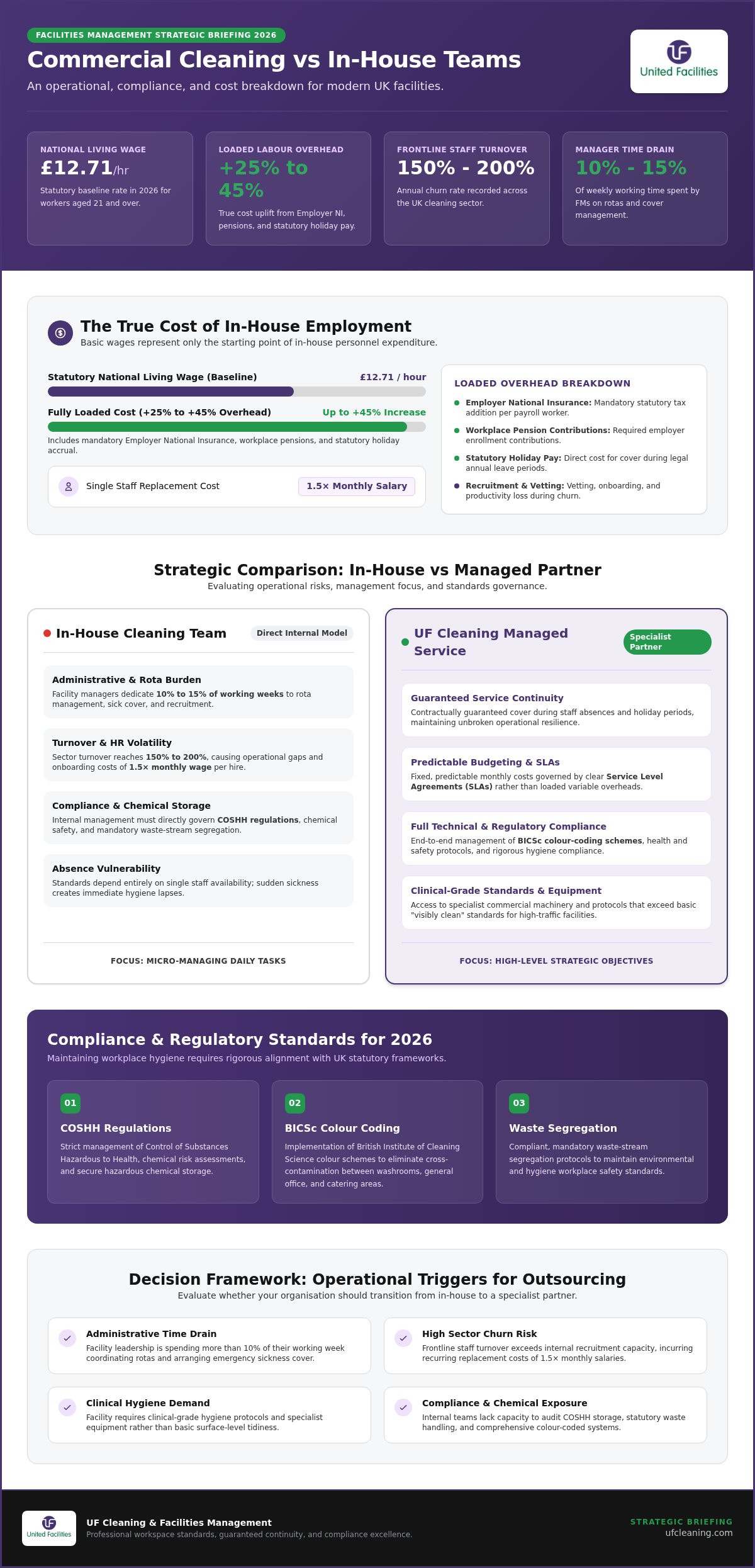
The primary distinction lies in where the burden of management rests. With an in-house team, your facility managers must coordinate rotas, handle performance reviews, and ensure compliance with commercial cleaning standards and health and safety legislation. This includes the intricate management of COSHH (Control of Substances Hazardous to Health) regulations, mandatory waste-stream segregation, and alignment with BICSc colour-coding schemes. When you evaluate the merits of a commercial cleaning vs in-house cleaning team, you'll find the focus shifts from micro-managing individual tasks to overseeing a Service Level Agreement (SLA). The partner becomes responsible for the meticulous details of training and supervision, allowing your internal leadership to prioritise high-level business functions.
Why Organisations are Re-evaluating Their Cleaning Strategy
Many organisations are reconsidering their approach due to the persistent challenges of high staff turnover, which can reach 200% in the cleaning sector. Maintaining a reliable internal team is increasingly difficult when recruitment and onboarding costs for a single replacement can equal 1.5 times the employee's monthly wage. In high-traffic environments, the standard of "visibly clean" is no longer sufficient. 2026 demands a level of clinical hygiene that requires professional-grade equipment and specialist expertise. Organisations are moving towards integrated facilities management because it offers a level of stability that an isolated internal department can rarely match. This shift reflects a desire for a guest-ready environment that doesn't depend on the daily availability of a single staff member.
Exposing the Hidden Costs of In-House Cleaning Teams
Managing an internal team often appears cost-effective on a balance sheet until you scrutinise the loaded labour costs. In the United Kingdom, the statutory National Living Wage of £12.71 is merely the starting point for financial planning. When you add Employer National Insurance contributions, workplace pension requirements, and statutory holiday pay, the total cost often rises by 25% to 45%. This financial multiplier transforms a modest hourly rate into a significant corporate commitment that many organisations fail to forecast accurately.
The cleaning sector is notorious for high churn, with annual turnover rates frequently cited between 150% and 200%. Replacing a single staff member costs approximately 1.5 times their monthly salary when you factor in vetting, onboarding, and the loss of operational continuity. Data from the Bureau of Labor Statistics custodial employment data suggests that these workforce pressures are systemic, making the "commercial cleaning vs in-house cleaning team" debate as much about HR stability as it is about hygiene. The constant cycle of recruitment creates a persistent administrative drain that distracts your HR department from higher-value tasks.
Facility managers often spend 10% to 15% of their working week managing rotas, handling sickness cover, and conducting quality audits. This silent cost diverts high-value leadership away from core business objectives, effectively increasing the "management tax" on your internal operations. When comparing commercial cleaning vs in-house cleaning team dynamics, the administrative burden of payroll and pension management is often the deciding factor for lean organisations seeking to protect their internal resources. Evaluating these burdens often leads organisations to seek a more streamlined approach through professional facilities support.
Equipment, Chemicals, and Inventory Management
Procuring professional-grade floor scrubbers and HEPA filtration units requires an upfront capital investment of £3,000 to £10,000 per facility. Beyond the initial purchase, you must account for ongoing maintenance, periodic PAT testing, and the inevitable costs of depreciation. Managing a bespoke inventory of eco-friendly supplies adds another layer of procurement friction that managed partners typically absorb, ensuring you don't have to worry about stock levels or chemical storage logistics.
Liability and Compliance Risks
Direct employment brings substantial liability that requires specialist insurance and rigorous health and safety records to mitigate the risk of slip-and-fall claims. In 2026, failing to maintain precise COSHH assessments and safety data sheets for stored chemicals exposes your organisation to severe regulatory fines and legal vulnerability. Delegating these risks to a specialist allows for a cleaner transfer of liability and ensures that your premises always meet the latest environmental and safety mandates.
The Strategic Advantages of Professional Commercial Partners
Engaging a professional partner provides a structural resilience that an internal department simply cannot replicate. Whilst an internal team is vulnerable to the immediate disruption of a single staff member's absence, a managed service operates with a guaranteed relief pool. This ensures that your facility remains guest-ready every day of the year, regardless of seasonal illnesses or holiday schedules. When weighing the benefits of commercial cleaning vs in-house cleaning team structures, the primary advantage is this seamless continuity, which protects your brand reputation from the visible decline that occurs when cleaning shifts are missed.
Modern facilities management is increasingly defined by technological accountability. Leading providers utilise platforms like Taskbe to offer real-time quality monitoring, providing you with transparent data on performance and attendance. This level of digitised oversight replaces the anecdotal feedback of traditional management with objective evidence of hygiene standards. Beyond technology, professional partners bring a commitment to sustainability through the use of eco-friendly products and bio-enzymatic agents. This approach reduces the chemical footprint of your premises whilst ensuring a safer, toxin-free environment for your employees and visitors alike.
Scalability and Flexibility of Service
A significant benefit of outsourcing is the ability to adapt your cleaning intensity to match your organisation's rhythm. Whether you are hosting a high-profile corporate event or managing the fluctuating occupancy of a hybrid workspace, a professional partner can scale resources up or down without the friction of internal recruitment. This flexibility extends to specialist tasks such as hard floor restoration and deep carpet care, which are often too capital-intensive for in-house teams to handle. For multi-site organisations, a national partner ensures a consistent standard of excellence across every location, consolidating multiple service lines into a single, cohesive contract.
Transfer of HR and Operational Liability
Transferring your cleaning function to a specialist allows for a clean break from the complex liabilities associated with manual labour. Professional firms assume full responsibility for maintaining OSHA cleaning industry compliance standards and UK-specific health and safety legislation, including the rigorous documentation required for chemical storage and hazard communication. In the UK, the transition is often governed by TUPE regulations, which protect the employment rights of existing staff whilst offloading the administrative and disciplinary burden from your internal HR team. With 24/7 operational support and dedicated account managers, you can focus entirely on your core business objectives, secure in the knowledge that the background environment is being managed with meticulous care.
Decision Framework: Which Model is Right for Your Organisation?
Deciding between a commercial cleaning vs in-house cleaning team depends on your organisation's operational maturity and risk tolerance. For small, single-site offices with minimal footfall, an internal cleaner who perhaps assists with reception duties might suffice. However, as the complexity of your premises increases, the burden of maintaining hygiene standards often outpaces internal management capacity. You must objectively assess whether your leadership team can dedicate the necessary time to supervise daily performance, manage chemical safety, and coordinate emergency cover without distracting from their primary responsibilities.
Brand reputation is another critical factor. In sectors where guest impressions are paramount, such as boutique hotels or corporate headquarters, any decline in cleanliness is a direct threat to your professional standing. Professional partners bring an air of quiet competence that ensures every surface is meticulously cared for, regardless of internal staff changes. From a financial perspective, you are comparing the predictable nature of a fixed monthly contract fee against the volatile, variable costs of direct employment. These variable expenses include recruitment fees, training programmes, and the capital outlay for machinery maintenance, which can fluctuate unexpectedly and disrupt your annual budgeting.
When In-House Might Be a Viable Option
The in-house model typically suits organisations where cleaning requirements are secondary to other site-specific roles. If your cleaner also functions as a security presence or a general caretaker in a low-traffic environment, the cultural integration of a direct employee provides value. Yet, this model often reaches its limits as an organisation grows. Once you require more than two full-time cleaners, the administrative friction of payroll and holiday rotas usually begins to outweigh the perceived benefits of direct control. Without the support of a dedicated facilities partner, these small teams often struggle to keep pace with modern health and safety regulations.
The Case for Immediate Outsourcing
High-traffic environments like educational centres, healthcare facilities, and large-scale corporate hubs require a level of operational resilience that only a managed partner can provide. If your organisation demands 24/7 coverage or must adhere to specialist hygiene standards, outsourcing becomes a strategic necessity rather than a luxury. Many leaders find that switching commercial cleaning provider UK services is the most effective way to restore standards after an internal team has struggled with high turnover or inconsistent supervision. This transition, often facilitated by TUPE regulations to protect existing staff, allows you to transfer the entire operational burden to a disciplined caretaker, ensuring your environment remains pristine whilst you focus on core business objectives.
Transitioning to Excellence with UF Cleaning
Transitioning from an internal operation to a managed service requires a partner who understands how to balance technical precision with minimal workplace disruption. Since 2010, UF Cleaning has provided premium facilities support across the UK, specialising in bespoke solutions for offices, hotels, and educational environments. We view the choice between a commercial cleaning vs in-house cleaning team as an opportunity to introduce rigorous systems without losing the caretaking presence of a dedicated team. Our transition methodology is designed to be completely seamless, respecting existing personnel through structured TUPE transfers whilst elevating the overall baseline of hygiene from day one.
Accountability forms the core of our operational philosophy, which is why we deploy the advanced Taskbe platform to provide real-time quality controls and complete operational visibility. This digital system allows facility managers to verify cleaning completions and audit results instantly, ensuring every corner of your premises remains guest-ready without requiring your active intervention. We recognize that every building possesses unique operational rhythms, so we design bespoke schedules tailored specifically to your sector, whether you manage a high-footfall retail environment or a complex industrial manufacturing plant.
A Partnership Built on Trust and Transparency
Our service delivery is anchored by a deep commitment to environmental responsibility, utilizing eco-friendly products and bio-enzymatic agents to protect both your workforce and the wider ecosystem. Backed by a 24/7 operational support network, our teams are equipped to handle urgent or ad-hoc requirements with immediate efficiency. Since its inception in 2010, UF Cleaning has built a proud 16-year history of maintaining impeccable hygiene standards across the UK through structured, reliable facilities management.
Next Steps for Your Facility
Embracing a managed model allows your organisation to shed the administrative risks of recruitment and focus entirely on your core commercial growth. When preparing for this transition, look for commercial contracts that offer clear service level agreements, transparent key performance indicators, and flexible scheduling options that adapt to your peak occupancy periods. We invite you to experience the peace of mind that comes from a meticulously managed environment. Contact our specialist team to arrange a comprehensive site survey, and Request a free, no-obligation quote from UF Cleaning today to discover how we can transform your facility's operational resilience.
Securing the Future of Your Facility Standards
Selecting the right model between commercial cleaning vs in-house cleaning team structures is a fundamental decision for any organisation seeking long-term stability. Whilst in-house teams offer a sense of direct control, the true cost of employment and the administrative burden of compliance often outweigh the benefits. Professional outsourcing provides a strategic transfer of liability, ensuring that your environment remains pristine without the constant pressure of recruitment or equipment maintenance. This shift allows your leadership team to reclaim valuable time whilst maintaining a guest-ready workspace.
Since 2010, we've refined a service-oriented approach that combines real-time monitoring via Taskbe with deep expertise across the hotel, office, and education sectors. This meticulous care ensures that your premises are always managed with precision and integrity. We invite you to Discover how UF Cleaning can transform your facility maintenance through a bespoke partnership built on transparency and reliability. Your journey towards a more efficient and compliant workspace starts with a single strategic shift that prioritises both excellence and peace of mind.
Frequently Asked Questions
Is commercial cleaning more expensive than having an in-house team?
Commercial cleaning often proves more cost-effective when you consider the total cost of ownership. Whilst an in-house team's hourly wage might appear lower, a fixed contract fee covers National Insurance, pension contributions, and statutory holiday pay. It also includes the procurement of chemicals and specialist equipment. This predictable monthly expenditure eliminates the financial volatility associated with recruitment and absence management, providing your organisation with greater budgetary stability.
What happens to my current cleaners if I outsource to a commercial cleaning company?
In the United Kingdom, the transition is governed by TUPE regulations, which protect the employment rights of your existing staff. These laws ensure that personnel transfer to the new provider on their current terms and conditions, maintaining operational continuity. We manage this process with meticulous care to ensure a smooth integration. This allows you to benefit from professional management and higher standards whilst retaining the cultural knowledge of your trusted team.
How does a commercial cleaning company ensure the security of my premises?
Security is maintained through rigorous vetting procedures and advanced digital tracking. Every member of our team undergoes comprehensive background checks, including DBS clearances where required for education or healthcare settings. We implement strict key management protocols and use the Taskbe platform to monitor staff attendance in real-time. This provides a transparent record of who is on-site and when, giving you peace of mind that your premises remain secure at all times.
Can I customise the cleaning schedule with a commercial provider?
Customisation is a fundamental part of our service-oriented approach. We don't believe in a one-size-fits-all model; instead, we design bespoke schedules that align with your specific operational requirements. Whether you need nightly deep cleans for a busy office or flexible housekeeping for a boutique hotel, our plans are adapted to your peak occupancy periods. This flexibility ensures that your facility remains guest-ready without disrupting your core business activities or events.
What is the benefit of real-time quality control in commercial cleaning?
Real-time quality control provides objective accountability that traditional supervision cannot match. By using platforms like Taskbe, we can monitor task completion and hygiene standards as they happen. This data-driven approach allows for immediate rectification of any issues, ensuring that service level agreements are consistently met. It replaces anecdotal feedback with transparent reporting, allowing you to verify that your environment meets the high standards required for a professional workplace.
Are eco-friendly cleaning products as effective as traditional chemicals?
Modern eco-friendly products are exceptionally effective and often surpass traditional chemicals in high-traffic environments. We utilise advanced bio-enzymatic agents that provide a deep, long-lasting clean without the use of aggressive toxins or volatile organic compounds. These sustainable solutions are safer for your employees and visitors, reducing the risk of respiratory irritation whilst maintaining impeccable hygiene. Our commitment to eco-friendly products ensures your facility meets modern ESG standards without compromising on cleanliness.
Do commercial cleaning companies provide their own equipment?
Yes, a professional partner assumes full responsibility for providing and maintaining all necessary equipment. This includes commercial-grade floor scrubbers, HEPA-filter vacuums, and microfibre laundering systems that are often too capital-intensive for internal departments. When evaluating commercial cleaning vs in-house cleaning team options, remember that we also handle PAT testing and depreciation costs. This ensures your facility always benefits from the latest cleaning technology without any additional upfront investment from your organisation.
How do I manage the transition from an in-house team to an outsourced service?
We lead the transition process to ensure it is seamless and stress-free for your organisation. It begins with a comprehensive site survey and a detailed review of your current requirements. We then coordinate the TUPE transfer of existing staff, providing them with the training and support needed to meet our high standards. By handling the administrative and legal complexities, we allow you to focus on your core business whilst we establish a disciplined, reliable cleaning function.