What if the most important change in facilities management cleaning UK isn’t a new machine, but a better way to match cleaning to how people use a building? With hybrid working shifting office attendance from day to day, organisations still need dependable hygiene, but fixed routines may not reflect changing occupancy. Cleaning is increasingly assessed not just by tasks completed, but by how consistently it supports people and the daily operation of a site.
That doesn’t mean every organisation needs sensors, automation or a complete process overhaul. It means identifying which developments address a real need, while maintaining reliable everyday delivery. This article explores the forces shaping the sector in 2026, including flexible schedules, digital quality monitoring, sustainability, workforce capability and preventative planning. You’ll learn how to assess relevant opportunities, connect cleaning outcomes with wider operational goals and prepare for change without adopting technology or processes indiscriminately.
Key Takeaways
- See how facilities management cleaning UK is moving towards measurable, people-centred performance, and which changes may be worth considering.
- Assess digital records, data-informed planning, sustainability and workforce capability by weighing practical value against limitations.
- Compare cleaning priorities across offices, hospitality, education, retail and industrial settings instead of applying one approach to every building.
- Use a readiness framework to identify evidence gaps, set priorities and review changes before expanding them.
- Understand how dependable commercial cleaning and facilities support can contribute to wider operational goals without replacing broader facilities management.
What facilities management cleaning means in the UK, and why its role is changing
Facilities management cleaning is the planned care of a building’s interior to keep its spaces hygienic, usable and presentable. It goes beyond a task list of vacuuming, wiping surfaces and emptying bins. It connects cleaning activity with the building’s purpose, occupancy and daily operation. For organisations, the aim is not simply to complete tasks, but to maintain consistent conditions suited to the environment.
Cleaning is one part of facilities management, not a substitute for the whole discipline. It contributes to the experience of staff, visitors, pupils, guests and customers, while maintenance, security and building management address different operational needs. Since responsibilities vary between organisations and sites, make the service scope and reporting arrangements clear from the outset.
How cleaning fits within UK facilities management
In facilities management, cleaning is generally classed as a soft service. It supports a building’s everyday use rather than maintaining its physical systems. Cleaning teams may care for shared areas, washrooms, floors and workspaces, while maintenance teams look after building fabric and equipment. Security and wider building management have separate functions, although teams may coordinate on access, incidents or site routines. For an overview of the broader discipline, see Facility management.
This distinction matters when setting expectations. A cleaning specification should identify the areas covered and the standards required, rather than imply that a cleaning service covers every aspect of facilities operation. An office, school, hotel or industrial site will have different patterns of use, so the service scope should reflect the building and its activities.
Why expectations are expanding beyond a clean appearance
A polished surface is visible, but it is only one sign of effective cleaning. Organisations may also assess whether high-use and shared areas are maintained consistently, whether spaces feel cared for and how products and resources are used. These priorities can support one another, but the right balance depends on the building, its occupants and its operational requirements.
Building use helps determine what needs attention and when. An office with variable attendance may see changing demand for meeting rooms and shared facilities. A school or retail space may experience more concentrated use at particular times. These examples don’t establish one universal model. They show why facilities management cleaning UK plans are increasingly assessed on how well they respond to site needs, not just on task completion.
Clear evidence makes this distinction practical. Records of completed work, reported issues and follow-up help facilities teams review consistency and identify where priorities may need to change. The focus is shifting towards outcomes that teams can understand and assess, while retaining the reliable routines that keep occupied environments clean and ready for use.
The 2026 trends reshaping facilities management cleaning across the UK
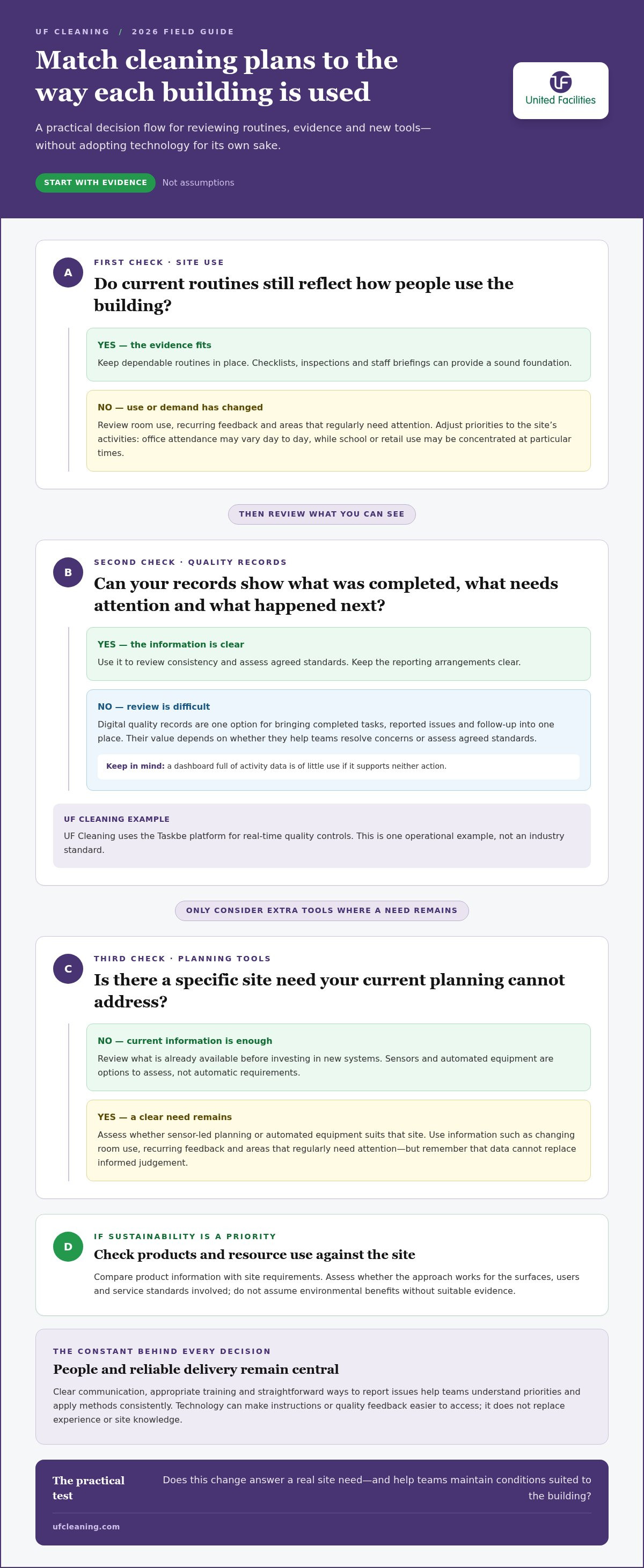
For facilities teams, the useful question isn’t whether a new tool or process is attracting attention. It’s whether it addresses a real site need. Checklists, inspections and staff briefings can provide a sound foundation. Digital records, sensor-led planning and automation are options to assess, not automatic requirements. Priorities depend on the building, how it is used and what current evidence shows.
Digital oversight and more measurable service delivery
Digital quality records can bring task completion, reported issues and follow-up into one place. Digital records make cleaning performance easier to review by showing what was completed, what needs attention and how issues were followed up. Their value depends on whether the information helps teams resolve concerns or assess agreed standards. A dashboard full of activity data is of little use if it doesn’t support either task. UF Cleaning uses the Taskbe platform for real-time quality controls. It is one operational example, not an industry standard.
Data-informed planning, without technology for its own sake
Planning can draw on practical information such as changing room use, recurring feedback and areas that regularly need attention. Reviewing these details can show whether existing routines still suit the site. Sensors and automated equipment are possible options, but not every space needs them, and data alone can’t replace informed judgement. Start by reviewing the information already available before investing in new systems.
Sustainability and responsible resource use
Organisations may review which products are used, how much is applied and whether working practices can reduce unnecessary consumption. Eco-friendly products and resource-conscious routines can be part of that review, but environmental benefits shouldn’t be assumed without suitable evidence. Compare product information and site requirements, then assess whether the chosen approach works for the surfaces, users and service standards involved.
Workforce capability and consistent delivery
People remain central to dependable cleaning. Clear communication, appropriate training and straightforward ways to report issues help teams understand priorities and apply methods consistently. Technology may make instructions or quality feedback easier to access, but it doesn’t replace experience or site knowledge. When considering facilities management cleaning UK trends, assess workforce capability alongside digital tools and resource choices.
These themes are discussed across the sector. BFM Magazine’s Cleaning & Hygiene coverage offers a dedicated place to follow that conversation. UF Cleaning provides recurring commercial cleaning and facilities support to organisations across the UK, with flexible schedules and quality monitoring. Explore UF Cleaning’s commercial cleaning support as you consider which developments fit your operational needs.
Which facilities management cleaning trends matter most in different settings?
A cleaning approach that suits a shared office may not suit a school, hotel or production environment. Consider how each trend fits the building’s purpose, occupancy and activity. The comparison below highlights points for facilities teams to review. It is not a universal specification.
| Setting | Hygiene consistency | Operating hours and user movement | Site activity and possible priority |
|---|---|---|---|
| Offices | Shared desks, meeting rooms and washrooms may need attention as use changes. | Hybrid attendance can make daily patterns less predictable. Flexible planning may help align effort with occupied areas. | Consider whether occupancy information or clear digital records would address a specific visibility gap. |
| Hospitality | Guest-facing spaces and back-of-house areas have distinct presentation and hygiene needs. | Guest movement and service activity can vary through the day and across different spaces. | Housekeeping coordination and consistent standards across guest areas may be more relevant than office-focused occupancy tools. |
| Education | Classrooms, shared facilities and circulation areas have different patterns of use. | Movement is shaped by teaching, breaks and wider site activity. | Planning should reflect the institution’s layout, activities and applicable guidance. |
| Retail | Customer-facing areas and shared facilities influence the overall impression of the premises. | Footfall and activity can vary by area and time. | Responsive checks and useful issue reporting can help teams focus attention where it is needed. |
| Industrial | Requirements depend on the work taking place and the areas being cleaned. | Cleaning must be planned around site operations and movement through work areas. | Site-specific risk assessments, relevant controls and applicable guidance should shape procedures. |
How building use changes cleaning priorities
Occupied offices often call for flexibility around shared spaces. Hospitality places particular emphasis on guest-facing areas and coordination with housekeeping. In retail, customer movement and the condition of public areas may guide attention. Education settings include distinct learning and shared spaces, while industrial environments require plans that account for site activity and relevant risks. These differences matter more than adopting a single trend across every building.
Final procedures should be informed by site-specific risk assessments and applicable guidance. Requirements vary with the premises, activities and materials involved, so use the table as a starting point for discussion, not a substitute for site-level judgement.
Choose trends by operational relevance, not novelty
For facilities management cleaning UK teams, begin with an evidenced need, such as a recurring service gap, limited visibility of completed work or a reporting requirement. Then consider the effort needed to implement a change, staff capability and any disruption for building users. A digital tool should make a meaningful task easier to manage. A sustainability measure should suit the site and its service requirements.
Review the results against the original need before extending a change. Technology and responsible resource use can support reliable service, but neither replaces appropriate planning, competent people or consistent delivery.
A practical readiness framework for UK facilities teams
Readiness starts with the site, not the technology. Before changing a cleaning process, establish what the building needs, what current records show and where a measured trial might improve everyday delivery. This keeps decisions proportionate and helps teams distinguish a useful development from a passing claim.
- Establish current needs. Map how the building is used, when areas are occupied, what the service is expected to deliver and where recurring issues arise.
- Identify evidence gaps. Review records such as task completion, reported issues and user feedback. Note what is missing or difficult to interpret.
- Prioritise a specific need. Select a service gap or reporting requirement that matters to the site, rather than adopting a trend simply because it is new.
- Pilot a suitable change. Choose a limited, representative area and agree what outcome the trial should support.
- Review and refine. Assess records and feedback together, then decide whether to adjust, extend or stop the change.
Set a useful baseline before changing practice
Start with a clear picture of the building: its different areas, occupied periods, user movement and current service expectations. Include recurring concerns, such as repeated reports about a shared space, but don’t treat one isolated comment as proof of a wider problem.
Next, record what evidence already exists and who is responsible for collecting and reviewing it. Completed tasks, reported issues and user feedback can all be useful, but there is no universal benchmark that suits every site. Interpret the evidence in light of the building’s purpose and service requirements.
Pilot, review and refine changes responsibly
Pilot a cleaning change against a defined operational need, then review the evidence before extending it. A small, representative area can help teams assess whether a new record-keeping method or resource choice works in practice, without committing to a building-wide change at the outset.
Consider recorded results alongside staff feedback and any disruption for building users. Document responsibilities for the trial, including who reviews issues and decides what happens next. Before procedures change, review relevant UK guidance and site-specific safety considerations, including chemical-use guidance where applicable. A tool or revised method should support staff and service outcomes, not create unnecessary reporting or operational burden.
For facilities management cleaning UK teams, this sequence provides a measured way to evaluate change while protecting reliable everyday delivery. UF Cleaning provides recurring commercial cleaning and facilities support across the UK, with flexible schedules and real-time quality controls through the Taskbe platform. Explore UF Cleaning’s commercial cleaning support as you consider your site’s priorities.
How UF Cleaning supports evolving UK facilities management cleaning
Cleaning contributes to dependable operations by helping keep occupied spaces cared for, presentable and ready for use. It is most effective when the service reflects how a building is used and provides clear oversight. Cleaning remains distinct from the wider maintenance, security and building management functions that make up facilities management.
UF Cleaning has supported organisations across the UK since 2010, providing recurring commercial cleaning and facilities support. Flexible schedules, eco-friendly products and 24/7 operational support are part of its service approach. These services can help organisations align cleaning arrangements with operational needs, while recognising that cleaning alone is not total facilities management.
A tailored cleaning approach for varied commercial environments
Different sites call for different considerations. UF Cleaning supports offices, hospitality, education, retail, industrial and event settings, adapting cleaning arrangements to site use and operational requirements. Office cleaning, housekeeping and hotel management, for example, serve distinct environments and needs. This approach helps cleaning fit the wider operation instead of treating every building as if its use and priorities were the same.
For organisations assessing facilities management cleaning UK provision, practical details matter: which spaces are included, how the building is used and what is expected from a recurring service. Flexible schedules can help align delivery with operational patterns. Eco-friendly products give organisations an option to consider when reviewing product choices. Assess their suitability in relation to the site and the work being carried out rather than assuming a particular environmental result.
Bring reliable oversight into the day-to-day service
UF Cleaning uses the Taskbe platform to deliver real-time quality controls. This provides a digital way to oversee service quality as part of everyday operations, giving organisations clearer visibility without promising specific results. Quality information is most useful when it builds a shared understanding of service expectations and connects oversight with the cleaning taking place.
Clear oversight complements dependable delivery. Recurring cleaning provides continuity, while quality controls make service activity more visible. Together, these elements can support a cleaning arrangement that responds to an organisation’s requirements and contributes to wider facilities objectives, without extending the cleaning service into unrelated building functions.
UF Cleaning’s UK-wide commercial cleaning and facilities support is shaped around the needs of varied organisations. Explore UF Cleaning’s commercial cleaning and facilities support, or request a free quote to discuss your requirements.
Make your next cleaning decision with confidence
A useful next step is to select a site priority, agree how you’ll assess it and give the change time to demonstrate its practical value. This keeps improvement grounded in the building’s needs while protecting the dependable service people rely on each day. Effective facilities management cleaning UK doesn’t require adopting every new idea. It requires choosing changes that fit your organisation and reviewing them carefully.
When you’re ready to shape a cleaning arrangement around your operational priorities, UF Cleaning can discuss tailored commercial support for your organisation. Request a free quote for tailored commercial cleaning support to take the next step towards a well-managed working environment.
Frequently Asked Questions
Can facilities management cleaning take place while a building remains occupied?
Yes. Facilities management cleaning UK services can be scheduled around people using a building, with access and disruption considered in the plan. Teams might clean a meeting room once it is free or use clear signs to indicate a temporarily unavailable area. Site contacts should communicate sensitive activities and access restrictions in advance so cleaning can be coordinated without interrupting work or compromising privacy.
Does eco-friendly cleaning mean compromising on hygiene?
No. Choosing eco-friendly products doesn’t automatically mean accepting a lower standard of hygiene. The product and method still need to suit the surface, soil and purpose of the task. A product intended for general surface cleaning, for example, may not suit every material or situation. Follow product instructions, use the correct equipment and method, and assess whether the approach meets the site’s hygiene expectations.
How do cleaning priorities differ between offices, hotels and schools?
Priorities differ according to how spaces are used and who relies on them. In offices, shared kitchens, meeting rooms and desk areas may need attention as teams move between spaces. Hotels must coordinate guest rooms and public areas with housekeeping and guest activity. Schools have classrooms, dining areas and shared facilities used by pupils and staff. Each site’s layout, activities and expectations should shape its cleaning priorities.
Can one cleaning approach work across several UK sites?
A shared framework can support consistency across sites, but it shouldn’t prevent local adjustments. An organisation might use common reporting categories and service expectations, then account for differences in building layout, opening patterns, materials and activities. A site with public reception areas, for example, may need different checks from one focused on staff workspaces. Compare results in context rather than assuming identical figures mean identical service quality.
What should facilities teams measure when reviewing cleaning performance?
Choose measures that answer a practical question. Teams could review whether agreed tasks were recorded as complete, how often issues were reported, how promptly follow-up was documented and what users say about specific areas. Look for recurring patterns instead of drawing conclusions from one comment or missed task. A concise review of relevant evidence is more useful than collecting data no one uses to guide decisions.
Does facilities management cleaning include building maintenance?
Not necessarily. Cleaning and building maintenance are distinct functions, even though they may coordinate as part of wider facilities management. A cleaning operative might notice a leaking tap or damaged flooring, but that doesn’t mean the cleaning service carries out repairs. Clear reporting routes help an issue reach the relevant maintenance team while keeping responsibilities and service expectations distinct.