True commercial housekeeping is an exercise in systematic asset preservation, not mere surface dusting. For facility directors and operations managers, maintaining flawless presentation across multi-room environments is a continuous, exacting challenge. When rapid turnaround windows collide with team turnover, essential hygiene protocols quickly slip, and inconsistent standards inevitably erode visitor trust. You already recognise that superficial tidying can never substitute for meticulous care. Distinguishing routine custodial upkeep from rigorous housekeeping cleaning demands a deliberate, repeatable operational framework designed to eliminate guesswork from the start.
In this guide, you'll discover how structured housekeeping cleaning protocols protect operational standards, guest satisfaction, and hygiene compliance across every facility. We examine the functional distinctions that elevate commercial hygiene, the architecture of auditable room workflows, and the digital quality tracking methods that guarantee uncompromised consistency day after day.
Key Takeaways
- Understand the strategic distinction between reactive custodial maintenance and proactive housekeeping cleaning frameworks designed to preserve commercial assets and elevate visitor confidence.
- Discover how disciplined chemical management and precise contact times safeguard hygiene compliance whilst eliminating cross-contamination risks across high-touch surfaces.
- Master a step-by-step room turnaround methodology that maximises operational velocity without sacrificing thorough sanitisation or room presentation standards.
- Explore modern auditing frameworks and objective Key Performance Indicators that convert routine quality checks into transparent, auditable performance data.
- Evaluate the strategic considerations between deploying in-house cleaning personnel and collaborating with specialised commercial partners to secure reliable, long-term consistency.
What Is Housekeeping Cleaning and Why Does It Matter?
Professional housekeeping cleaning represents far more than superficial tidying; it's a structured operational discipline designed to maintain commercial properties in peak functional condition. When exploring what is housekeeping within an enterprise or institutional context, the scope quickly expands beyond basic sanitation. It encompasses proactive asset preservation, spatial alignment, and meticulous hygiene governance. Left unmanaged, commercial spaces experience accelerated wear on fixtures, degraded floor finishes, and compromised indoor air quality. By implementing planned care cycles, facility operators protect their capital investments whilst cultivating an environment where visitors and personnel feel immediately reassured.
The Distinct Pillars of Professional Housekeeping
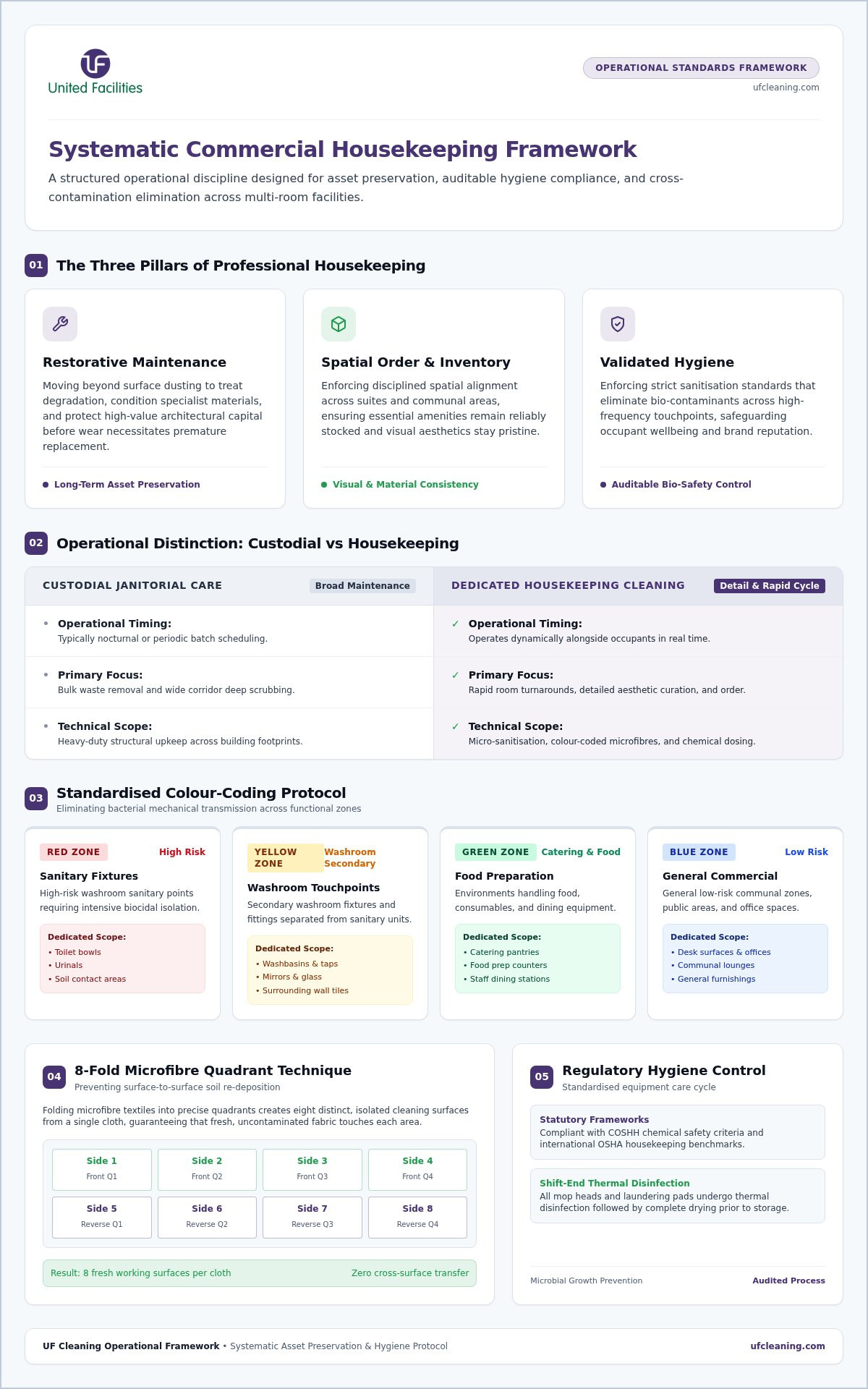
Effective commercial operations rest on three interrelated pillars that separate genuine housekeeping from ad-hoc surface wipe-downs:
- Restorative Maintenance: Moving beyond light dusting to treat surface degradation, condition specialist materials, and protect high-value architectural assets before premature wear requires costly replacement.
- Spatial Order and Inventory Control: Maintaining disciplined presentation throughout suites and communal areas, ensuring essential amenities are consistently stocked and visual aesthetics remain pristine.
- Validated Environmental Hygiene: Enforcing strict sanitisation standards that eradicate bio-contaminants across high-frequency contact zones, directly safeguarding brand perception and visitor wellbeing.
Custodial Janitorial Care versus Dedicated Housekeeping
While modern facilities depend on both disciplines, conflating custodial janitorial care with structured housekeeping creates operational blind spots. Custodial duties typically follow a nocturnal or periodic schedule. Their primary focus centres on bulk waste removal, deep corridor scrubbing, and heavy-duty structural maintenance across wide building footprints.
In contrast, high-traffic commercial environments require dedicated housekeeping cleaning frameworks that operate alongside building occupants. Professional housekeepers manage rapid room turnarounds, curate fine aesthetic details, and execute micro-sanitisation using colour-coded microfibre systems and precision chemical dosing. This ongoing attention to detail resolves hygiene lapses in real time, preventing minor oversights from developing into costly guest complaints.
Essential Standards and Hygiene Protocols in Housekeeping
Maintaining institutional safety requires robust operational disciplines that protect both building users and cleaning teams. Regulatory benchmarks like Control of Substances Hazardous to Health (COSHH) regulations and international frameworks like OSHA housekeeping standards define the minimum safety criteria for physical environments. However, exceptional commercial operators don't settle for baseline compliance. They establish rigorous chemical handling, systematic material tracking, and standardised hygiene workflows that turn routine housekeeping cleaning into an auditable line of defence against environmental contamination.
Cross-Contamination Prevention and Colour-Coding Systems
Preventing the mechanical transmission of bacteria between distinct zones relies heavily on strict colour-coding systems. Standard commercial protocols assign specific colours across four functional areas:
- Red: High-risk washroom sanitary fixtures, including urinals and toilet bowls.
- Yellow: Washroom secondary touchpoints, including taps, mirrors, tiles, and washbasins.
- Green: Food preparation areas, catering pantries, and staff dining stations.
- Blue: Low-risk office environments, guest desk surfaces, communal lounges, and general furnishings.
Housekeepers complement these colour assignments using an eight-fold microfibre technique. Folding each cloth into quadrants exposes eight fresh cleaning faces, preventing soil from redepositing across successive surfaces. At the shift's conclusion, mop heads and laundering pads undergo thermal disinfection and complete drying before storage. This disciplined care cycle stops microbial growth inside maintenance equipment.
Chemical Safety, Dilution, and Contact Time Science
Effective sanitisation hinges on the fundamental difference between cleaning and disinfecting. Cleaning lifts particulate matter through physical friction and surfactants. Disinfecting destroys pathogens at a cellular level, yet it only works after physical debris is cleared away.
Surfaces must remain visibly wet with chemical disinfectant for the manufacturer's specified contact time. Wiping solutions away too early allows resilient pathogens to survive on touchpoints. Modern facilities are also transitioning away from harsh petrochemicals that emit volatile organic compounds (VOCs). Progressive operators deploy high-grade bio-based detergents and eco-friendly enzymatic solutions that eliminate pathogens without degrading indoor air quality. If managing these compliance layers strains your internal resources, partnering with a dedicated commercial housekeeping specialist guarantees consistent protocol execution while meeting stringent sustainability standards across your properties.
The Step-by-Step Methodology for Flawless Room Turnaround
Speed without precision creates liability. An efficient turnaround sequence coordinates individual movements to eliminate missed corners and wasted effort. Structured workflows align operational output with recognised industry-wide cleaning and safety standards, transforming room turnover from a frantic scramble into a predictable routine. When teams follow a disciplined path, housekeeping cleaning achieves rapid turnaround times alongside uncompromised hygiene.
Initial Clearance, Stripping, and Pre-Treatment
Upon entry, housekeepers open windows or activate ventilation systems to introduce fresh airflow. They visually assess the space for maintenance faults or discarded property before stripping linens. Soiled textiles are gently rolled inwards away from the body to trap surface debris, then placed directly into laundry bags without touching clean areas. After segregating general waste and dry recyclables, technicians apply bio-based detergents to sanitary fixtures, allowing active solutions necessary dwell time while work proceeds elsewhere.
Directional Cleaning: Top-to-Bottom and Clockwise Progression
Executing a clockwise circuit ensures no surface escapes attention. Housekeepers begin by dusting ceiling cornices, light fixtures, and upper shelving. This top-to-bottom sequence allows dislodged dust to fall before lower furnishings receive care. Moving methodically along the perimeter walls, staff clean, wipe, and disinfect every touchpoint, paying close attention to:
- Thermostats, digital control consoles, and wall switches
- Wardrobe handles, clothes hangers, and safe keypads
- Bedside lamps, desk surfaces, and television remote controls
Once surrounding surfaces are polished, fresh linens are fitted with crisp, uniform alignment across every edge.
Floor Finishing and Final Operational Sign-Off
Floor preparation represents the final physical phase. Housekeepers vacuum carpets and damp-mop hard flooring by moving backwards from the farthest corner towards the room exit, avoiding footprint marks on drying surfaces. At the threshold, technicians perform a structured doorway inspection. This final visual check verifies symmetry across curtain drops, straight amenity presentation, and streak-free glass. The room status is then recorded in the facility management platform, confirming it's fully verified for arrival.
Quality Assurance and Performance Tracking in Housekeeping
Subjective visual inspections are no longer sufficient to protect commercial facilities. Modern operations require systematic auditing frameworks that transform housekeeping cleaning into a measurable, verifiable discipline. By establishing clear operational markers, leadership teams replace guesswork with quantifiable performance data. This structured approach guarantees that every suite, meeting room, and communal lounge consistently meets strict environmental criteria before reoccupation.
Establishing Auditable Housekeeping Key Performance Indicators
Clear metrics provide cleaning teams with definitive benchmarks whilst providing facility directors with transparent evidence of service delivery. Three core Key Performance Indicators anchor an effective quality programme:
- Turnaround Velocity versus Compliance: Measuring room completion intervals against defined sanitisation checklists to ensure operational speed never compromises hygiene standards.
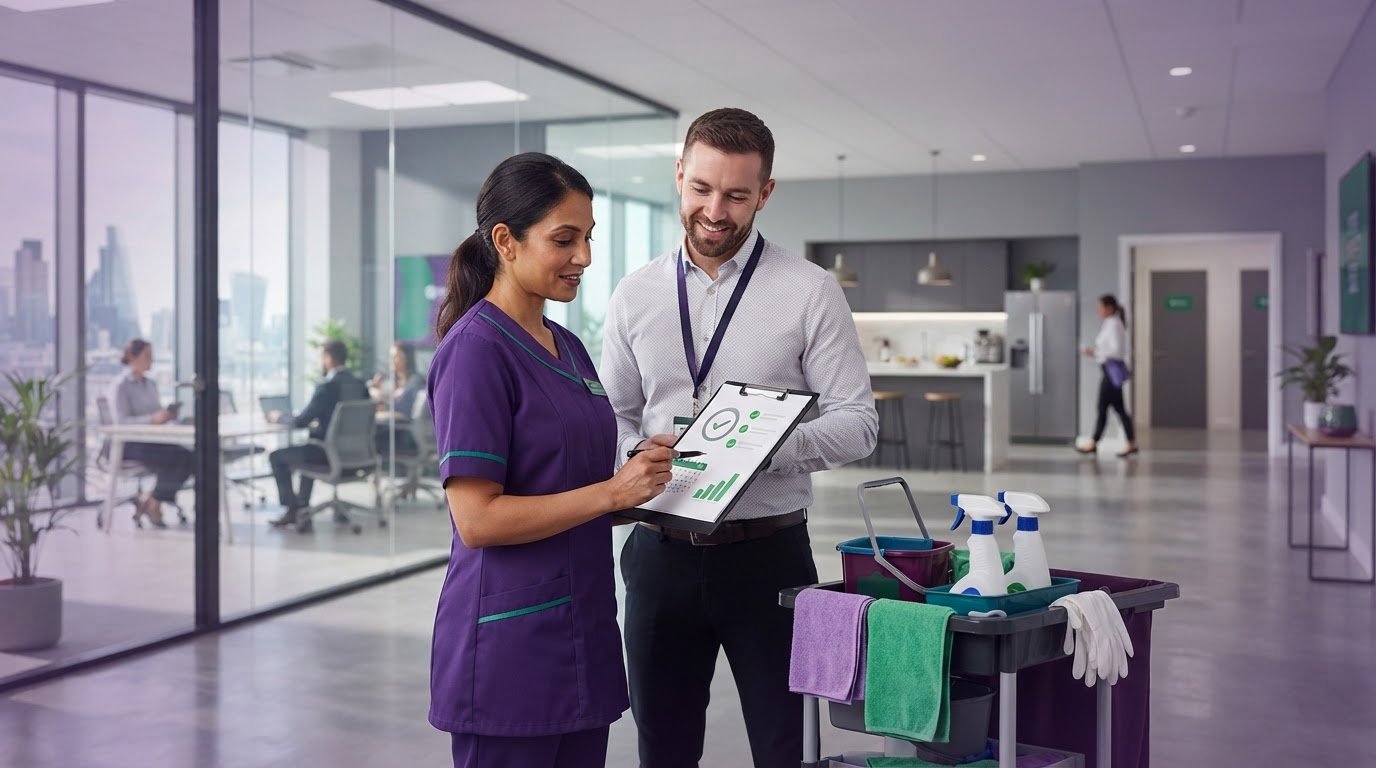
- Objective Audit Scores: Applying weighted numerical evaluations during spot inspections to assess touchpoint sanitisation, textile freshness, and spatial presentation.
- Re-Clean Ratios and Maintenance Logs: Monitoring the percentage of spaces requiring secondary cleaning, alongside the rapid reporting of physical defects like leaky fixtures or worn flooring.
Real-Time Operational Monitoring via Digital Management Platforms
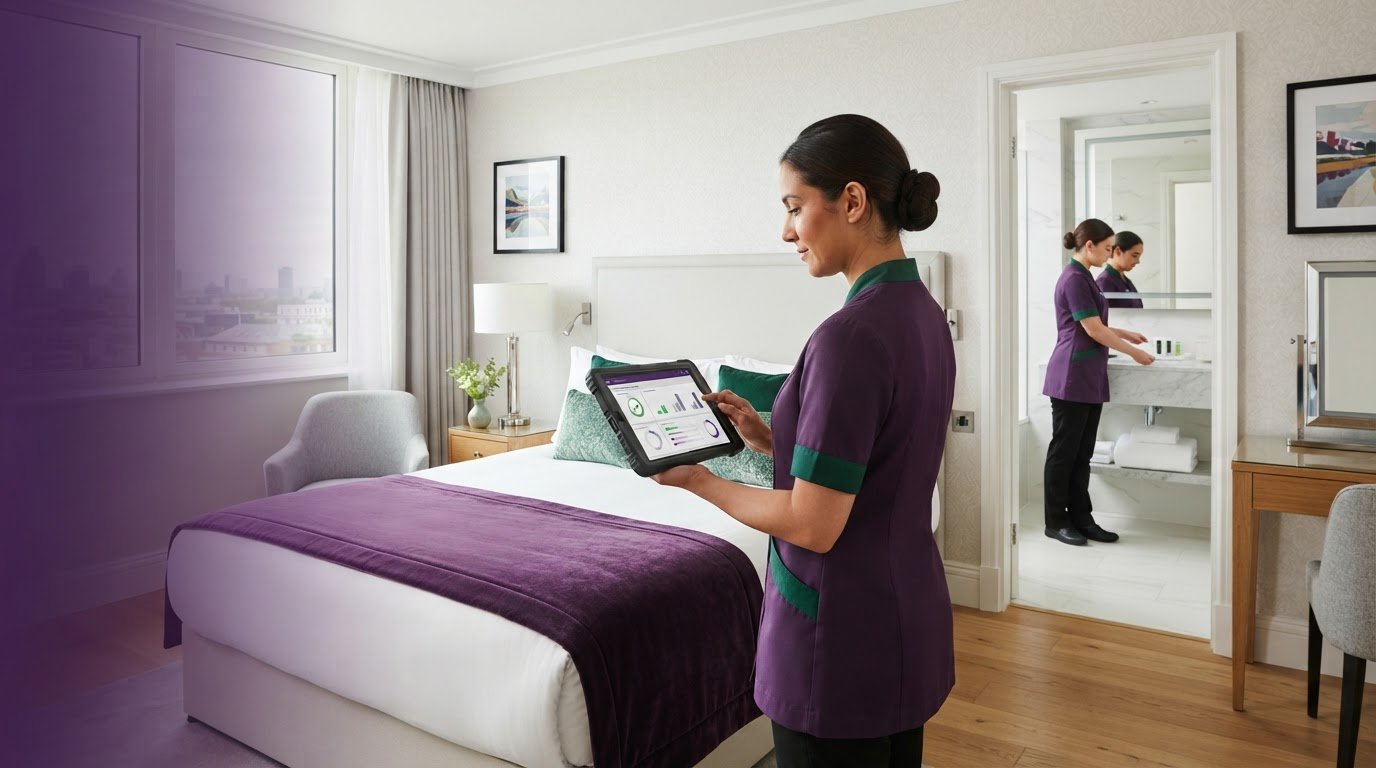
Traditional paper logbooks inevitably cause communication bottlenecks and fragmented oversight across expansive premises. Dedicated digital architectures, such as the Taskbe platform, eliminate these delays by recording room statuses and compliance logs instantaneously. Operatives complete assigned workflows on handheld devices, uploading photographic verification of finished tasks and lodging maintenance tickets directly with facilities teams.
This automated data flow creates an indisputable audit trail, making performance trends visible across entire property portfolios. Continuous skill development programmes then utilise this inspection data to address specific operational gaps, refreshing team capabilities on chemical handling and equipment care. If you want to replace inconsistent outcomes with auditable, high-level presentation, partner with UF Cleaning for professional housekeeping to secure verified operational consistency across your commercial properties.
Developing an Optimised Commercial Housekeeping Strategy
Structuring a high-performing programme demands precise alignment between facility usage patterns, asset preservation goals, and commercial accountability. High-occupancy commercial properties face continuous wear, meaning arbitrary cleaning schedules quickly lead to degraded finishes and visitor dissatisfaction. A bespoke housekeeping cleaning strategy combines structured operational cadences, sustainable procurement principles, and disciplined workforce management to protect property value across every square metre.
In-House Housekeeping versus Professional Commercial Outsourcing
Directly managing an internal housekeeping department introduces substantial administrative overheads. Facility directors must navigate ongoing recruitment, resolve sudden sickness cover, maintain specialist machinery, and coordinate continuous health and safety training. These operational burdens inevitably pull key management attention away from core business objectives.
Outsourcing to an accredited commercial provider shifts these logistical challenges onto an expert team. Professional partners absorb fluctuating occupancy levels and sudden demand spikes with flexible, pre-vetted staffing pools. Structured commercial agreements also provide clear financial predictability, replacing unexpected machinery repair costs and staffing emergencies with a fixed operational framework backed by verifiable service levels.
Implementing Sustainable and Responsible Housekeeping Operations
Modern commercial strategies prioritise environmental responsibility alongside pristine presentation. Leading operators adopt green procurement practices by replacing single-use containers with concentrated, bio-based chemical formulations and precision dilution dispensers. This closed-loop approach drastically curtails plastic packaging waste while preventing chemical over-dosing.
Indoor environmental quality equally depends on the machinery deployed across your premises. Implementing commercial vacuums fitted with multi-stage HEPA filtration traps micro-particulates, allergens, and dust, actively purifying the air that occupants breathe. By pairing sustainable supplies with disciplined operational routines, facilities achieve uncompromising hygiene without environmental compromise. Commercial operators seeking to establish transparent, auditable quality across their portfolio can partner with the expert team at UF Cleaning to maintain impeccable standards and total peace of mind.
Elevating Your Facility Standards Through Structured Housekeeping
Transforming routine maintenance into a robust asset preservation strategy requires discipline, clear accountability, and proven operational sequences. Adopting clockwise turnaround pathways, rigorous colour-coded hygiene barriers, and real-time digital auditing ensures your premises consistently exceed regulatory benchmarks. When executed with precision, structured housekeeping cleaning protects your brand reputation, prevents premature asset depreciation, and fosters an immaculate environment that visitors trust instinctively.
Delivering professional facility support across the United Kingdom since 2010, UF Cleaning combines sustainable, eco-friendly supplies with 24/7 operational support tailored to demanding commercial properties. Through real-time quality assurance powered by the Taskbe platform, our dedicated teams eliminate operational guesswork, giving you complete visibility over every room cycle. Take the definitive step towards effortless operational consistency today: Discover bespoke commercial housekeeping solutions with UF Cleaning and safeguard your facility's future with confidence.
Frequently Asked Questions
What is the core difference between housekeeping cleaning and regular commercial cleaning?
Commercial janitorial cleaning primarily addresses high-volume floor maintenance, bulk waste management, and basic facility upkeep during off-peak hours. Dedicated housekeeping cleaning focuses on immediate, guest-facing aesthetic presentation, detailed surface sanitisation, and rapid turnaround protocols. It operates alongside facility occupants to ensure continuous hygiene, precise amenity replenishment, and active fabric or furniture preservation.
Why is colour-coding mandatory in professional housekeeping cleaning operations?
Colour-coding creates an unmistakable visual hygiene barrier that stops cross-contamination between distinct functional spaces. Assigning red cloths exclusively to high-risk sanitary fixtures and blue items to general furnishings prevents pathogenic transmission to low-risk touchpoints. This systematic framework simplifies operative training, minimises human error during fast-paced turnovers, and provides facility managers with auditable procedural compliance across every room.
How do professional housekeeping teams prevent cross-contamination between guest rooms?
Operatives follow strict single-room containment disciplines to eliminate microbial transfer across thresholds. Soiled linens are rolled inwards and sealed in dedicated laundry hampers before fresh textiles enter the space. Microfibre cloths and mop pads are replaced after every individual room cycle, while handheld tools and chemical dispensers receive sanitising wipe-downs between suites to maintain protective isolation.
What key performance indicators should facility managers use to evaluate housekeeping quality?
Operations leaders evaluate service quality through three primary metrics: objective audit inspection scores, re-clean request ratios, and average turnaround duration against benchmark protocols. Audits score micro-level cleanliness, contact-time adherence, and aesthetic uniformity across furnishings. Tracking prompt maintenance logging also measures how proactively operatives identify physical defects, ensuring infrastructure remains protected without relying on visitor complaints.
How does digital task management software improve housekeeping operational consistency?
Digital platforms replace paper logbooks with real-time room tracking, photographic proof of completed workflows, and immediate maintenance flagging. Systems like the Taskbe platform allow supervisors to track turnaround status instantly across expansive facilities. This transparent data flow alerts teams to missed touchpoints, monitors operational velocity, and builds an auditable performance history that keeps service levels consistent across every shift.
Can commercial housekeeping programmes utilise eco-friendly cleaning chemicals effectively?
Modern plant-based, enzymatic cleaning agents deliver bactericidal and virucidal efficacy that matches conventional chemicals without leaving toxic residues. Concentrated eco-friendly solutions significantly reduce plastic packaging waste and eliminate volatile organic compound emissions, protecting indoor air quality for building occupants. When paired with disciplined contact times, sustainable chemicals maintain hospital-grade sanitation safely and responsibly.
What are the main advantages of outsourcing commercial housekeeping over in-house staffing?
Outsourcing transfers the time-consuming administrative weight of recruitment, payroll, and sickness cover to a specialised partner. Professional providers easily absorb fluctuating occupancy patterns and seasonal demand spikes with flexible, vetted staffing pools. Structured commercial agreements also provide total financial predictability, replacing unexpected machinery repair costs with a guaranteed service framework backed by continuous digital supervision.