
What if the same dusty ledge, marked floor or overlooked washroom keeps appearing on your list of concerns? These may be signs your commercial cleaners are cutting corners, but one missed task doesn’t establish a pattern. The key question is whether the same service gaps recur against clearly agreed expectations.
It’s understandable to wonder whether visits are being rushed when standards seem inconsistent, especially if there’s no clear baseline for what should be cleaned and when. This practical checklist will help you identify observable warning signs, distinguish occasional oversights from persistent gaps and assess the evidence without guesswork.
You’ll also learn how to clarify task scopes, record repeated concerns and agree practical next steps, then review whether service improves. Clear expectations and consistent oversight are foundations of a dependable cleaning partnership. UF Cleaning’s recurring commercial cleaning schedules and real-time quality controls through the Taskbe platform can give organisations a clearer framework for reviewing service.
Key Takeaways
- Use a practical checklist to spot signs your commercial cleaners are cutting corners, including repeated misses and overlooked hygiene or safety points.
- Compare observations across visits, areas and task types. Visit speed alone isn’t proof of poor service.
- Assess cleaning fairly by matching each concern to the agreed schedule and recording where and when it occurred.
- Organise your evidence, raise specific concerns calmly, agree actions and set a review point.
- Tailored recurring schedules and Taskbe real-time quality controls can support clearer oversight of commercial cleaning.
Signs Your Commercial Cleaners Are Cutting Corners: What to Check First
Inconsistent cleaning can undermine confidence in a service, particularly when the same areas seem to need attention soon after a visit. Still, one missed task isn’t proof that cleaners are cutting corners. It may fall outside that visit’s agreed scope, or it may be an isolated oversight. Start by comparing what you can see with the cleaning schedule, then note whether the gap recurs.
Focus on observable details rather than assumptions about how long a visit took. The Commercial Cleaning Overview describes the range of work and techniques involved, but the appropriate standard for your premises is the scope agreed for your facility.
Which visible cleaning gaps deserve attention?
Check each area against the tasks and frequency in your cleaning schedule. An unemptied bin, a marked floor or an untidy shared kitchen matters if that task was due. Washroom hygiene deserves particular attention because washrooms are frequently used shared spaces. Dust, marks or cobwebs returning in the same spot may point to a recurring gap, but first check whether that area is included in the relevant visit.
- Bins: Check whether they’ve been emptied and the surrounding area left in the agreed condition.
- Floors: Look for recurring dirt, sticky patches or marks where floor care is scheduled.
- Washrooms and shared kitchens: Note visible signs that agreed cleaning tasks may not have been completed.
- Less prominent areas: Watch for dust or cobwebs repeatedly collecting in corners, on ledges or behind shared equipment.
- Safety and equipment: Record wet-floor hazards or equipment left unattended, and follow your site’s procedures to address any immediate risk.
These are prompts for checking, not universal pass-or-fail standards. Some areas or tasks may be scheduled less frequently, so confirm what was due before treating a missed item as evidence of poor service.
When does a missed task become a pattern?
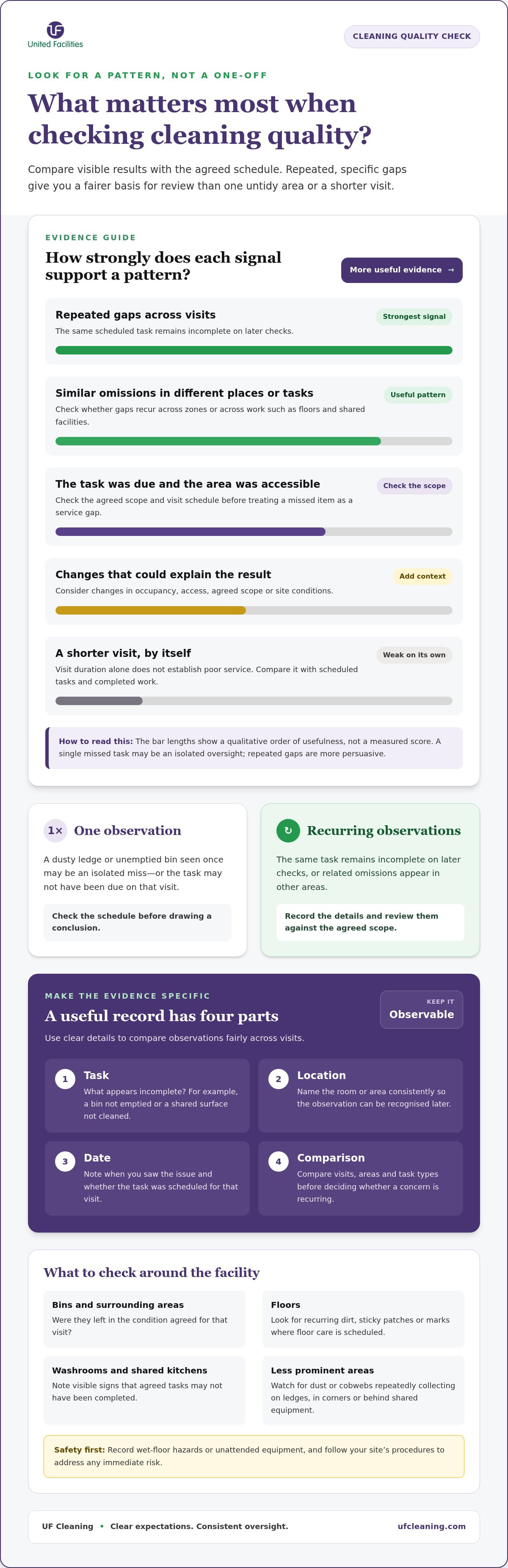
A pattern is more persuasive than a single impression. Record the task, location and date, then compare your notes across visits. A dusty ledge seen once may be an isolated oversight. If it remains dusty on later checks and other tasks in the same zone are also missed, it deserves closer review. Avoid general descriptions such as “the office wasn’t cleaned properly”.
- Identify the task: Describe what appears incomplete, such as an unemptied bin or an uncleaned shared surface.
- Pinpoint the location: Use a room or area name that can be recognised consistently.
- Add the date: Note when you observed the issue and whether the task was scheduled for that visit.
- Compare visits: Look for recurrence across time, areas or task types before drawing conclusions.
This simple record helps distinguish isolated misses from the signs your commercial cleaners are cutting corners. It also gives you a fair basis for discussing concerns against the agreed scope, rather than relying on assumptions about visit speed or a single untidy area.
How to Recognise a Pattern of Shortcuts Across Your Facility
A single missed task is an observation. Repeated gaps across visits, locations or types of work can point to a broader consistency issue. Look for connections rather than treating every small imperfection as evidence. Recurring omissions in several zones may warrant a review, while one isolated problem may have a straightforward explanation.
Compare like with like. Check the scheduled tasks, the areas they cover and the results after each visit. An evidence-led checklist can help you organise what you notice:
- Across time: Does the same task remain incomplete on successive visits, or does the concern resolve?
- Across locations: Are gaps confined to one room, or do similar omissions appear in separate parts of the facility?
- Across task types: Are floors, shared facilities or touchpoints affected together, or is one specific task recurring?
- Against scope: Was the task due for that visit, and was the area accessible?
- Alongside changes: Has occupancy, access, the agreed scope or a site condition changed?
Related observations can raise questions about the clarity of the scope, staff training or supervision. On their own, they don’t establish which factor is responsible. The Commercial Cleaning Industry Standards discussion highlights the value of defined scopes, checklists and quality control. For your review, the agreed requirements for your own facility remain the most relevant reference.
Are shorter cleaning visits a reliable warning sign?
Not on their own. Compare a change in visit duration with the tasks scheduled and the work completed, while allowing for changes in occupancy, access, scope or site conditions. A shorter visit with consistent completion may have a different explanation from a repeated reduction accompanied by missed tasks. If the change persists without a clear reason, treat it as a prompt for a measured review, not a verdict.
Why do some areas remain clean whilst others are overlooked?
Compare prominent areas with less-frequented rooms, corridors and shared facilities, then check whether the schedule assigns tasks to each zone consistently. Uneven results may raise questions about priorities, access restrictions or how the work is allocated, but they don’t prove the cause. Note which zones differ and whether the same contrast appears across visits before deciding what needs clarification.
Consider the evidence as a whole. Recurring omissions across different locations and tasks may suggest that expectations, training or oversight need attention. Isolated misses with no recurrence may call for a different response. The objective is to identify a pattern for constructive discussion, not to infer intent from appearances or visit duration alone.
Clear scopes and tailored recurring schedules make it easier to compare planned work with observed results. UF Cleaning provides recurring commercial cleaning with schedules tailored to a facility’s requirements, helping organisations set a clear reference point for reviewing service.
How to Assess Cleaning Quality Fairly: Scope, Evidence and Follow-Up
A fair review starts with the agreed cleaning scope, not an assumed standard for every commercial building. One facility may require a task at every visit, while another may schedule it less frequently. Compare what was due with what you observed, and include relevant service details, such as restricted access or communication that a task could not be completed.
A concise record makes concerns easier to discuss and progress easier to assess. Keep the language factual: describe a visible result rather than judging effort or intent. This helps distinguish a confirmed gap from an issue that needs clarification.
What should a commercial cleaning quality checklist include?
List tasks by area and frequency in plain, observable terms. Instead of “clean kitchen”, specify the agreed actions, such as wiping the worktop or emptying the bin. Include exclusions and access limitations, so an area that was unavailable during a visit isn’t recorded as a missed task without context. Add space for dated observations, photographs where appropriate, and the status of any follow-up.
A simple comparison record can use these fields:
Agreed task: The action described in the contract or cleaning schedule.
Location: The named room, zone or facility.
Observation: What was visible, or what communication was received about access or completion.
Date: When the visit took place and when the concern was noted.
Follow-up: The agreed action, responsible contact and review status.
For example, record “worktop still marked in shared kitchen” rather than “kitchen not cleaned properly”. If a photograph helps illustrate the observation, make sure it shows the relevant area and can be understood alongside the date and scheduled task. Avoid recording more than is needed to explain the issue.
How can you compare expected and observed service?
Check each entry against the relevant contract or schedule, then group findings by location or recurring task. This can show whether a concern is isolated, repeated in one zone or appearing across the facility. Keep access issues, changes in requirements and tasks not due on that visit visible in the record. These details help keep conclusions proportionate.
Use the grouped evidence to agree practical next steps. Specify what needs attention, how the task or communication should be handled, and who will follow up. Set a review date that allows enough relevant visits to assess the pattern. There’s no universal review period: a task scheduled infrequently needs a different observation window from one included on every visit.
At review, compare new observations with the original record. Was the agreed task completed on the visits when it was due? Were access issues communicated? Is the same gap recurring, or has the evidence changed? This consistent method helps assess the signs your commercial cleaners are cutting corners without treating a single observation as proof. It also gives everyone a clear basis for discussing service quality.
What to Do When Your Commercial Cleaning Checklist Has Gaps
A checklist is most useful when it leads to a clear, proportionate response. If you’ve identified possible signs your commercial cleaners are cutting corners, avoid drawing conclusions from a single observation. Organise the evidence, compare it with the agreed scope, then raise specific concerns and agree how you’ll assess any changes. This keeps the conversation focused on service and practical next steps, not assumptions about intent.
Use a straightforward sequence:
- Organise your notes. Group dated observations by location and task, and include the relevant scheduled visit. Add photographs where they help explain what you saw.
- Check the agreed requirements. Review the contract or cleaning schedule to establish whether the task was due and whether access or another condition affected it.
- Raise specific issues. Share the clearest examples and discuss possible causes, priorities and appropriate actions.
- Record the agreement. Note responsibilities, any changes to the scope and the date you’ll review progress.
How should you raise concerns with a cleaning provider?
Keep the discussion calm and factual. Explain that a particular task appeared incomplete in a named area on a dated visit, then refer to the relevant scheduled requirement. Review what happened, including access, priorities or communication, before deciding on corrective action. Agree who will take each action and when you’ll follow up, and keep a short written record of the discussion.
This approach gives everyone a clear account to work from and avoids treating one isolated incident as proof of a wider problem. If the review shows that expectations are unclear, clarify the task description or frequency so the next assessment uses an agreed reference point.
How do you know whether the service is improving?
Repeat the same checks across comparable visits and locations, concentrating on the issues previously raised. One improved result may be encouraging, but consistent completion of tasks when they’re due provides a more useful basis for assessing progress. Record whether each concern is resolved, recurring or affected by a new access or scheduling issue.
If gaps persist, or communication about access and completion remains unclear, raise the matter through the agreed service contact and review the scope or service arrangement together. Identify whether the task, frequency, access process or follow-up needs adjusting. For more on what a written scope should cover, see What to Look for in a Commercial Cleaning Contract.
UF Cleaning tailors recurring cleaning schedules to a facility’s requirements, with clear scopes and consistent oversight supporting a considered working relationship. If you’re looking to discuss commercial cleaning for your facility, get in touch with UF Cleaning.
How UF Cleaning Supports Consistent Commercial Cleaning Standards
Consistent commercial cleaning begins with understanding the facility: how its spaces are used, which tasks matter most and how often each area needs attention. UF Cleaning tailors recurring schedules to a facility’s requirements, giving the service a defined structure that can be reviewed as needs change. This clarity also helps organisations assess concerns fairly, using agreed tasks rather than assumptions about what every cleaning visit should include.
How does a tailored cleaning schedule support consistency?
A schedule should reflect a facility’s operations, not simply apply the same routine everywhere. A busy shared area may need a different cleaning frequency from a room used less often, while access arrangements can affect how tasks are planned. UF Cleaning agrees the scope and schedule around the premises, giving both parties a shared reference for what work is expected and when.
That reference makes conversations about missed tasks more practical. If an area appears overlooked, compare it with the agreed schedule to establish whether the task was due, whether access was available and whether the requirements need clarification. Clear expectations also make it easier to review service over time without treating every isolated observation as proof of a wider problem.
When defining standards, document the task, the area it applies to, its frequency and any access requirements. The most useful benchmark is a scope that reflects your organisation’s facility and requirements.
What visibility does ongoing quality control provide?
Technology can support oversight, but it’s one part of a considered cleaning partnership. UF Cleaning uses the Taskbe platform for real-time quality controls, supporting ongoing visibility of service. These controls work alongside a clear scope and recurring schedule. They don’t replace the need to agree expectations or discuss observations constructively.
UF Cleaning also uses eco-friendly products and provides 24/7 operational support. These are part of the wider service arrangement, while the schedule and quality controls help create a practical framework for monitoring the work. No single tool removes the need to review results against the tasks agreed for a particular facility.
If you’re assessing the signs your commercial cleaners are cutting corners, a structured approach can turn uncertainty into a more useful review: define the work, monitor it consistently and discuss recurring gaps. UF Cleaning has served organisations since 2010 and tailors recurring cleaning schedules to facility requirements. Request a free quote to discuss a commercial cleaning arrangement and a schedule suited to your premises.
Make Your Next Cleaning Review More Confident
Use your checklist as the beginning of a clearer working relationship, not simply a record of what went wrong. A shared understanding of what matters in your premises, how tasks will be assessed and when progress will be reviewed can turn uncertainty into practical, manageable decisions.
If you’re still weighing up the signs your commercial cleaners are cutting corners, focus on evidence you can compare over time. Identify the service requirements that matter most to your organisation, then decide what consistent delivery should look like in those areas. This gives future conversations a constructive purpose: agreeing expectations and checking whether they’re being met.
If your current arrangement would benefit from a clearer scope or a more tailored schedule, UF Cleaning can help you consider an approach for your facility. Take the next step and request a free quote for tailored commercial cleaning. With clear expectations in place, you can move forward with greater confidence in how your premises are cared for.
Frequently Asked Questions
How can I tell if commercial cleaners are cutting corners?
The clearest signs your commercial cleaners are cutting corners are repeated failures to complete tasks clearly included in the agreed service. Consider whether results deteriorate in several areas, whether the same standards slip after concerns are raised, and whether explanations or updates are consistently absent. If a scheduled task is missed again after it has been discussed, record the new instance and assess it alongside the earlier evidence.
Are shorter cleaning visits proof that cleaners are cutting corners?
No, a shorter visit alone doesn’t prove that cleaning tasks have been skipped. The time needed may change with occupancy, access, site conditions or an agreed change to the work. Compare the duration with the service requirements and results, and consider whether the same tasks are being completed to the agreed standard. A lasting, unexplained change is a reasonable subject for a service review, not a conclusion by itself.
What should be included in a commercial cleaning checklist?
Include the areas covered, the tasks expected in each area, how often they’re scheduled and what completion should look like in observable terms. You might distinguish a clear desk surface from a task that depends on staff moving personal belongings. Note any agreed exclusions, access arrangements and who to notify if work cannot be completed. A checklist is most useful when someone unfamiliar with the site can interpret it consistently.
What should I do if the same cleaning tasks keep being missed?
First check that each task was due and that the relevant area was accessible. Then present a concise record of examples and ask the service contact to review what may be affecting completion. Agree a practical response, such as clarifying the task description or arranging an access process, and record who is responsible. If the issue continues, bring the earlier examples and agreed actions into the next review rather than restarting the discussion from memory.
Can I assess cleaning quality without inspecting every area?
Yes. Use representative spot checks, selecting a range of areas and varying them over time so less-visible spaces aren’t always excluded. Give priority to areas with a history of concerns or tasks that matter to your operations, while occasionally checking other zones. This won’t provide a complete inspection, but a consistent method can reveal issues worth investigating and help you use review time efficiently.
How often should commercial cleaning quality be reviewed?
Set a review rhythm that reflects how often the relevant tasks are scheduled and how quickly a change should become apparent. A task carried out on every visit can be assessed more regularly than one scheduled less frequently. Review sooner if there’s a material change in site use, access or cleaning requirements. Keep the timing practical and allow enough comparable checks to judge whether an agreed action is being sustained.
Should I change commercial cleaning providers after repeated missed tasks?
Not automatically. First consider whether the scope is clear, concerns have been raised through the agreed contact and reasonable actions have had time to take effect. Repeated missed tasks after clear expectations and follow-up may justify reviewing whether the current arrangement remains suitable. Before making a decision, consider the service requirements, documented outcomes and applicable contract terms, so any next step is informed rather than driven by one disappointing visit.