
Could changing a cleaning contractor put experienced staff, site routines and service standards at risk? A contractor change does not automatically determine whether employees transfer. Uncertainty about the tupe regulations commercial cleaning contractor handover can make planning harder, so assess the people, responsibilities and day-to-day service requirements carefully.
If you are managing a change, you will want to protect employees while keeping essential cleaning work on track. This checklist sets out key TUPE decision points and practical steps for organising employee information, consultation and operational responsibilities. It helps structure preparation, but it cannot determine the legal outcome of a particular handover.
You will also find guidance on coordinating staffing with site needs, documenting cleaning schedules and monitoring the service as the new arrangement takes shape. Clear expectations and consistent quality checks help teams identify gaps and support continuity for employees and the people who use the premises.
Key Takeaways
- A change of cleaning contractor does not automatically mean TUPE applies. Assess the service arrangement and workforce circumstances before drawing conclusions.
- Use the tupe regulations commercial cleaning contractor handover checklist to map responsibilities for employee information and consultation.
- Record site access, security procedures, cleaning schedules, equipment arrangements and escalation routes before the transfer date.
- Review service delivery early after handover. Clear schedules and quality reporting help identify gaps and maintain oversight.
- Build a recurring cleaning agreement around the site’s activities, priorities and required schedule flexibility to support a stable operating model.
TUPE in a commercial cleaning contractor handover: what it means
TUPE is the common name for the Transfer of Undertakings (Protection of Employment) Regulations 2006. The regulations can protect employees when a business or service transfers to a new employer, including in some commercial cleaning contract changes. Their purpose is to preserve relevant employment rights through a qualifying transfer. A change in the organisation delivering the work does not, by itself, remove those protections. The TUPE Regulations 2006 provide an overview, but a legal assessment should be based on the facts and applicable guidance.
A client’s decision to appoint a different cleaning provider does not, on its own, establish that TUPE applies. The service before and after the change, how the work is organised and which employees are assigned to it can all be relevant. The phrase tupe regulations commercial cleaning contractor handover describes an issue to assess, not an automatic result of changing a contract.
What does TUPE mean for cleaning staff?
Where the legal conditions are met, employees assigned to the transferring service may move to the incoming employer. Their employment may continue with preserved terms and continuity of service, subject to the regulations and circumstances of the transfer. This can affect cleaners’ pay, working hours, holiday arrangements and length of service, which makes clear, timely communication important. TUPE does not set the client’s cleaning scope or service standards. Plan those operational requirements separately.
The client’s role in choosing or changing a contractor is distinct from the employers’ legal responsibilities. The outgoing and incoming employers may have duties relating to affected employees, information and consultation. If the client brings cleaning in-house, its position may differ because it could become the employer taking on the service. Consider responsibility in light of the actual arrangement rather than assuming it follows from the client’s role in procurement.
When might TUPE apply to a cleaning contract change?
A service provision change is one situation to assess. It may arise when a client changes from one cleaning contractor to another, outsources a service previously delivered in-house, or brings outsourced cleaning back in-house. A contract’s label alone does not decide the issue. For example, a revised cleaning specification or a different organisation of duties may be relevant to whether the service has transferred in the required way.
The details matter. For a service provision change, the assessment can include whether the activities after the change are fundamentally the same and whether an organised grouping of employees was principally assigned to carry them out for the client. The site, work patterns, staff deployment and scope of duties may all inform that review. A handover is not proof that a particular group of cleaners will transfer.
For practical planning, record the existing service and how the proposed arrangement will differ. Keep operational questions, such as cleaning schedules and site access, separate from the employment assessment. The checklist in the next section can help organise preparation, but it cannot provide a legal determination. Because the outcome depends on the facts, the relevant employers should obtain case-specific employment law advice before relying on a TUPE conclusion.
How to assess TUPE before changing a cleaning contractor
A structured evidence-gathering process helps the client and employers identify questions to resolve before mobilisation begins. It will not determine whether TUPE applies. That requires an assessment of the relevant facts and, where needed, qualified employment law advice. Use the steps below to build a clear record, rather than treating a contract retender as a legal conclusion.
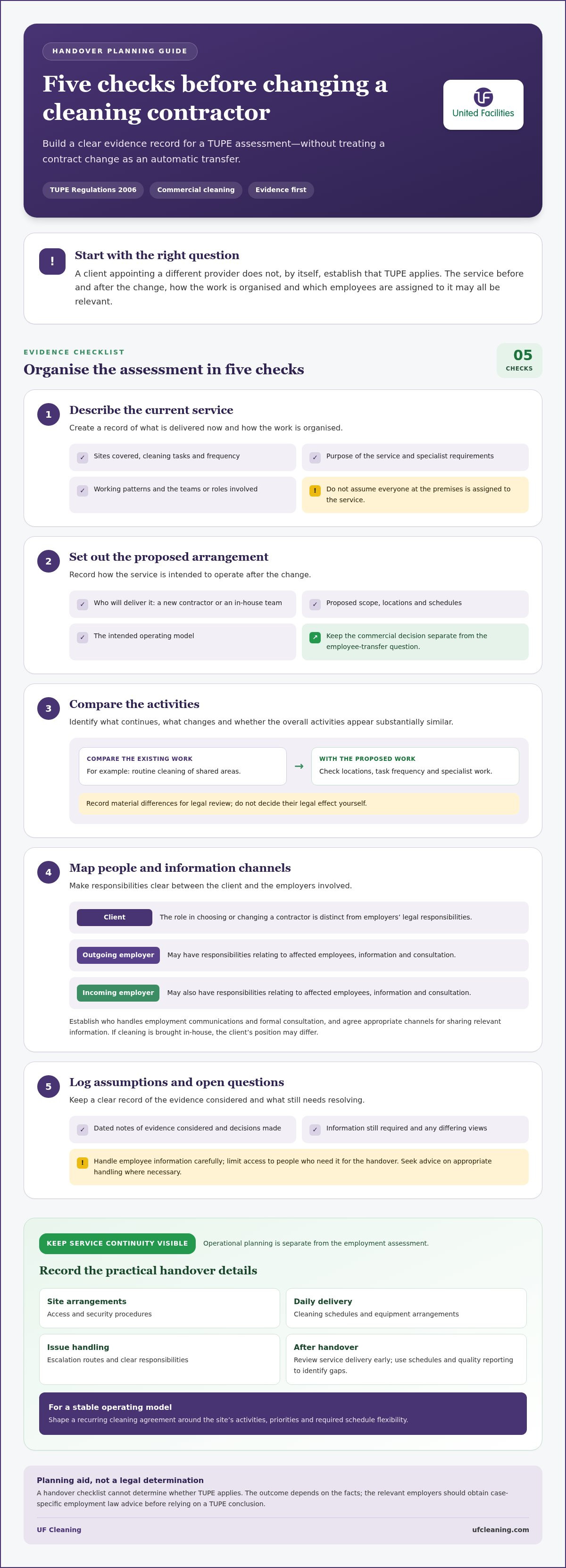
- Describe the current service. Record the sites covered, cleaning tasks, frequency, working patterns, purpose of the service and any specialist requirements. Note how the work is organised and which teams or roles are involved. Do not assume that everyone working at the premises is assigned to the service.
- Set out the proposed arrangement. Document who will deliver the service after the change, whether it will be outsourced or brought in-house, and the proposed scope, locations, schedules and operating model. Keep the commercial decision distinct from the question of employee transfer.
- Compare the activities. Identify which duties will continue, which will change and whether the overall cleaning activities appear substantially similar. For example, compare routine cleaning of shared areas with proposed changes to locations, task frequency or specialist work. Record material differences for legal review rather than deciding their effect yourself.
- Map the people and information channels. Identify the client, outgoing employer, incoming employer and staff who may be affected. Establish which employer is responsible for employment communications and formal consultation. Agree how relevant information will be discussed and shared through appropriate channels.
- Log assumptions and unanswered questions. Keep dated notes of the evidence considered, decisions made, information still required and any differing views. Handle employee information carefully and limit access to people who need it for the handover. Seek advice on appropriate handling where necessary.
- Refer the legal assessment. If facts are incomplete, the parties disagree or the proposed service differs materially from the existing one, obtain case-specific advice from a qualified employment law adviser before relying on an assumption about TUPE.
Make the comparison practical, not just contractual. A specification may use different wording while describing much the same work, or it may set out a genuinely changed service. Consider the tasks in context, how they are delivered and whether the same client activity continues. The Acas TUPE Advice guidance provides further information on transfers and employer responsibilities, but it cannot decide the outcome for a particular contract.
These steps help organise the facts behind the tupe regulations commercial cleaning contractor handover decision. They are not a legal test or a substitute for advice. Once employment questions are being managed through the appropriate channels, operational planning can proceed in parallel. For example, commercial cleaning support can be planned around the site’s schedules and service priorities, keeping continuity planning connected to the work the premises require.
TUPE handover responsibilities: compare the parties’ roles
A well-organised handover separates employment responsibilities from the client’s procurement and site-coordination tasks. If TUPE applies, the outgoing and incoming employers have responsibilities towards affected employees. The client’s decision to change provider does not, by itself, transfer those duties to the client. The division can differ when cleaning is brought in-house, so the parties should confirm their roles with qualified employment law advice.
| Party | Typical handover focus |
|---|---|
| Client | Set the cleaning scope, contract and transition dates; coordinate facilities, procurement and site teams; and share access, security and operational information through agreed channels. Monitor dependencies without directing either employer’s legal process. |
| Outgoing contractor | As the current employer, manage employee communications and applicable consultation, and provide required employee liability information to the incoming employer within the statutory timeframe. |
| Incoming contractor | As the proposed new employer, work with the outgoing employer on relevant employee information and transfer arrangements, and meet its own applicable information and consultation responsibilities. |
What should the outgoing and incoming employers coordinate?
The employers should establish a secure route for sharing relevant employee liability information (ELI), identify who will handle staff questions and agree how transfer timing and employment arrangements will be communicated. ELI generally has to be provided at least 28 days before the transfer date. Before relying on that deadline, the employers should verify it and the required information against current official guidance, particularly if the timetable changes.
Information and consultation requirements depend on the circumstances, including the parties involved and the number of affected employees. Make clear which employer is responsible for each communication. The client should not assume that consultation is its task simply because it is coordinating the contract change. Agreeing responsibilities early can reduce confusion for staff and prevent inconsistent messages about the transfer.
What should the cleaning client coordinate?
Keep procurement, facilities and site teams aligned on the contract scope, mobilisation milestones and intended service start. Share practical requirements, including site access, security procedures, cleaning schedules and escalation routes, with the relevant contractor contacts. Record who owns each action, when it is due and which employment-related matters remain with the employers.
TUPE does not automatically prevent a client from changing cleaning providers. The contract decision and the legal consequences for employees are separate questions. If the regulations apply, relevant protections may follow the transfer. A preference for different staffing arrangements or operating practices is not, on its own, a basis for changing transferred employment terms. The responsible employer should assess any proposed changes with employment law advice, rather than treating them as a routine part of mobilisation.
For a tupe regulations commercial cleaning contractor handover, a clear responsibility record links employee processes with site readiness without blurring accountability. Keep decisions, agreed communication routes, transfer dates and outstanding dependencies in one controlled handover record. Review it whenever the scope or timetable changes.
Commercial cleaning contractor handover checklist for service continuity
A carefully planned handover keeps the practical details of cleaning visible while employment matters remain with the responsible employers. Use this checklist to prepare site teams, share operational requirements and review service delivery once the new arrangement begins. Adapt each action to the premises, cleaning scope and agreed transfer date.
Before the transfer date
Bring procurement, facilities and contractor contacts together to confirm what the site needs from the first day of service. Record decisions and assign an owner and due date to each outstanding action.
- Document the service scope: list the areas, tasks, cleaning frequency and site priorities, including spaces with particular access or hygiene requirements.
- Confirm access and security: agree how cleaners will enter the premises, which areas are restricted and how keys, passes and security procedures will be managed.
- Clarify schedules and equipment: set out cleaning times, task sequencing and arrangements for the equipment needed to deliver the agreed work.
- Map operational dependencies: note site activities, events or other routines that could affect access or cleaning, and identify who can resolve conflicts.
- Set communication routes: name operational contacts, agree how issues will be escalated and establish a controlled channel for relevant handover information.
- Coordinate mobilisation: plan site inductions and familiarisation with local procedures alongside the responsible employers. Keep operational induction separate from employer-led consultation and employment communications.
On the transfer date and during the first service review
At the start of the new arrangement, confirm that access works, equipment is in place and the team understands the agreed schedule and site procedures. Set a clear route for reporting missed tasks, access difficulties or changing site requirements. Operational checks should support the agreed service plan, not replace employment processes managed by the employers.
Agree in advance how service performance will be reviewed. Decide which tasks will be checked, who will record issues, how often reports will be shared and who will approve corrective actions. Compare completed work with the schedule and identify whether recurring issues relate to access, timing, equipment or unclear instructions. Record each issue, the responsible contact and the follow-up action so concerns are addressed rather than repeatedly raised without resolution.
Real-time quality monitoring through the Taskbe platform can provide an additional view of cleaning performance during this period. Use it alongside agreed site checks and regular communication, so observations lead to practical action and the service remains aligned with the premises’ needs.
A tupe regulations commercial cleaning contractor handover involves more than changing the name on a contract. Clear schedules, defined escalation routes and measured follow-up help maintain day-to-day standards as arrangements settle. Discuss tailored cleaning schedules and quality oversight to shape a service plan around your site’s activities and priorities.
Choosing a post-handover cleaning arrangement that supports stability
Once the transition is under way, a stable cleaning arrangement depends on more than keeping the previous rota. The service should reflect how the premises are used, clarify responsibilities and provide a reliable way to review standards. These operational decisions sit alongside, not in place of, any employment processes required under TUPE.
What to assess in a continuing cleaning service
Compare service arrangements against the same practical criteria so the chosen model fits the organisation’s day-to-day requirements:
- Scope clarity: define the areas, tasks and priorities covered, including spaces that need particular attention.
- Schedule flexibility: match cleaning frequency and timing to occupancy, site activity and changes in how the premises are used.
- Quality reporting: agree how completed work and service issues will be recorded, reviewed and followed up.
- Operational support: understand how questions and emerging issues are escalated, and how support fits the organisation’s working patterns.
A tailored recurring agreement can bring these elements together in a consistent operating plan. An education site, retail environment and manufacturing facility, for example, have different patterns of use and cleaning priorities. A clear schedule can reflect those differences, while an agreed review process helps identify whether the service remains aligned as activities change.
Transparent monitoring can strengthen oversight. UF Cleaning uses real-time quality monitoring through the Taskbe platform, giving organisations a structured way to review service delivery. Monitoring is most useful when it is linked to agreed tasks, reporting arrangements and a clear process for addressing gaps. Eco-friendly cleaning products can also form part of the service approach where they align with the organisation’s requirements.
Plan the next step with UF Cleaning
UF Cleaning provides commercial cleaning support across the UK and has served organisations since 2010. Flexible schedules and 24/7 operational support can form part of a continuing arrangement, with service planning tailored to the site and its priorities. Share the type of premises, cleaning scope and transition objectives to shape a suitable schedule and recurring agreement.
A considered tupe regulations commercial cleaning contractor handover plan keeps employment responsibilities distinct from service design, while giving site teams a clear basis for monitoring standards after the change. To discuss your commercial cleaning requirements and request a free quote, outline the areas to be cleaned, preferred service pattern and key priorities. This gives you a practical starting point for an arrangement designed around how your organisation operates.
Set a clear direction for the next cleaning arrangement
A contractor change is an opportunity to set a considered operating model for the months ahead. Use the tupe regulations commercial cleaning contractor handover as a prompt to identify what the site needs from its cleaning service, including priorities that may have shifted as the organisation or premises have changed.
Turn those priorities into a practical service brief. Define the areas to be cleaned, the desired schedule, how standards will be reviewed and who should receive updates. Keep employment questions with the responsible employers, and focus the service plan on a clean, well-managed environment for the people who use the premises. A clear brief creates a constructive starting point for a tailored arrangement.
When you are ready to discuss your requirements, request a free quote for tailored commercial cleaning support. Set out your priorities and preferred service pattern to begin planning a dependable arrangement for your premises.
Frequently Asked Questions
Does TUPE automatically apply when a commercial cleaning contract changes?
No. A contract change alone does not mean TUPE applies. The outcome depends on the legal conditions and the facts, including how the cleaning service is organised before and after the change. As a practical starting point, compare the current and proposed arrangements side by side, noting differences in activities, locations and delivery. A retender is not a definitive answer. Seek qualified employment law advice if it is unclear how TUPE applies to a commercial cleaning contractor handover.
Can a client choose a new cleaning contractor if TUPE may apply?
Yes. A client can make a commercial decision to change its cleaning arrangement, but that decision does not determine what happens to employees. Keep the procurement record focused on service requirements, such as scope, schedule and performance expectations, and manage employment questions separately with the relevant employers. For example, do not present a preferred team structure as proof that no employees transfer. Obtain qualified advice before making staffing assumptions or communicating a definitive TUPE outcome.
Can a cleaner refuse a TUPE transfer?
An employee can object to transferring, but the legal consequences depend on the circumstances and applicable rules. An objection may affect whether their employment transfers and whether other rights arise, so it should not automatically be treated as a resignation. Employers should give employees a clear route to raise concerns and avoid promising a particular result before receiving advice. The client can support orderly site planning while leaving individual employment discussions to the responsible employers.
What happens if employee information is late or incomplete during a cleaning handover?
Late or incomplete employee information can leave the incoming employer with less time to plan staffing and prepare communications. The employers should identify what is missing, record when it was requested and follow up through their agreed secure channel. For example, unresolved information about working patterns may affect rota planning. The client can track operational dependencies and flag potential service impacts, but should not take over employer-led information or consultation responsibilities.
Can a cleaning contractor change employees’ terms after a TUPE transfer?
Not simply because a new contract has begun. TUPE generally protects transferred employees’ existing terms, and changes connected with a transfer can raise legal issues. Before proposing a change to hours, pay or working arrangements, the employer should establish the reason and obtain qualified employment law advice. A client’s revised cleaning schedule or service preference does not, by itself, alter an employee’s contractual terms. Keep service specifications and employment arrangements distinct during planning.
Does TUPE apply when cleaning is brought back in-house?
It may apply, but bringing cleaning in-house does not automatically trigger a transfer. The assessment depends on the service activities and workforce arrangements before and after the change, including whether an organised grouping of employees was principally assigned to the work. Before setting implementation dates or making staffing plans, document the proposed in-house model and refer uncertain points for qualified advice. This helps the organisation plan service delivery without assuming which individuals may transfer.