A cleaning contract is only as dependable as the details it puts in writing. If task lists are unclear or standards are vague, it can be difficult to resolve missed work or agree on what falls outside the service. Knowing what to look for in office cleaning contract terms helps you set clear expectations before work begins.
Consistent service depends on both parties understanding what will be done, how quality will be reviewed and how changes will be managed. A practical agreement should spell out these points, so responsibilities are clear and avoidable disputes are less likely.
This checklist covers the essential clauses to review, from cleaning tasks and schedules to quality checks, communication, extra work and notice arrangements. It also explains how to document responsibilities for access, equipment and safety, and how UF Cleaning’s Taskbe platform supports real-time quality monitoring. With these details in view, you can assess a proposal with greater confidence and rely on clear commitments rather than vague assurances.
Key Takeaways
- Learn what to look for in office cleaning contract terms, starting with the rooms, surfaces and tasks included in the agreed scope.
- Turn broad promises about cleanliness into clear standards, supported by task records, inspections and issue reporting.
- Record service times and site-access arrangements, including who manages keys, alarms, permissions and site information.
- Clarify how changes, complaints, additional work, invoicing and contract exit arrangements will be handled.
- Use the final checklist to identify blank fields, conflicting schedules and unclear approval routes before signing.
What to Look for in an Office Cleaning Contract: Define the Scope First
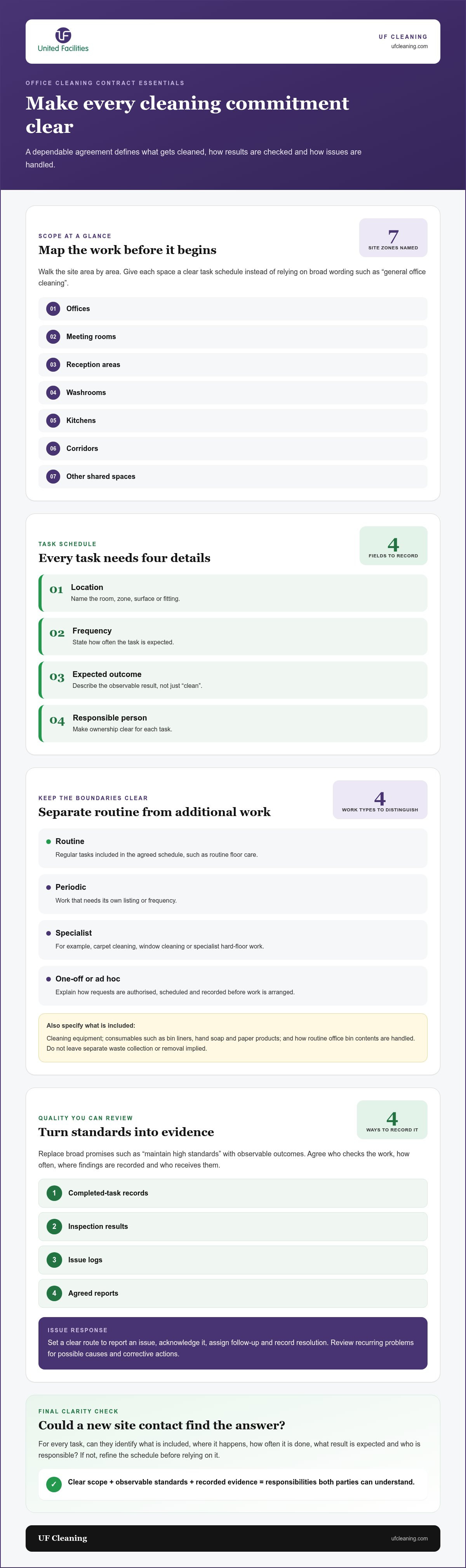
A cleaning contract records the work, standards and responsibilities agreed between the client and cleaning company. The scope should identify the premises covered and specify which rooms, surfaces and shared areas are included. A phrase such as “general office cleaning” leaves too much open to interpretation. A clear schedule shows what will be done, where and how often.
Walk through the site area by area: offices, meeting rooms, reception areas, washrooms, kitchens, corridors and other shared spaces may each have different needs. Specify relevant tasks for each, such as vacuuming a carpeted floor or wiping kitchen surfaces. Commercial cleaning covers a range of premises and tasks, so the contract should define the service for your particular site rather than rely on broad assumptions.
Separate routine work from periodic, specialist and one-off tasks. Regular floor care may be part of the routine schedule, while carpet cleaning, window cleaning or specialist hard-floor work may need a separate listing, frequency or approval process. State what falls outside the agreed scope, too, so additional requests can be discussed and recorded before they are treated as authorised work.
How should an office cleaning task schedule be written?
Use a room-by-room or zone-by-zone schedule attached to the agreement. For each task, record its location, frequency and expected outcome, as well as who is responsible. “Clean the washroom” is less useful than identifying the surfaces or fittings to be cleaned and the agreed visit frequency. If the floorplan, occupancy or use of the site changes, document how and when the schedule will be reviewed and updated.
Which exclusions and additional services should be stated?
Make the boundary between routine cleaning and specialist services explicit, including carpet, window and hard-floor work. The agreement should explain how ad hoc requests are authorised, scheduled and recorded, so expectations are clear before work is arranged.
Clarify assumptions that can otherwise cause friction: who supplies cleaning equipment, and whether consumables such as bin liners, hand soap or paper products are included. Describe how routine office bin contents will be handled, without implying that this includes separate waste collection or removal. These details make the scope practical as well as precise.
When reviewing office cleaning contract documents, use a simple test: could a new site contact identify every included task, its location, frequency and owner from the schedule? If not, refine the scope before relying on it.
Set Measurable Office Cleaning Standards and Quality Checks
A contract that promises to “maintain high standards” sounds reassuring, but gives neither party a consistent way to judge the work. Set out observable outcomes instead, then agree how they will be checked and what happens when a shortfall is identified. For example, describe what a cleaned kitchen surface should look like rather than relying on a general impression of cleanliness.
Measurable standards need evidence and a response process. Evidence could include completed-task records, inspection results, issue logs and agreed reports. Specify how often inspections take place, who carries them out, where results are recorded and which contacts receive the findings. Schedule review meetings at an agreed frequency so both sides can consider patterns, not just isolated comments.
What makes an office cleaning standard measurable?
Choose criteria that can be observed in the areas covered by the service. For example, an inspection could record whether agreed surfaces have been cleaned or a task completed as scheduled. Avoid assuming one universal pass mark suits every office. Agree standards that reflect the site and the contracted work.
Identify who reviews the evidence and how often, then distinguish these service measures from broad satisfaction statements. Feedback matters, but “the office feels clean” can mean different things to different people and is difficult to assess consistently without agreed criteria.
How should missed tasks and service issues be handled?
Set out a straightforward route for reporting an issue, acknowledging it, assigning follow-up and recording its resolution. The agreement can also explain how recurring problems trigger a review of possible causes and corrective actions, with responsibility and next steps noted. This makes the process clear without treating every concern as the same type of failure.
UF Cleaning uses Taskbe for real-time quality controls, supporting accountability with current service information. Agree how quality information will be shared and reviewed as part of the service arrangement, so records lead to clear communication and follow-through.
UF Cleaning’s office cleaning services use real-time quality controls to support recurring service. The key points to define in the contract are the expected result, the evidence used to assess it and the agreed route for addressing issues. These should be clear to the people managing the site.
Check Office Cleaning Schedules, Site Access and Responsibilities
A well-defined cleaning schedule needs to work alongside the practical arrangements for entering and operating within the premises. Record the agreed service days and time windows, including any arrangements for cleaning outside normal opening hours. Explain what happens if access is unavailable, a visit is disrupted or a member of the cleaning team is absent, and how replacement cover will be arranged or communicated.
Clear site responsibilities make reliable service delivery easier to maintain. Set out who provides and manages keys, alarm details and access permissions, and who shares changes to those arrangements. Identify restricted areas, the process for authorising entry and the relevant site contact if an issue arises.
What operational details belong in the agreement?
List the authorised contacts for day-to-day matters and escalation, along with the agreed route for urgent operational updates. Explain how changes to opening hours, occupancy or access to particular areas should be communicated and recorded. A documented handover process helps ensure relevant site information reaches the people coordinating the service, including when contacts or arrangements change.
Record arrangements for site induction and the information needed before work begins. If a room is temporarily unavailable or an event affects access, make clear who notifies whom, how the affected work is handled and whether a revised visit or schedule needs approval.
How should health, safety and compliance responsibilities be recorded?
Describe how relevant site hazards and safe working arrangements will be shared, updated and acknowledged. This may include information about restricted areas, changing conditions or cleaning products used on site. Specify the appropriate contacts and communication route so updates are passed on rather than left to informal assumptions.
References to COSHH or HSE materials should be reviewed for relevance to the work, site and current guidance before they are included. Mentioning them alone does not establish that one particular document is a universal contractual requirement. Record the arrangements that are appropriate to the circumstances.
Staff absence, restricted access and disruption all benefit from the same clarity. State how the parties will communicate a change, who decides on the next step and how the agreed arrangement will be recorded. A schedule is only dependable if access, updates and responsibilities are understood by everyone involved.
Understand Office Cleaning Contract Terms for Changes, Complaints and Exit
Even a carefully scoped service may need to adapt as occupancy, opening hours or business priorities change. The agreement should explain how a proposed variation is raised, who can approve it and when it takes effect. Record each agreed change in writing, including any impact on the schedule, responsibilities or service fees, so everyone can refer to the current arrangement.
Check that the commercial terms are equally clear. The agreement should explain the invoicing basis, when invoices are issued and how additional work is described and authorised before it proceeds. Set out a route for complaints, escalation and corrective action, with review points for discussing unresolved or recurring concerns.
How can a contract reduce uncertainty about changes and extra work?
A written change-control process should identify who may request a change, who approves it and its effective date. For extra work, record the task, location, timing and any agreed fee before delivery. Changes to occupancy or the cleaning schedule can then be assessed consistently rather than managed through informal requests. TUPE may be a relevant UK employment consideration in some service-transfer circumstances. Its applicability depends on the situation and should be reviewed with a qualified legal adviser.
Which renewal, notice and termination points deserve attention?
Locate the initial term, review dates, renewal mechanism and notice periods, and make sure the wording explains what action is needed and by when. At exit, check how outstanding invoices, unresolved service issues, access arrangements and any agreed handover will be managed. The agreement should make responsibilities during the transition clear to both parties.
Reviewing contract terms also means recognising where a clause needs interpretation. Its effect can depend on the agreement as a whole and the circumstances, so seek qualified legal advice about specific wording rather than treating this checklist as legal advice.
Clear terms create a steadier basis for communication as service needs evolve. UF Cleaning’s office cleaning services support recurring workplace cleaning through coordinated service arrangements.
Use This Office Cleaning Contract Checklist Before You Sign
A final review helps confirm that the written agreement reflects the service discussed, rather than leaving important details to assumption. Use this checklist alongside the proposal and any attached task schedules. Resolve blank fields, conflicting schedules and undefined approval routes before signing, and ensure agreed changes appear in the final documents.
What should the final pre-signature checklist include?
- Scope: Check that each included area and recurring task is listed clearly, with exclusions and specialist or additional work distinguished from routine cleaning.
- Standards: Confirm that expected outcomes can be assessed and that records, inspections or other agreed evidence are understood.
- Issue handling: Make sure reporting, follow-up, escalation and review responsibilities are clear.
- Schedule and access: Check that service times and access arrangements align across the contract and its attachments.
- Responsibilities: Identify the relevant contacts and how site updates, access changes and operational issues will be communicated.
- Terms: Review the invoicing basis, approval process for additional work, change procedure, renewal, notice and exit arrangements.
Read the documents together. If the proposal describes a task that is missing from the contract or schedule, have the discrepancy resolved in writing. Do the same if two documents give different service times or fail to identify who can approve extra work. A clear record reduces the chance of differing expectations later.
How can the agreement support a dependable long-term service?
Clear responsibilities and agreed review routines give both parties a practical reference as the workplace changes. UF Cleaning provides flexible schedules, real-time quality controls through Taskbe and 24/7 operational support, each relevant to a different aspect of service coordination. UF Cleaning has served organisations since 2010, bringing established experience to recurring office cleaning and facilities support.
A clear agreement connects the service promised with the way it will be assessed and the process for managing change. That structure supports continuity because everyone can refer to the same documented expectations.
UF Cleaning’s commercial cleaning support brings together recurring cleaning and facilities support for organisations.
Make Your Cleaning Agreement Clear and Dependable
A well-prepared office cleaning contract turns expectations into a practical framework for consistent service. Before signing, make sure the scope and task schedule match the proposal, quality standards can be assessed, and responsibilities for access, communication and service changes are clear. Review the terms for additional work, complaints, renewal and notice as well, so fewer questions are left unanswered once delivery begins.
Knowing what to look for in office cleaning contract terms means assessing more than the cleaning tasks alone. It also means understanding how service quality will be monitored and how changing workplace needs can be managed. UF Cleaning has served organisations since 2010, with real-time quality controls through the Taskbe platform, flexible schedules and 24/7 operational support.
Clear agreements support calm, dependable working relationships. UF Cleaning’s commercial cleaning support brings a considered approach to maintaining a well-cared-for workplace.
Frequently Asked Questions
What should be included in an office cleaning contract?
An office cleaning contract should set out the premises and areas covered, the agreed tasks and frequencies, expected standards, service times and each party’s responsibilities. It should also explain how quality is recorded, how issues are raised, and how additional work, changes, invoicing, renewal and notice are handled. Attach a clear task schedule where useful. Compare the written agreement with the proposal before signing.
Is a cleaning schedule part of an office cleaning contract?
Yes, a cleaning schedule can form part of the contract or be attached as a supporting document. It should identify the relevant rooms or zones, the tasks for each area, how often they are completed and the expected outcome. State how schedule changes will be agreed and recorded if the workplace layout, occupancy or access arrangements change.
Can an office cleaning contract include performance measures?
Yes, the agreement can describe observable service outcomes and how they will be assessed. For example, it could specify inspection frequency, the person responsible for reviews and how results or missed tasks are recorded. Evidence might include completed-task records, inspection findings and issue logs. Clear measures make service discussions more consistent than broad statements such as “high standards”, which can mean different things to different people.
How should a contract handle additional cleaning work?
The contract should explain how additional work is requested, described, approved and scheduled before it begins. Record the task, the area involved, the agreed timing and any applicable fee in writing, along with who has authority to approve it. This separates one-off requests from routine duties and reduces misunderstandings about whether a specialist task, such as carpet or window cleaning, is already within the agreed scope.
What happens if the agreed office cleaning standard is not met?
The agreement should provide a clear process for reporting and addressing a service issue. It can identify the appropriate contact, how the concern is recorded, who follows it up and how corrective action is reviewed. If a problem recurs, the parties can use the agreed review process to examine its cause and record next steps. The precise response depends on the contract, so check its wording rather than assuming a particular remedy.
How long should an office cleaning contract last?
There is no single suitable contract length for every organisation. The term should reflect the service arrangement and give both parties a clear basis for planning, review and changes in requirements. Check the initial term, review dates, renewal process and notice period, including when notice must be given. If you’re unsure how a particular term affects your organisation, seek qualified legal advice before agreeing to it.
Can an office cleaning contract be changed after it is signed?
It can be changed if the parties agree to a variation under the contract’s terms. A written change process should identify who can request and approve a change, what details need to be recorded and when the revised arrangement takes effect. Document changes to tasks, frequency, service times or access rather than relying on informal conversations. For advice on the effect of a specific clause, consult a qualified legal adviser.