
The lowest cleaning quote can become the least predictable commitment. Hidden costs in commercial cleaning contracts often arise when the headline fee doesn’t reflect the full service scope, recurring requirements or work charged separately. A proposal may look straightforward, but unclear responsibilities for supplies, extra tasks and schedule changes can make budgeting difficult and leave operational teams managing avoidable gaps.
Look beyond the initial figure. The value of an agreement depends on what’s included, how service quality is monitored and whether the arrangement supports consistent standards across your premises. This guide explains where direct charges and less visible costs can arise, and how to compare proposals using consistent assumptions and performance measures.
You’ll learn what to examine in the scope of work, how to clarify responsibility for supplies and additional tasks, and why service consistency matters to wider operations. Recurring cleaning agreements can make planning clearer when schedules and inclusions are defined, while real-time quality monitoring helps make delivery more visible over the life of the contract.
Key Takeaways
- Look beyond the headline fee to distinguish contract add-ons from indirect costs caused by service gaps or unclear responsibilities.
- Use the review prompts to identify where hidden costs in commercial cleaning contracts could arise, without assuming every contract includes the same charges.
- Compare proposals using consistent assumptions, including tasks, cleaning frequency, supplies, exclusions and quality oversight.
- Before agreeing an arrangement, clarify the scope, document assumptions, define how changes are approved and establish how service quality is reported.
- See how tailored daily or weekly cleaning, included eco-friendly supplies and real-time quality monitoring can support clearer contract planning.
Hidden Costs in Commercial Cleaning Contracts: What Counts Beyond the Headline Fee?
A headline fee is only meaningful when it describes the work your premises need. Hidden costs in commercial cleaning contracts include charges outside the stated fee and operational burdens that arise when the agreed service doesn’t meet site requirements. A separate charge may appear on an invoice; an indirect cost can show up as staff time spent raising issues, disruption to daily operations or remedial cleaning.
Assess these categories together, but don’t confuse them. A separately billed task is a contractual cost to identify in the terms. Time spent arranging a missed task is an indirect cost, even if no additional cleaning charge appears. Neither is inevitable. Both depend on the written scope, the allocation of responsibilities and the needs of the building.
Direct charges versus indirect costs
Direct charges are items billed separately or fees triggered by particular circumstances. Depending on the agreement, these might include periodic carpet or window cleaning, consumables, extra work beyond the regular schedule or a change to service requirements. They’re not automatically hidden or unreasonable, but they’re difficult to budget for if the contract doesn’t state what is included and how additional work is authorised.
Indirect costs are less visible. If a task is missed or ownership is unclear, a facilities manager may need to inspect the area, follow up, rearrange access or organise remedial work. Repeated lapses can also affect how staff and visitors experience the premises. These impacts aren’t fixed charges, so assess them against your site’s operating needs and the service standards in the agreement.
Why the headline fee can mislead
Two proposals can have different headline figures because they describe different levels of service. One may cover more frequent cleaning in high-use areas, while another assumes fewer visits or limits the tasks performed at each visit. Comparing totals without aligning those assumptions risks treating a narrower scope as better value.
Inclusions matter, too. If one proposal includes routine supplies and another leaves them to the client, the headline figures don’t represent the same commitment. The same applies to periodic tasks: an area may appear covered in a general description, while its detailed cleaning frequency or method remains unspecified. Record these differences rather than assuming similar wording means equivalent service.
Total contract cost is the combined financial and operational commitment required to deliver the agreed cleaning scope, including separate charges and the effort needed to manage service gaps.
A useful review looks beyond the fee to four connected questions: what tasks are covered, what assumptions shape the proposal, how delivery is monitored and how changes are handled. Make the scope specific enough to distinguish routine work from additional requests, and identify who is responsible for supplies and approvals. This gives you a sound basis for comparing like-for-like proposals and understanding where extra charges or avoidable management effort could arise. Next, examine the contract wording and service arrangements for particular risks. These are review prompts, not charges found in every agreement.
Which Cleaning Contract Charges and Service Gaps Can Increase the Total Commitment?
Potential costs are easiest to assess when grouped by their source: contract wording, changes to site operations and consistency of service delivery. The examples below are prompts for review, not charges that appear in every agreement. Their relevance depends on the written scope and how your premises are used.
Contract wording and task boundaries
Broad descriptions such as “clean all common areas” can be interpreted in different ways. Does this include every entrance, stairwell and shared kitchen? How often should each be cleaned? If the agreement doesn’t define tasks, locations and frequencies, your expectations may extend beyond the agreed scope. A task could then become an additional request, or a site team may spend time resolving a gap neither party had clearly allocated.
Look for clear boundaries between routine cleaning and periodic or specialist work. Carpet and window cleaning, for example, may sit outside a general maintenance schedule unless expressly included. Event-related requirements need definition, too. Specify which work forms part of the regular service and how extra tasks are requested, approved and recorded.
Supplies, working hours and additional tasks
Consumables can be included, supplied by the client or listed separately. Identify which arrangement applies and what products or items the contract covers. A general reference to “supplies” may not clarify whether it means cleaning products, washroom consumables or both. Recording the boundary helps prevent assumptions from becoming unplanned expenditure or last-minute procurement work.
Check how the agreed cleaning window is described, including any access or scheduling assumptions. If operating hours, building use or access arrangements change, the contract should explain how a revised schedule is discussed and authorised. This makes the effect of a change visible before it becomes an ongoing expectation.
For each additional task, establish what triggers it, who can approve it and how the change is documented. A clear process gives facilities teams a record of what was requested and helps distinguish a one-off requirement from a lasting change to the service.
Service delivery and the indirect cost of inconsistency
Missed tasks can create work that never appears as a separate cleaning charge. Staff may need to inspect areas, report omissions, follow up on remedial work or adjust site routines. Inconsistent presentation can also affect how employees and visitors experience the premises. A charge is a separately billed amount triggered by the agreement; an operational cost is the time, disruption or remedial effort caused by a gap in delivery.
Set out how completed work and service quality will be reviewed, who receives updates and how concerns are logged and resolved. A defined reporting approach makes delivery more visible and can help identify recurring issues before they require repeated intervention. The Cleaning Industry Management Standard (CIMS) provides a framework relating to quality, efficiency and customer satisfaction, useful reference points when setting clear service expectations. You can also document site-specific access instructions and responsibilities for communicating them to cleaning teams.
For a practical example of defined scope, recurring schedules and quality oversight working together, explore UF Cleaning’s commercial cleaning arrangements.
How to Compare Commercial Cleaning Contracts on Like-for-Like Value
A useful comparison starts by making each proposal answer the same questions. If one quote covers more areas, more frequent visits or additional quality oversight, its headline figure isn’t directly comparable with a proposal based on narrower assumptions. Align the service first, then assess the overall commitment and how clearly each provider’s responsibilities are defined.
Build a like-for-like scope comparison
List the areas to be cleaned, the tasks required in each area, how often they’re scheduled and the agreed service window. Separate routine maintenance from specialist or one-off work so occasional requirements don’t disappear inside a broad description. Record whether labour, eco-friendly supplies and quality monitoring are included, excluded or described separately. Matching the scope makes quote comparisons more useful because each proposal is assessed against the same work, frequency and inclusions.
A simple comparison template can keep assumptions visible:
- Areas and tasks: Proposal A | Proposal B
- Visit frequency and service window: Proposal A | Proposal B
- Labour and supplies: Proposal A | Proposal B
- Periodic or specialist work: Proposal A | Proposal B
- Quality monitoring and reporting: Proposal A | Proposal B
- Exclusions and change process: Proposal A | Proposal B
Fill in each field using the written proposal, not assumptions based on a brief conversation or a general service description. Mark every difference clearly. For instance, if one proposal includes regular attention to a particular area and another leaves the frequency open, resolve that distinction before treating the figures as comparable. This helps show whether an apparent saving reflects a genuine difference in value or simply less work.
Compare accountability and service visibility
Scope describes what should happen; accountability explains how delivery is made visible. Compare how the proposal defines quality expectations, records completed work, reports concerns and escalates unresolved issues. A clear process gives site teams a practical way to monitor service, rather than leaving them to rely on informal follow-up. Note how schedule changes and additional requests are approved and recorded, too, so evolving needs don’t become ambiguous ongoing commitments.
Consider whether the proposal explains who reviews service information and how that review informs follow-up. A record of completed tasks, for example, is more useful when responsibilities for reviewing exceptions and addressing recurring concerns are also clear. Keep your evaluation focused on the arrangements documented for your premises, including site-specific procedures that affect access, task delivery or communication with the cleaning team.
Once the entries are aligned, review the full picture instead of selecting on the lowest headline figure alone. Consider the completeness of the scope, the treatment of supplies and additional work, and the visibility of service quality. This disciplined comparison gives decision-makers a clearer basis for judging total value and identifying assumptions to settle before an agreement begins.
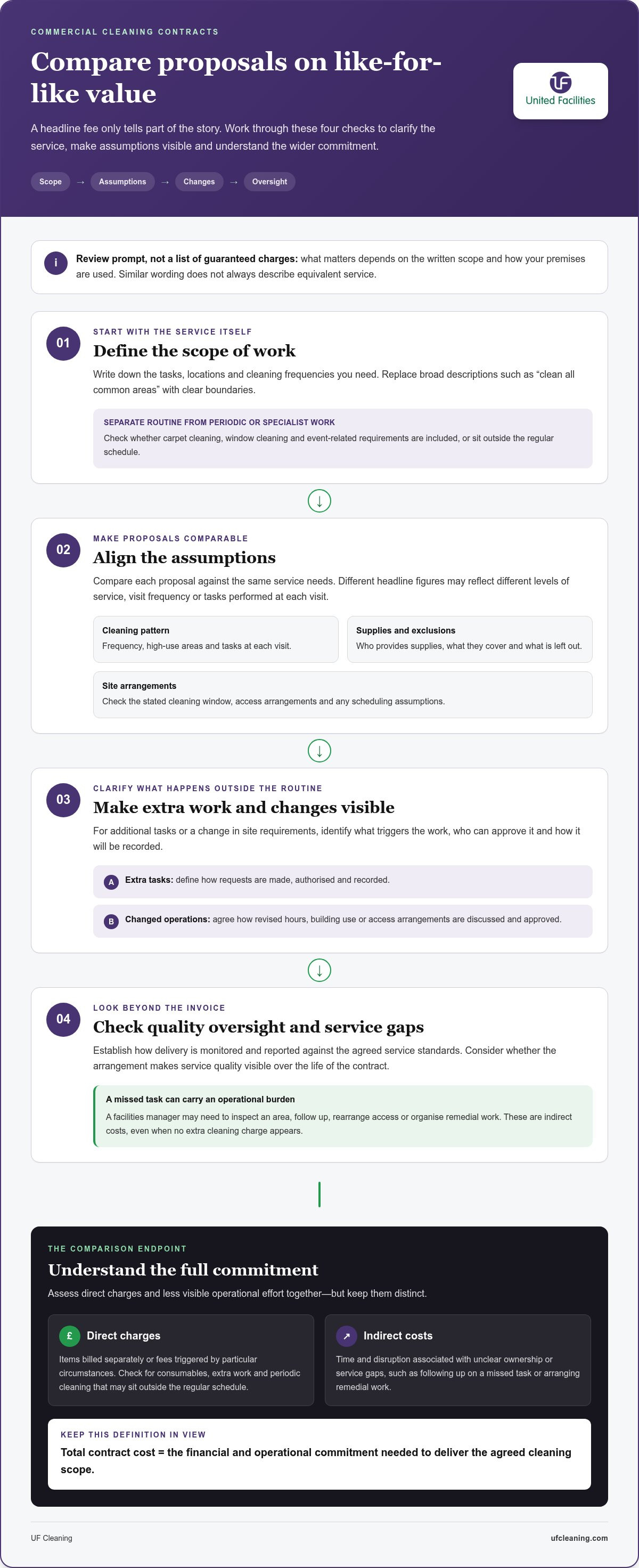
A Practical Checklist for Reviewing Contract Scope, Changes and Oversight
A careful review before agreeing an arrangement can clarify expectations from the outset. Use the steps below to check that the written scope reflects how the premises operate, and that changes and service quality have a defined process. This turns potential hidden costs in commercial cleaning contracts into specific points to resolve, rather than assumptions to manage later.
- Match the specification to site use. List the areas that need attention and the tasks required in each. Consider how occupancy and patterns of use affect the required frequency, then check that the proposed schedule reflects those needs rather than relying on broad descriptions.
- Record inclusions and exclusions. Set out which routine tasks, labour and supplies are included, and identify any consumables or specialist work handled separately. If periodic tasks such as carpet or window cleaning are relevant, describe their scope clearly rather than assuming they form part of routine maintenance.
- Write down the assumptions. Capture practical conditions that shape delivery, such as access arrangements and the agreed cleaning window. Note what happens if these requirements change, including how a revised schedule or service scope is documented and approved.
- Define authority for additional work. Specify who can request and approve extra tasks, how the request is recorded and how the agreed change is reflected in the service arrangement. This gives site teams a clear way to manage new requirements without allowing informal requests to become ambiguous ongoing expectations.
- Set out quality reporting and follow-up. Describe how completed work and service quality will be monitored, where issues are logged, who is responsible for responding and how unresolved concerns are followed through. The process should make it possible to see both the issue and its progress towards resolution.
Make oversight part of the agreement
Quality expectations are most useful when they can be reviewed consistently. Agree what evidence of delivery will be available and how often performance will be reviewed, so recurring concerns can be distinguished from isolated issues. Real-time monitoring can make service delivery more visible; UF Cleaning uses the Taskbe platform for real-time quality monitoring. Define how quality information will be used to discuss and address service gaps, rather than treating reporting as an end in itself.
Keep the final review practical: can the site team identify what is covered, what requires approval and how to raise an issue? If any answer depends on an unwritten assumption, refine the documentation before service begins. Clear scope and oversight support predictable day-to-day operations and help both parties understand their responsibilities.
For a cleaning arrangement shaped around your site’s requirements, explore UF Cleaning’s recurring commercial cleaning services.
How UF Cleaning Makes Commercial Cleaning Contracts Easier to Manage
A well-defined cleaning agreement should make the service, its regular requirements and its quality oversight easier to understand. UF Cleaning’s recurring commercial cleaning agreements cover daily or weekly maintenance, with schedules tailored to site requirements. This provides a practical starting point for setting out what needs attention and how regularly, rather than relying on a generic routine that may not suit how a building is used.
A tailored recurring service with visible quality controls
Flexible schedules can be aligned with an organisation’s operating needs, while a clearly described scope helps establish which tasks form part of the regular service. Labour and eco-friendly supplies are included in recurring agreements, bringing these elements into the service plan and helping teams understand the arrangement they’re managing.
Quality oversight matters throughout the agreement, not only at set-up. UF Cleaning uses the Taskbe platform for real-time quality monitoring, making service delivery more visible over time. Organisations can use quality information as part of ongoing oversight rather than relying solely on occasional feedback. Monitoring supports visibility; it doesn’t replace clear expectations and a shared process for addressing issues.
UF Cleaning also provides 24/7 operational support when operational matters need attention. Defined recurring service, included supplies, real-time monitoring and operational support can make responsibilities more straightforward to plan and review. These features matter when assessing hidden costs in commercial cleaning contracts, because clarity about service components and oversight helps organisations understand what their arrangement covers.
Plan the next step around your site requirements
To shape a useful cleaning scope, bring together a concise picture of the site and its priorities. Consider:
- The premises and areas that need regular cleaning.
- Whether daily or weekly maintenance best fits site use.
- Key cleaning priorities, including any areas that need particular attention.
These details connect the schedule and scope to the way your organisation operates. They also provide a clear basis for discussing service expectations, supplies and quality oversight, so the proposed arrangement reflects practical requirements rather than assumptions. If site needs change, a documented scope and review process can help keep the service plan aligned.
UF Cleaning has served organisations since 2010, bringing experience in recurring commercial cleaning to arrangements planned around each site. A useful discussion can start with the premises, the required frequency and the outcomes that matter most to your team. From there, the cleaning scope can be shaped around your operational priorities.
For a tailored scope, request a free commercial cleaning quote.
Make Your Next Cleaning Agreement Work in Practice
A commercial cleaning agreement should support the way your organisation operates, not simply record a service requirement at the point of purchase. Treat the scope as a working reference. As site use evolves, keep responsibilities, priorities and approval processes aligned so expectations remain clear. This forward-looking approach helps prevent hidden costs in commercial cleaning contracts from becoming unexpected demands on budgets or staff attention.
Turn your site’s needs into a clear starting brief. Consider which areas matter most, how the premises are used and what a dependable service should make easier for your team. A tailored discussion can translate those priorities into a practical cleaning scope, with clear expectations from the outset.
UF Cleaning has served organisations since 2010, and its recurring agreements bring together flexible schedules, labour, eco-friendly supplies, Taskbe real-time quality monitoring and 24/7 operational support. Request a free, tailored cleaning quote from UF Cleaning and take a considered step towards a more predictable arrangement for your premises.
Frequently Asked Questions
Is the lowest commercial cleaning quote always the cheapest option?
No. Quotes can describe different task lists, visit frequencies, supply arrangements and levels of quality oversight, so their headline figures may not represent the same service. For example, a proposal covering washrooms on every visit isn’t directly comparable with one that leaves the frequency unspecified. Align the assumptions first, then consider the complete service commitment and its fit with your premises. A higher quote isn’t automatically better value either.
What should be included in a commercial cleaning contract?
A clear agreement should set out a written service specification covering the areas to be cleaned, tasks, frequency and service windows. It should distinguish inclusions from exclusions, state how consumables are treated and explain how quality reporting works. For instance, if a reception area needs attention more often than meeting rooms, record that difference rather than relying on a broad phrase such as “general cleaning”. Include a process for recording changes and additional work.
Can cleaning supplies be charged separately under a commercial cleaning contract?
Yes, depending on the agreed scope and contract wording. A proposal may include supplies, list them separately or exclude them from the service. Compare proposals using the same assumptions, and identify who is responsible for ordering and replenishing items such as washroom consumables. This helps distinguish cleaning products used to deliver the service from supplies intended for staff or visitors, and reduces uncertainty about who manages each requirement.
How much do hidden costs in commercial cleaning contracts add?
There’s no single reliable figure: the total depends on site requirements, the agreed scope, supply arrangements, working patterns and changes during the contract. A building that adds areas or alters its schedule may have different needs from one whose requirements remain stable. Rather than relying on a general estimate, review the written scope alongside the assumptions behind each proposal. A like-for-like comparison gives a more useful view of the full commitment.
What happens if a business needs to change its cleaning schedule?
The outcome depends on the agreement’s change process and how the revised schedule affects the scope and delivery of the service. For example, a change to building access may affect when tasks can be completed, even if the task list remains the same. Record who can approve a change, when it takes effect and how altered work is documented. This gives both parties a clear reference if expectations later differ.
Are eco-friendly cleaning supplies included in a commercial cleaning contract?
That depends on the contract scope, so the proposal should state clearly which supplies are covered and who manages replenishment. UF Cleaning includes eco-friendly supplies in its recurring service agreements. If you’re comparing proposals, use consistent assumptions about the products and replenishment responsibilities; otherwise, one arrangement may appear to cover more than another. Clear wording also helps your team plan what it needs to provide or manage on site.
How can a business monitor cleaning quality after signing a contract?
Agree how service standards will be assessed, how completed work is reported and how issues are raised, assigned and followed through. For example, a site team can record a missed task and review its resolution through the agreed reporting process. Monitoring makes delivery more visible, but it works best alongside a clearly defined scope. UF Cleaning uses Taskbe for real-time quality monitoring, supporting ongoing visibility without guaranteeing a particular outcome.