
A spotless inspection does not tell the whole story. To understand how to measure commercial cleaning performance, look beyond a single visit: consistent results depend on clear standards, evidence gathered over time and action when something falls short.
Performance reviews can feel subjective when expectations are unclear, recurring issues appear between inspections or a long list of metrics creates more admin than insight. A focused scorecard built around your facility’s priorities makes reviews clearer and more constructive.
This guide explains how to choose meaningful cleaning KPIs, collect reliable evidence and use results to support practical improvements. Consistent inspections, task completion records and feedback can build a balanced picture, rather than letting one observation define performance.
Ongoing measurement makes trends easier to recognise and discuss. UF Cleaning uses the Taskbe platform for real-time quality monitoring, supporting a considered approach to service delivery. The sections ahead explain how to connect standards with evidence, review performance fairly and agree clear next steps when results improve or need attention.
Key Takeaways
- Define performance against agreed site requirements, considering service quality, reliability, responsiveness and resource use.
- Learn how to measure commercial cleaning performance with a focused set of KPIs, each supported by clear evidence and a suitable review period.
- Compare inspections, task records, issue logs and user feedback to understand what each source reveals and where it has limitations.
- Use a step-by-step review process, assigning responsibility for each measure and turning trends into practical next actions.
- See how flexible cleaning schedules and UF Cleaning’s real-time quality monitoring through Taskbe can support ongoing service reviews.
What does commercial cleaning performance actually measure?
Commercial cleaning performance is how well the service meets agreed site requirements, delivers consistently and responds when an issue is identified. It is not simply whether a space looks clean during one inspection. A fair assessment considers what was specified, what was completed and whether the standard is maintained across relevant areas and visits.
That assessment has several dimensions. Service quality concerns visible cleanliness and hygiene observations against the agreed specification. Operational reliability considers whether scheduled work is completed and recorded. User experience captures how staff, visitors or guests experience the environment. Resource efficiency looks at how time and effort are used to deliver the required service, rather than rewarding speed at the expense of quality.
A single overall score can conceal important differences. A strong result in corridors could mask a recurring shortfall in washrooms, while a site-wide average may hide a problem limited to a particular shift. To understand how to measure commercial cleaning performance, break results down by relevant space, task or service period. This makes patterns easier to interpret and gives reviews a practical focus.
The agreed cleaning specification should guide what you measure, while reflecting how the facility is used and the consequences of missed tasks. The broad purposes and methods of cleaning vary by context, as outlined in the concept of cleaning. For a scorecard, the useful question is more specific: which outcomes matter in this facility, and what evidence will show whether they are being achieved?
Which outcomes should a commercial cleaning scorecard reflect?
Start with observable outcomes linked directly to the specification, such as floor appearance, washroom condition or completion of agreed tasks. Pair these with evidence that scheduled work took place and a record of how identified issues were handled. Stakeholder feedback can reveal concerns an inspection misses, but it should not replace consistent checks against agreed standards.
A useful cleaning performance measure links an agreed site outcome to consistent evidence collected over a defined period. This keeps the scorecard focused: each measure should help explain whether the service is meeting a priority or where follow-up may be needed.
Why do facility priorities change the definition of good performance?
An office may prioritise presentable shared spaces and dependable daily routines; a hotel may place greater weight on guest-facing areas and room readiness. Education sites and high-footfall venues have different patterns of use, so the areas and tasks needing attention may differ. The same generic checklist will not necessarily describe good performance in each setting.
Operating hours and occupancy also affect when an inspection provides useful evidence. A check before a busy period may show preparation, while one afterwards may reveal how well standards held up under use. Align inspection timing with the facility’s activity and agreed priorities, so findings reflect real conditions rather than a convenient but unrepresentative moment.
Which commercial cleaning KPIs give a balanced view of performance?
A useful KPI set is small enough to review consistently, yet broad enough to show whether work is being completed to the expected standard. For each measure, document what is counted, what it is compared with, where the evidence comes from and how often it is reviewed. This makes the results interpretable instead of turning the scorecard into a collection of unrelated figures.
A balanced KPI set is stronger than a single score because it shows not only whether the service is on track, but where attention may be needed. Set thresholds from the agreed service requirements and an initial baseline, then refine them as the facility’s needs become clearer. Avoid applying a universal target to sites with different tasks or patterns of use.
Which indicators show quality, reliability and responsiveness?
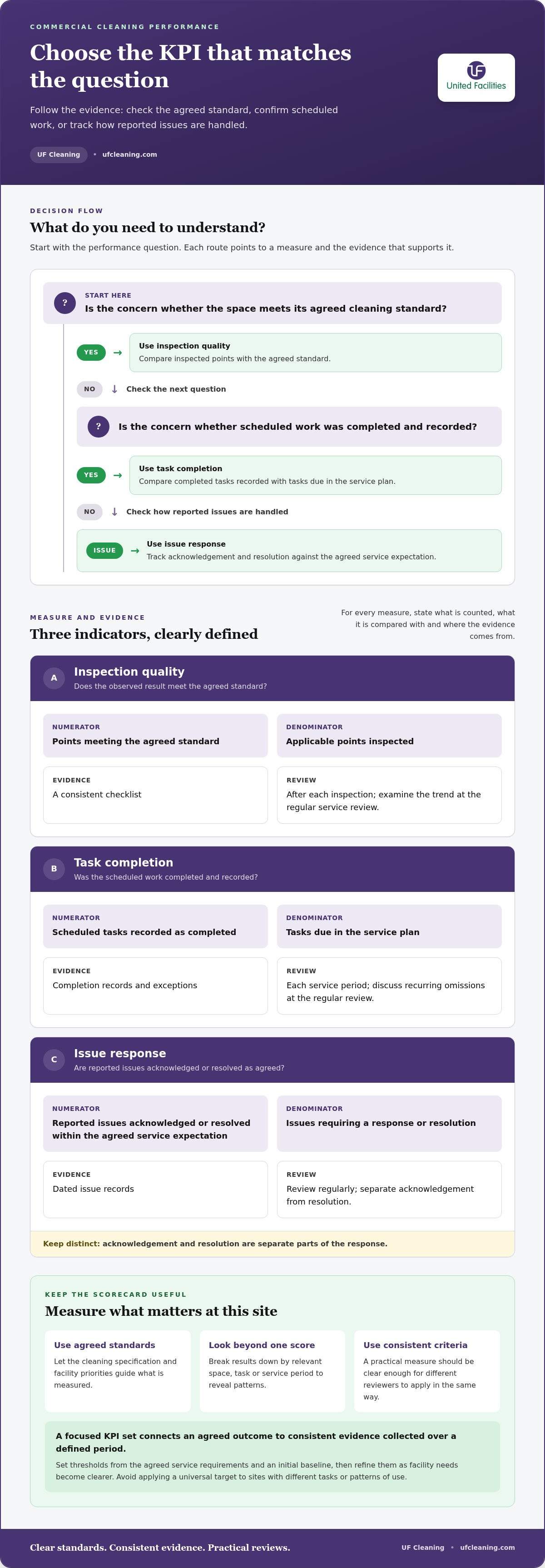
Use consistent criteria for quality inspections, and record scheduled work and reported issues against the service plan. A practical measure should be clear enough for different reviewers to apply in the same way.
- Inspection quality: Numerator: points meeting the agreed standard. Denominator: applicable points inspected. Evidence: a consistent checklist. Review: after each inspection, then examine the trend at the regular service review.
- Task completion: Numerator: scheduled tasks recorded as completed. Denominator: tasks due in the service plan. Evidence: completion records and exceptions. Review: each service period, with recurring omissions discussed at the regular review.
- Issue response: Numerator: reported issues acknowledged or resolved within the agreed service expectation. Denominator: issues requiring a response or resolution. Evidence: dated issue records. Review: regularly, separating acknowledgement from resolution so one does not obscure the other.
How can productivity and feedback measures be used responsibly?
Efficiency measures are most useful when they provide context, not pressure to work faster. Area cleaned per labour hour, for example, should only be compared across spaces with similar layouts, tasks and service requirements. Pair it with quality and completion evidence: speed alone cannot show whether the required work was done well.
- Productivity: Numerator: comparable area cleaned. Denominator: labour hours assigned to that work. Evidence: area records and time records. Review: over a consistent period, comparing like-for-like spaces and tasks.
- User feedback: Numerator: favourable responses, if using a consistent rating question. Denominator: valid responses to that question. Evidence: the same survey or feedback method. Review: at a set interval, looking for recurring themes as well as the overall result.
- Labour plan variance: Numerator: actual labour hours minus planned hours. Denominator: planned hours. Evidence: schedules and time records. Review: each reporting period, investigating changes alongside quality and completion results.
Feedback can highlight a missed concern, but it represents respondents’ experiences rather than a complete inspection of the site. Combine it with operational evidence to make a fair assessment. UF Cleaning’s flexible commercial cleaning schedules can be aligned with agreed priorities. Find out more about commercial cleaning support and how it can fit into a considered service review.
How should you compare cleaning inspections, service data and feedback?
No single evidence source gives a complete account of cleaning performance. An inspection shows conditions in selected areas at a particular time; service records indicate what was scheduled and recorded; issue logs reveal where problems were reported; and user feedback describes people’s experience. Compare them together, using the same site areas, tasks and review periods wherever possible.
This matters when results appear to conflict. Completion records may show a task as finished, while an inspection identifies a missed detail. That discrepancy warrants investigation, not an automatic conclusion that either source is definitive. Equally, positive feedback does not prove every requirement was met. To understand how to measure commercial cleaning performance fairly, consider the quality, timing and coverage of each source.
| Evidence method | What it reveals | Main limitation |
|---|---|---|
| Scheduled inspections | Visible outcomes against agreed criteria in the areas inspected. | Findings may vary with inspection timing, location and sample size. |
| Completion records | Whether scheduled tasks were recorded as completed, and where exceptions occurred. | A recorded task is not, by itself, proof that the required standard was achieved. |
| Issue logs | Reported problems, repeat locations and how issues were acknowledged or resolved. | They capture reported issues, not necessarily every shortfall on site. |
| User feedback | How staff, visitors or guests experience the environment and recurring concerns. | Comments reflect individual experiences and may not represent the whole facility. |
What can a cleaning inspection reveal that a dashboard cannot?
A consistent inspection lets a reviewer observe sampled surfaces and spaces against agreed criteria, adding context that a summary figure may not show. A dashboard might record completion or an overall score, but an inspection can describe what was observed and where. Findings are only comparable if the records clearly identify the area, task, criteria and inspection timing.
Timing and coverage shape the result. A washroom checked before a busy period may present differently from one inspected afterwards; a small sample may also miss a localised issue. Keep the method consistent, note relevant conditions and describe observations precisely. That makes it easier to compare like with like over time, rather than treating each visit as an isolated verdict.
How do operational records and user feedback complete the picture?
Task records help show completion patterns, while issue logs can reveal repeated exceptions or locations that need attention. Compare these with inspection findings: if records indicate completion but observations repeatedly identify the same shortfall, review how the task and standard are defined. Self-reported completion is useful evidence, but it should not be treated as conclusive proof of the result.
Organise feedback by location, issue type and time period, then look for recurring themes alongside inspection and service data. A single comment may flag something worth checking, but it cannot establish a wider pattern on its own. Where sources agree, confidence in the finding grows; where they differ, the gap points to a question to investigate and document at the next service review.
How to measure commercial cleaning performance step by step
A repeatable process turns cleaning data into decisions, rather than a score that sits unused in a report. The following cycle connects the agreed service with evidence, review and action, while keeping responsibility clear.
- Agree the outcomes. Set out the spaces, tasks and standards that matter most, using the service specification and facility priorities as the reference point. Clarify what counts as meeting the standard so reviewers apply the same criteria.
- Establish a baseline. Gather observations and service records across a representative period. Note the areas, tasks and operating conditions covered; a baseline should describe typical performance, not rely on a single inspection or unusual day.
- Select a focused set of measures. Choose indicators that reflect quality, completion, responsiveness and, where useful, resource use. For each one, define the calculation, evidence source, review period and person responsible for maintaining it.
- Collect evidence consistently. Use the agreed inspection criteria and record completion, issues and feedback in a consistent format. Log exceptions with their context, action owner, due date and follow-up result, so an open issue remains visible until reviewed.
- Review results and agree action. Compare current evidence with the baseline and agreed requirements. Distinguish an isolated miss from a repeated pattern before changing the service plan, then record the decision and check whether the action addressed the issue.
How do you establish fair cleaning performance targets?
Start with the contract specification and site priorities, then use the baseline to understand what performance looks like under representative conditions. Agree scoring definitions and thresholds with relevant stakeholders before reporting begins, including how exceptions will be treated. Avoid importing benchmarks that do not reflect the facility, its operating pattern or the agreed scope; a target is useful only if it measures a meaningful requirement.
How should performance reviews turn findings into improvement?
Review evidence with the people responsible for the service, focusing on recurring patterns as well as exceptions. For each action, record the issue, owner, due date and follow-up review date; at the next review, note whether the evidence shows the intended change. This closes the loop. Real-time quality control can extend the same discipline by bringing evidence into the ongoing review cycle.
A practical framework needs to work alongside the service itself. UF Cleaning provides flexible commercial cleaning schedules and real-time quality monitoring through the Taskbe platform, supporting ongoing service reviews against agreed priorities. UF Cleaning’s commercial cleaning services can form part of a structured measurement cycle for your facility.
How UF Cleaning supports measurable commercial cleaning performance
A useful measurement framework should inform ongoing service delivery, not sit apart from it. UF Cleaning provides flexible commercial cleaning schedules and real-time quality monitoring through the Taskbe platform. These support regular conversations about agreed priorities, inspection findings and feedback, keeping review discussions connected to the facility’s requirements without assuming that any single KPI tells the whole story.
UF Cleaning has served organisations since 2010 and provides 24/7 operational support. These are part of the service context; performance expectations should still be set around each organisation’s agreed specification, site priorities and evidence. The purpose of a review is to understand what the information shows and agree appropriate next steps, not to promise a particular score or outcome.
How does real-time quality monitoring fit into performance reviews?
Taskbe is UF Cleaning’s real-time quality monitoring platform. Its monitoring can inform a service review alongside inspection observations and stakeholder feedback, giving the discussion an ongoing quality perspective rather than relying only on a one-off assessment. Consider each source in context: compare what was observed with the agreed requirements, then discuss any differences or recurring concerns with the people responsible for the service.
Monitoring is one part of a balanced evidence picture. It does not replace clear standards, consistent inspections or the judgement needed to understand why a result may have changed. Used as part of an ongoing review, it can help keep attention on service priorities as they evolve.
What should a practical service review agree next?
A review should end with decisions that can be revisited, not simply a score. Summarise the priorities discussed, the evidence considered, any recurring issues and the actions agreed. Assign an owner and follow-up point to each action, so the next conversation can assess progress and determine whether the service plan remains suitable.
- Priorities: Which spaces, tasks and outcomes matter most to the organisation?
- Evidence: What do monitoring, inspections, service records and feedback collectively indicate?
- Exceptions: Which issues appear isolated, and which have recurred?
- Actions: Who will take each next step, and when will it be reviewed?
- Schedule: Does the cleaning schedule reflect current operating requirements and site use?
As occupancy and operational needs change, consider the schedule alongside agreed cleaning priorities and discuss any adjustments as part of the service review. A structured approach keeps measurement connected to the facility’s current requirements.
Make your next service review a starting point
A performance scorecard is most valuable when it helps people make a clear decision. Use the next review to identify one priority worth addressing, agree what evidence will show whether the response is working, and set a point to revisit the result. This keeps measurement connected to the day-to-day experience of the facility, rather than letting reporting become an end in itself.
As your organisation’s needs shift, revisit whether the measures still reflect what matters most. A concise, relevant framework makes it easier to have constructive conversations and adapt service expectations with care. That is the practical value of understanding how to measure commercial cleaning performance: clearer decisions, grounded in evidence and focused on the environment your people use.
To discuss a cleaning plan shaped around your organisation’s priorities, contact UF Cleaning to outline your commercial cleaning requirements and request a free quote.
Frequently Asked Questions
What is a good KPI score for commercial cleaning?
There is no universal score that defines good cleaning performance. Set a threshold for each measure using the agreed service requirements and the facility’s baseline, then make clear which criteria are essential and which can be averaged. For example, a strong overall inspection result should not conceal a miss on a priority task. A useful score is one that supports a fair decision, not simply a high number.
How often should commercial cleaning performance be measured?
Measure each indicator often enough to identify issues before they become established, with the cadence shaped by site use and the measure itself. A completion record can be checked against each service period, whilst inspection results and broader trends may be reviewed at agreed intervals. Reassess sooner after a change in occupancy, schedule or site use, so the framework continues to reflect current conditions.
Which KPIs matter most in a commercial cleaning contract?
Prioritise the indicators that relate directly to the contract’s most important outcomes. A facility concerned with presentation may emphasise inspection results, whilst one with time-sensitive cleaning tasks may focus on completion and exceptions. Include a measure of issue handling if response is an agreed requirement. Keep the set manageable, and confirm that each KPI has a clear definition, evidence source and accountable owner.
Can customer feedback measure cleaning quality on its own?
No. Feedback can draw attention to a concern, but it does not show whether all specified tasks were completed or establish the condition of every area. For instance, a staff member might report an unpleasant smell in one washroom, while a separate inspection finds surfaces appear clean. Record the comment, investigate that location and compare it with inspection and service evidence before deciding what it indicates.
How do you measure cleaning performance when a site has several areas?
Give each area a consistent identifier and record its results separately before reviewing any site-wide picture. A simple structure might distinguish reception, shared offices, washrooms and kitchen areas, with each checked against its relevant requirements. This helps reveal whether a lower overall result comes from one recurring problem area or several unrelated exceptions. Keep inspection methods consistent within each area to make comparisons meaningful.
What should happen if cleaning KPIs are not met?
First, check that the result is supported by clear evidence and relates to the agreed measure. Record what fell short, where and under what conditions, then discuss the finding with the person responsible for the service. Agree a proportionate corrective action, an owner and a date to review it. If the issue affects an immediate site priority, raise it through the organisation’s usual service channels.
Who should be responsible for tracking commercial cleaning KPIs?
Assign one accountable role to maintain each measure, even if several people contribute evidence. A facilities manager might oversee the scorecard, a cleaning supervisor record service exceptions, and site users provide feedback through an agreed route. Define who checks the information and who can approve changes to priorities. Clear ownership prevents gaps between collecting a result, interpreting it and acting on it.