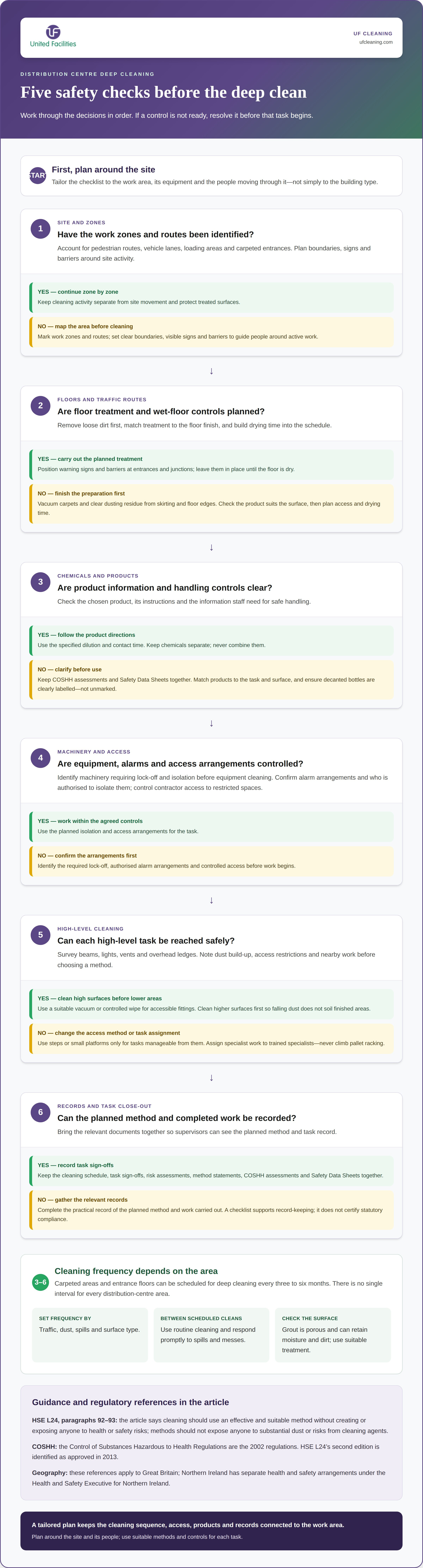
A distribution centre deep cleaning safety checklist should be tailored to the site, not applied unchanged across warehouses, retail units and industrial facilities. Core checks can cover floors, traffic routes and high-level surfaces, but controls must reflect each work area, its equipment and the people moving through it. A checklist is useful only when it accounts for those differences.
Busy sites need thorough cleaning, but wet floors, moving equipment and work at height can create risks if the sequence and access controls are poorly planned. This guide explains how professional teams manage these hazards and what informs the choice of PPE, equipment and cleaning methods.
It covers floor and route preparation, high-level cleaning, chemical and machinery controls, and records that support safe working. You’ll also see how to adapt a deep-clean plan to warehouses, retail and industrial settings without obstructing essential operations.
Key Takeaways
- Plan floor and traffic-route cleaning around site activity, suitable products and drying time to help manage slip and access risks.
- Keep compliance records and safe chemical controls together; paragraph 93 of HSE L24 says cleaning methods should not expose anyone to substantial dust or risks from cleaning agents, according to the Health and Safety Executive.
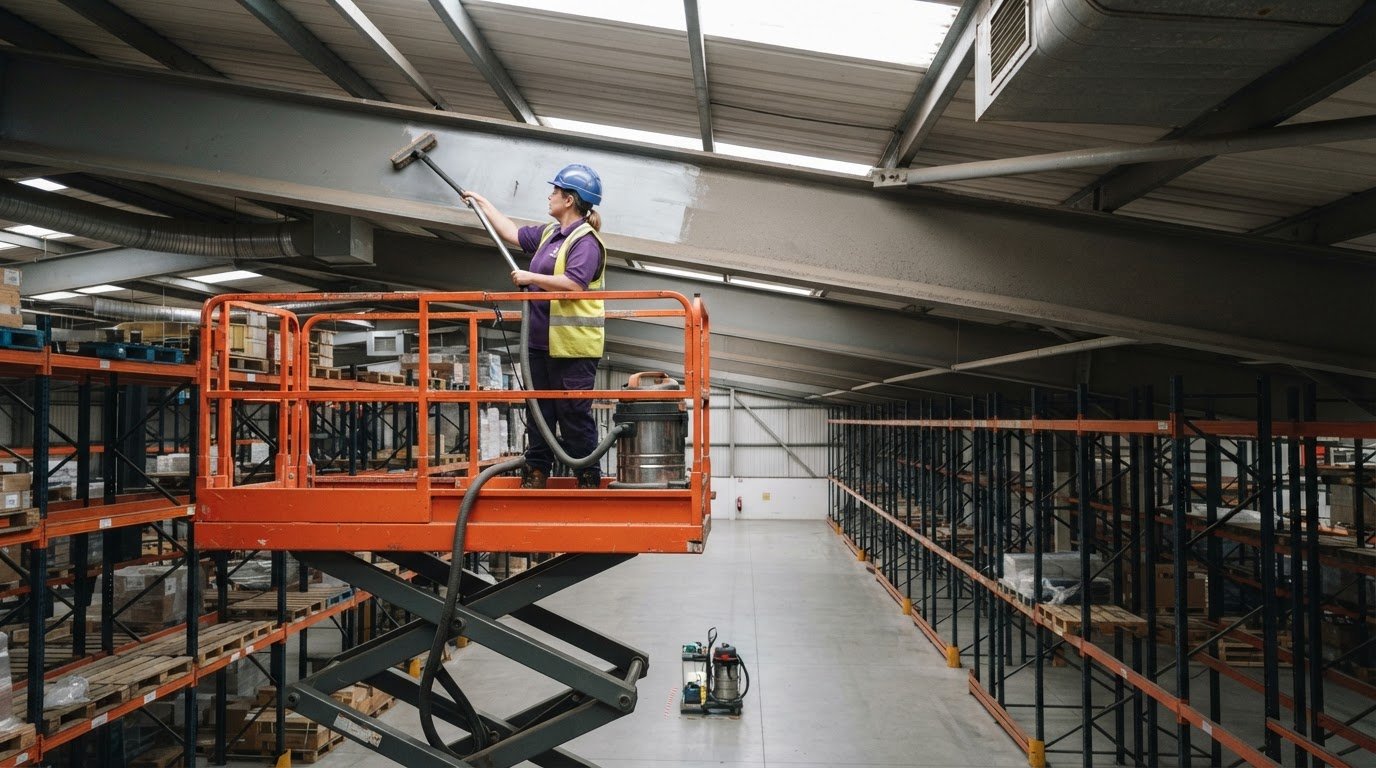
- Clean high-level surfaces before lower areas, using safe access methods and avoiding unsafe climbing on pallet racking.
- Match PPE and equipment to the task, and organise the cleaning sequence so dust, wet work and moved items are managed safely.
How professionals clean industrial floors and traffic routes
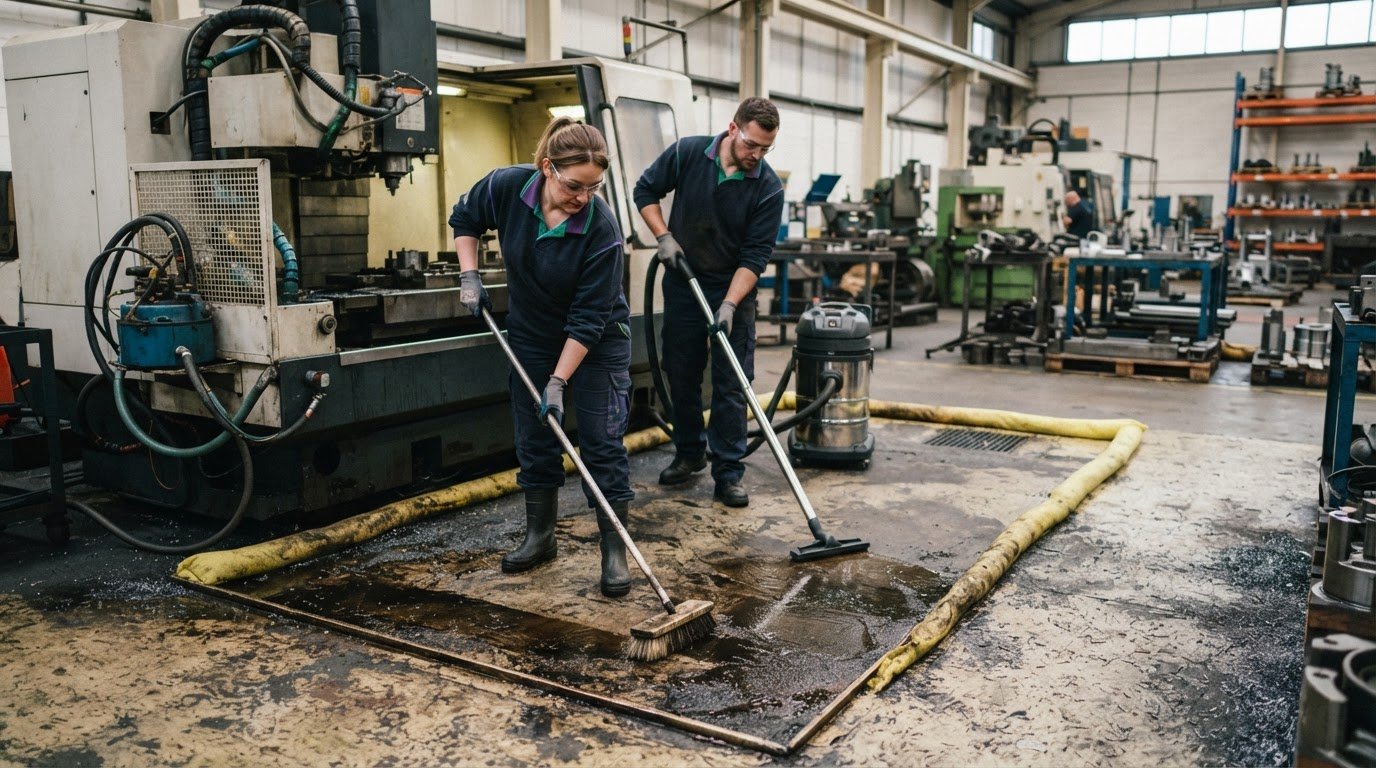
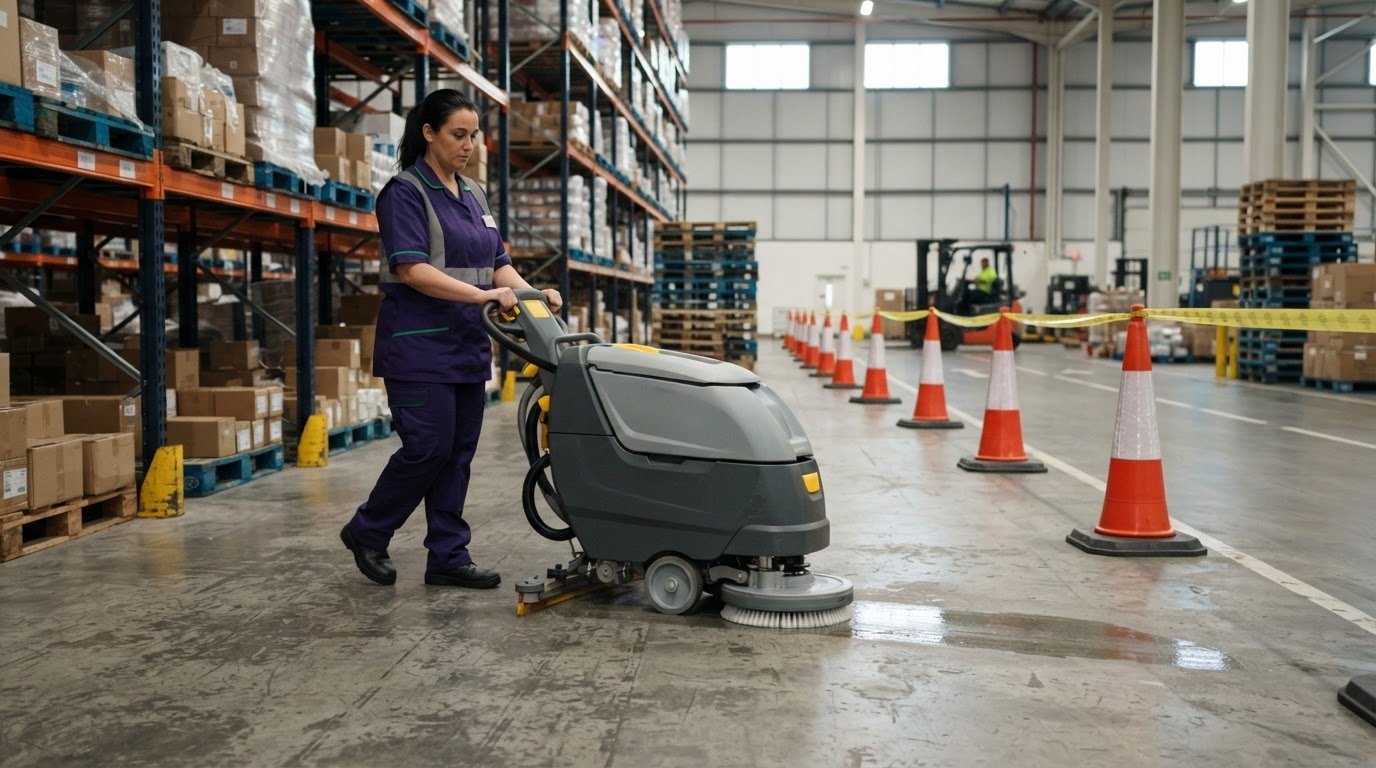
Before cleaning starts, professional teams divide the floor plan into manageable work zones. They identify pedestrian routes, vehicle lanes, loading areas and carpeted entrances. This sequence helps separate cleaning activity from site movement and protects newly treated surfaces.
- Mark each work zone and route. Clear boundaries, visible signs and barriers guide people around active cleaning areas and reduce accidental entry.
- Remove loose dirt before wet treatment. Teams vacuum carpets and clear dusting residue from skirting and floor edges, limiting soil spread during extraction or mopping.
- Match treatment to the floor finish. Suitable products protect the surface, while hard-floor stripping and polishing remove old wax layers and restore the protective seal.
- Plan carpet extraction and drying. Hot water extraction can remove spills, allergens and ground-in dirt; drying time is built into the work schedule before routes reopen.
- Control wet-floor access. Professionals position warning signs and barriers at entrances and junctions, then keep them in place until floors are dry.
For carpeted areas and entrance floors, a typical deep-clean planning range is three to six months. Spills and messes need prompt attention between scheduled cleans, as residue can spread along busy routes. Grout also requires suitable treatment because its porous surface can retain moisture and dirt.
The Workplace (Health, Safety and Welfare) Regulations 1992 are referenced in connection with workplace cleaning, according to The National Archives. The Health and Safety Executive identifies Approved Code of Practice L24, second edition, as approved in 2013.
These references apply to Great Britain; Northern Ireland has separate health and safety arrangements under the Health and Safety Executive for Northern Ireland. A clear cleaning sequence supports hygiene while keeping routes controlled and floors suitable for use.
How do professionals keep a deep clean safe and compliant?
Professional teams plan chemical use, equipment isolation and cleaning order before work begins. This gives supervisors a clear overview of products, affected areas and controls, rather than leaving staff to rely on informal instructions during a shift.
There is no single deep-clean interval for every distribution-centre area. Professionals set frequencies according to traffic, dust, spills and surface type, with high-use routes needing closer attention than quieter spaces. Carpeted areas and entrance floors can be scheduled for deep cleaning every three to six months, while routine cleaning and prompt spill response address conditions between cleans.
According to the Health and Safety Executive, paragraph 92 of HSE L24 says cleaning should use an effective and suitable method without creating or exposing anyone to a health or safety risk. Paragraph 93 says methods should not expose anyone to substantial dust or risks from cleaning agents. The Control of Substances Hazardous to Health Regulations are the 2002 regulations, according to The National Archives.
- Review chemical records. Teams keep COSHH assessments and product Safety Data Sheets together, so staff can consult handling, storage and emergency information.
- Match products to surfaces and tasks. A product selected for a washroom may not suit a kitchen floor or another finish; product directions guide dilution and contact time.
- Control containers. Staff label decanted bottles clearly and avoid unmarked containers, reducing the chance of mistaken use.
- Separate incompatible products. Cleaning chemicals are never combined, and teams follow manufacturer directions throughout the task.
- Isolate machinery where required. For equipment cleaning, the plan identifies machinery needing lock-off and isolation before work starts.
- Plan alarms and access. Supervisors identify alarms requiring isolation and who is authorised to do it, while restricted spaces receive controlled contractor access.
Records should bring together the cleaning schedule, task sign-offs, risk assessments, method statements, COSHH assessments and Safety Data Sheets. Together, these provide a practical account of the planned method and completed work. A checklist supports record-keeping, but does not certify statutory compliance.
How professionals clean high-level surfaces and light fittings
High-level cleaning starts with a survey of beams, lights, vents and overhead ledges. The team records dust build-up, access restrictions and nearby workplace activity. This map helps them choose a safe method for each surface instead of treating every fitting alike.
Accessible grilles and diffusers can be vacuumed and wiped to remove settled dust. Extractor fans can be cleaned and checked for operation, as functioning ventilation supports air-quality control. Professionals clean higher surfaces before desks and floors, so falling dust does not soil finished areas.
- Choose suitable access equipment. The team identifies tasks manageable from steps or small platforms. Work requiring specialist skills is assigned to trained specialists, not attempted from pallet racking.
- Control the work area. Equipment and furniture are positioned to preserve access and protect surfaces below. This also helps prevent dust or cleaning materials reaching active workspaces.
- Use a surface-appropriate method. A vacuum or controlled wipe can remove dust from accessible fittings. The method is matched to the material and the fitting’s location.
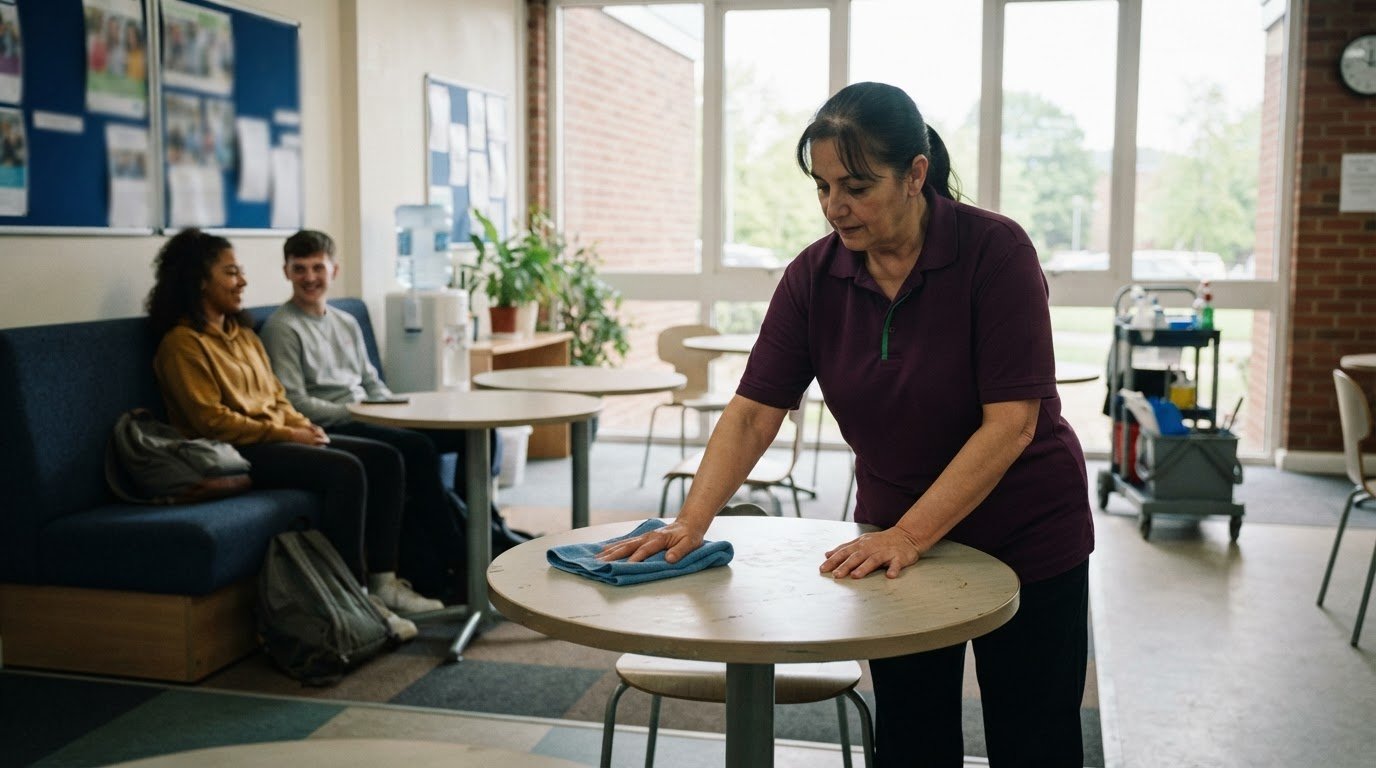
- Clean furniture from high to low. Professionals treat ledges and upper furniture surfaces before lower areas. This sequence captures dust build-up before it settles on cleaned desks or other facilities.
- Disinfect high-touch points carefully. Teams identify handles, switches and shared controls, then apply a suitable product. They follow its directions and contact time to support effective disinfection.
For light fittings, the method depends on access, nearby equipment and the surface being treated. Professionals avoid applying liquid directly to electrical components and use controlled techniques to limit drips. They confirm the relevant areas are clean before removing equipment and returning the space to use.
This sequence combines overhead dust removal with furniture and touchpoint cleaning. It also helps prevent work carried out above from contaminating clean surfaces.
PPE, equipment and the steps professionals take to deep clean a distribution centre
Professionals select PPE and cleaning equipment to suit the task, product and work area. Gloves, eye protection and other protective items are chosen according to assessed exposure, while product instructions guide safe chemical handling. Equipment is inspected before use, and damaged items are removed from service to prevent unsafe operation.
Cleaning is coordinated around forklifts, conveyors and other warehouse machinery, with access arranged alongside site operations. If machinery cleaning requires it, professionals arrange lock-off and isolation before starting so the equipment cannot operate during the task.
- Check equipment condition before work. A pre-use inspection covers cables, plugs, guards and machine parts, helping identify faults before equipment enters an active area.
- Keep maintenance records current. Service and fault records help teams identify equipment requiring attention and reduce the risk of using unsuitable machinery.
- Choose supplies for the surface. The product, cloth and tool are matched to the task; separate washroom equipment helps prevent dirt travelling to other spaces.
- Protect IT equipment and workstations. Professionals power down devices where needed, avoid spraying liquids directly onto screens or keyboards, and use approved anti-static wipes or lightly dampened cloths.
- Move heavy items with care. Teams use trolleys or glides and team lifts where appropriate, rather than forcing furniture or equipment across floors.
- Keep task order controlled. Dry work comes before wet cleaning, with floors left until last; this limits re-soiling and keeps routes easier to manage.
Spills are cleaned promptly using a method and supplies suited to the material. Waste and contaminated materials are contained and managed through the site’s designated disposal arrangements, not left in traffic routes.
Professionals also keep cleaning tools organised and wipe handles and boards thoroughly after use. Toilets and washrooms have separate equipment, reducing the transfer of soil into workstations and shared facilities.
UF Cleaning
UF Cleaning can support organisations planning professional commercial cleaning for floors and shared workplace areas. Its Office Hard Floor Cleaning and Office & Commercial Cleaning services address related needs, with cleaning plans tailored to occupancy, access arrangements, floor types and the spaces that need the most attention.
A clear cleaning plan defines priority areas, suitable methods and how work fits around site activity. For distribution centres, the checks in this guide provide a framework for discussing requirements and identifying where professional cleaning support may help.
If you’d like to discuss your cleaning requirements, contact UF Cleaning.
Set a clear standard for the next clean
Use a distribution centre deep cleaning safety checklist as a working framework, then tailor each task to the site’s layout, activity and surfaces. Turn agreed priorities into a practical scope so cleaning teams and site contacts understand which areas need attention and how the work fits the operation.
UF Cleaning provides Office & Commercial Cleaning, Professional Housekeeping and Hotel Housekeeping & Management Support. These services support different commercial environments, while a well-defined plan keeps the focus on each site’s needs. Clear communication about priority areas, access and operational constraints helps establish a suitable brief before cleaning begins.
If you’re planning professional cleaning support, contact UF Cleaning to discuss your requirements. A considered plan is a positive first step towards a cleaner, safer and more orderly workplace.
Frequently Asked Questions
Does the checklist work for warehouses, retail and industrial sites?
Yes. Use the core checks as a starting point, then adapt them to each site’s activities. A warehouse plan may need to account for vehicle routes and racking; a retail site may prioritise customer access and display areas. Industrial spaces can involve machinery or process-specific residues, so the cleaning sequence and controls should reflect the work taking place.
How do professionals clean IT equipment and ventilation?
Teams use methods suited to the equipment and surfaces being cleaned. For workstations, this can mean powering down devices where needed, avoiding direct sprays and using approved anti-static wipes or lightly dampened cloths. Accessible ventilation grilles and diffusers can be vacuumed and wiped; extractor fans can also be cleaned and checked for operation.
What disinfection standard should a deep clean deliver?
There isn’t one disinfection benchmark that applies to every task or surface. The cited benchmark for electrostatic disinfection is 99.99% of pathogens on treated surfaces, but that figure relates to that method, not every deep clean. Professionals should match the method to the surface and follow the disinfectant’s label, including its specified contact time.
What should a professional distribution centre deep cleaning safety checklist include?
Include the work areas, cleaning sequence, access arrangements, relevant machinery controls and products planned for each task. Add the associated risk assessments, method statements, COSHH assessments and product Safety Data Sheets. The record should also provide space for task completion and site issues found during cleaning, such as damaged flooring or equipment needing attention.
What UK health and safety laws apply to deep cleaning a distribution centre?
For workplace cleaning, relevant references include the Workplace (Health, Safety and Welfare) Regulations 1992 and the Control of Substances Hazardous to Health Regulations 2002, according to The National Archives. HSE L24 also addresses suitable cleaning methods and exposure risks. These references apply to Great Britain; Northern Ireland has separate arrangements under HSENI.
What PPE should a professional provider use for warehouse deep cleaning in the UK?
Select PPE for the cleaning task, products, site conditions and assessed exposure, rather than using a fixed set for every warehouse. The COSHH assessment and product Safety Data Sheets inform chemical-handling controls; the work method and equipment also affect the protection needed. Make sure PPE is available to the team before cleaning begins.