Does the landlord always have to pay for cleaning? Not necessarily. In a UK multi-let office, the lease usually sets how common-area cleaning costs are shared, while tenants typically arrange and pay for cleaning inside their own premises.
It’s understandable to expect a shared building bill to be divided fairly and clearly. The rules for multi-tenant office building cleaning cost allocation depend on the lease and the area measure used, and a landlord doesn’t automatically have the right to recover every service-charge cost. In England, section 19 of the Landlord and Tenant Act 1985 limits recovery to costs reasonably incurred for services of a reasonable standard, according to the UK Government.
This article explains how lease terms allocate cleaning costs, how vacant space can affect each tenant’s share, and what influences the work required. It also covers the records and calculations that make service-charge breakdowns easier to understand, including where landlord responsibilities end and a tenant’s share begins.
Key Takeaways
- Use the lease to understand how cleaning costs are divided and which areas each tenant is responsible for.
- Find out whether the allocation uses total lettable space or only occupied space, as vacancies can affect each tenant’s share.
- Separate cleaning within leased offices from work in shared areas, and look for how the service charge accounts for each.
- Clear records and a transparent calculation can help explain how cleaning work and costs are reflected in service-charge accounts.
Gross Leasable Area versus Gross Leased and Occupied Area
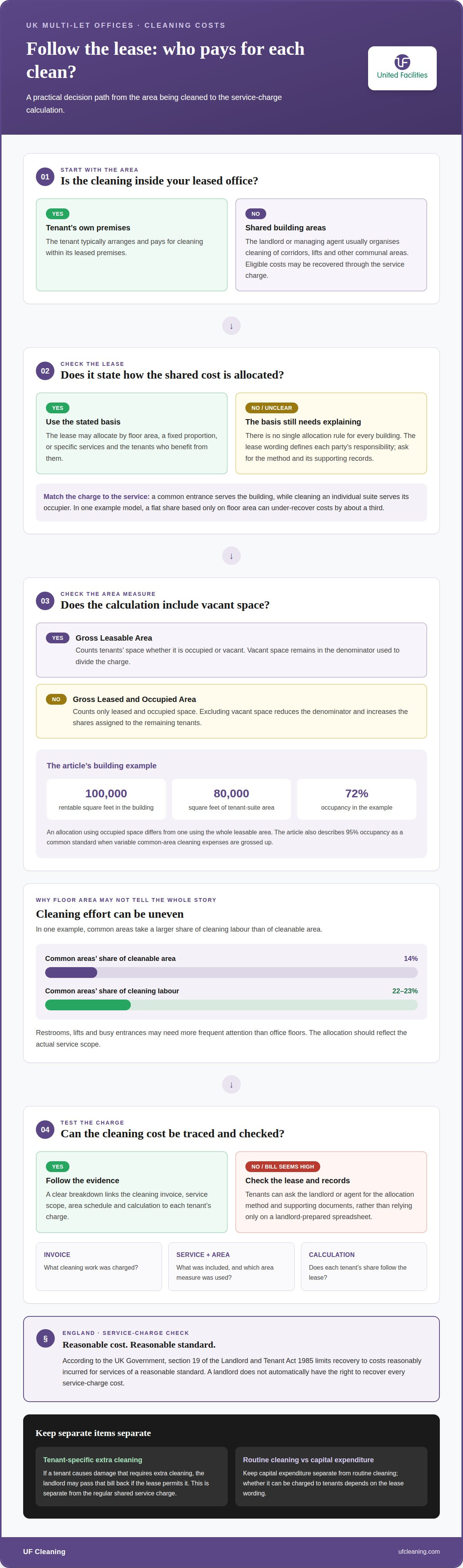
The lease usually sets each tenant’s share of common cleaning costs, often using floor area or a fixed proportion. The area measure matters because vacant space can change the denominator used to divide the charge.
Area measures for cost allocation
Gross Leasable Area includes tenants’ space whether occupied or vacant. Gross Leased and Occupied Area counts only space that is leased and occupied. This distinction affects each tenant’s proportion: excluding vacant space reduces the denominator and increases the shares assigned to the remaining tenants.
For example, a 100,000 rentable-square-foot building may include 80,000 square feet of tenant-suite area. At 72% occupancy, an allocation based on occupied space differs from one using the whole leasable area. A 95% occupancy level is described as a common standard when variable common-area cleaning expenses are grossed up.
Lease-based cleaning allocations
With lease-based allocation, the lease determines which cleaning costs tenants pay and how each share is calculated. It may use floor area, a fixed proportion, or specific provisions for communal areas. The wording of the lease defines each party’s responsibility.
Tenants can challenge an unreasonable charge by comparing it with the lease and asking the landlord or agents for the allocation method and supporting records. According to the UK Government, section 19 of the Landlord and Tenant Act 1985 allows recovery only for costs reasonably incurred and services of a reasonable standard.
Lease terms may also cap recoverable charges or increases. Capital expenditure should be separated from routine cleaning, as whether it can be charged to tenants depends on the lease wording.
Allocation records and calculations
A clear breakdown should connect the cleaning invoice, service scope, area schedule and calculation to each tenant’s charge. If a bill seems high, tenants can request the supporting documents and allocation method, rather than relying only on a landlord-prepared spreadsheet.
For labour shared across buildings, the General Ledger and Labor Journal can show how costs were recorded and allocated. Reconciling journal entries against the ledger helps identify whether the calculation follows the lease and whether any costs were charged more than once.
Cost allocation in multi-let buildings
In UK multi-let offices, tenants normally arrange and pay for cleaning inside their leased premises. The landlord or managing agent usually organises cleaning for shared corridors, lifts and other communal areas, recovering eligible costs through the service charge. The lease determines the division of responsibility; there is no single allocation rule for every building.
For example, a lease may divide a shared cleaning bill by floor area, use fixed proportions, or assign particular services to the tenants who benefit. The calculation should reflect the work: cleaning a common entrance serves the building, while cleaning an individual suite serves its occupier. In one example model, a flat share based only on floor area can under-recover costs by about a third.
That difference can arise because cleaning effort does not track area evenly. In one example, common areas represent 14% of cleanable area but account for 22-23% of cleaning labour. Restrooms, lifts and busy entrances may need more frequent attention than office floors, so a lease-based allocation should match the actual service scope.
Where a particular tenant causes damage that requires extra cleaning, the landlord may pass that bill back if the lease permits it. This separates a tenant-specific charge from the regular shared service charge. The lease may also define a minimum contribution, such as 75% of the tenant’s same-year cost per square foot, as an example term.
Mixed-use buildings need particular care. Residential and commercial occupiers may use different facilities, so an equal split may not reflect who benefits. Clear schedules should distinguish shared services from tenant-only work, explain the allocation basis and show how costs are recovered. Linking each charge to the relevant area, service and lease provision can help prevent disputes.
What are the RICS rules and best practices for allocating office service charge costs?
In UK multi-let offices, landlords or managing agents usually arrange cleaning of common parts, with tenants paying through the service charge. Charges are typically budgeted annually, collected on account and reconciled against actual costs. This process separates the planned contribution from the final expenditure and makes the year-end adjustment visible.
RICS guidance for mixed-use developments identifies paragraph 4.7, published in September 2012, as relevant to apportionment. The RICS Real Estate Management Standards, 1st Ed., identifies paragraph 3.1.9, published in March 2013, as relevant to apportionment in mixed-use developments. These references are useful where offices share facilities with other uses, because the allocation should reflect which occupiers benefit from each service.
Landlords can connect the service-charge scope to actual cleaning tasks and frequencies. For example, a specification might require floors to be mopped daily or lifts to be wiped twice a day. This detail helps tenants understand what the cleaning provision covers instead of seeing only a single total in the annual accounts.
In England, section 19 of the Landlord and Tenant Act 1985 allows service-charge costs to be recovered only where they are reasonably incurred and services meet a reasonable standard, according to the UK Government, legislation.gov.uk. Landlords have no automatic entitlement to recover 100 per cent of service-charge costs from tenants. They also cannot claim the cost of organising work or travelling to the property.
A practical review compares the lease, cleaning specification and service-charge reconciliation. If the accounts include shared-area cleaning, the schedule should identify the tasks, while the reconciliation should show actual expenditure against the annual budget. Any mismatch between the service delivered and the amount charged may need an explanation. These records help distinguish cleaning costs from unrelated landlord expenses.
What records and calculations should landlords provide to explain cleaning cost allocations?
A clear service-charge calculation links the cleaning work to the amount allocated to each occupier. Useful records include invoices, the cleaning specification, the areas covered and the apportionment method. Together, they show what work was done, which costs were included and how the tenant’s share was calculated.
The specification should identify communal spaces and the tasks performed there, such as lift and corridor cleaning. Frequency matters too: a schedule stating that floors are mopped daily or lifts wiped twice a day can help explain the service purchased. For extra work, the supporting record should identify the task and why it was needed.
For costs shared across buildings or legal entities, the calculation should show the allocation basis for each cost. Invoice-by-invoice allocation can be difficult to audit, and sampling invoices may not reveal a consistent method. A schedule linking each cost category to its allocation basis makes the calculation easier to follow.
Labour allocations also need a traceable record. Compare the General Ledger and Labor Journal to see how entries were recorded and distributed. For example, a tenant reviewing staff costs can trace a journal entry back to the ledger, then see how the relevant amount was assigned to the building.
If a cleaning charge seems high, tenants can request supporting records and the calculation method. Compare the service scope with the invoices, then trace the apportionment from the total cost to the tenant’s billed share. Any discrepancy between the recorded work and the amount charged gives a specific point to discuss.
For a clearly defined office cleaning scope, discuss your office cleaning requirements.
UF Cleaning
UF Cleaning helps office occupiers and landlords turn an agreed cleaning scope into consistent day-to-day care. Its office cleaning and office hard floor cleaning services can support a clearly defined programme for a building’s premises and surfaces.
For multi-let offices, clarity about the work matters as much as clarity about the service-charge calculation. A well-defined scope distinguishes routine office cleaning from specialist floor care, helping the parties understand what work is arranged. UF Cleaning provides commercial cleaning tailored to different organisations and environments.
If you’re planning cleaning for an office building or reviewing the scope of work, contact UF Cleaning to discuss your requirements.
Make the next cleaning decision with clarity
The next step is to connect the building’s cleaning requirements with a clearly described scope of work. Consider how tenants use shared areas, which spaces need routine attention, and where particular occupiers need a tailored arrangement. This gives landlords and tenants a practical basis for discussing the service before expectations diverge.
Treat multi tenant office building cleaning cost allocation as part of planning a well-managed workplace, not simply as an accounting exercise. Clear expectations about the work can support more constructive conversations about service quality and responsibilities as building needs change.
If you’re planning cleaning for a multi-let office or refining the requirements for your premises, contact UF Cleaning about your cleaning needs. A considered conversation can help you identify a suitable way forward for your building.
Frequently Asked Questions
Does the landlord always have to pay?
No. The lease may allow the landlord to recover eligible cleaning costs from tenants through a service charge, while the landlord remains responsible for costs the lease does not make recoverable. In England, section 19 of the Landlord and Tenant Act 1985 limits recovery to costs reasonably incurred for services of a reasonable standard, according to the UK Government. The lease and the nature of the work both matter.
When might the tenant be responsible?
Tenants are normally responsible for cleaning within their own leased offices. A separate charge may also apply if a tenant causes damage that requires additional cleaning, provided the lease permits the cost to be passed on. For example, cleaning a specific spill beyond the routine schedule could be treated differently from regular shared-area service.
How are cleaning costs allocated between tenants in a UK multi-tenant office building?
A sound approach to multi tenant office building cleaning cost allocation starts with the lease, which may divide eligible shared costs by floor area or fixed proportions. A building may also separate cost pools, such as cleaning for common reception areas and work serving a particular part of the property. Apply the relevant lease method to each pool rather than assuming every cleaning task benefits all tenants equally.
What factors determine office cleaning costs per tenant in the UK?
A tenant’s charge depends on the lease’s allocation method and the cleaning work included. The scope, task frequency, building areas, floor types, access arrangements and operating hours all affect the work required. For example, a specification covering kitchen surfaces and washrooms should account for those tasks separately from general floor cleaning, then apply the agreed allocation basis.
Should cleaning costs be allocated by floor area, occupancy, or actual usage?
The right basis for multi tenant office building cleaning cost allocation depends on the lease and the service; no single measure suits every case. Floor area provides a defined allocation measure, while an occupancy-based denominator excludes vacant space and can increase occupied tenants’ shares. Actual usage may better reflect services used by particular occupiers, but it requires an agreed method and reliable records. Match the lease wording to the service being charged.
How are shared areas such as reception, lifts, toilets, and kitchens included in cleaning service charge budgets?
Shared-area cleaning can be included where the lease and service-charge scope cover those areas. A budget can list reception, lifts, toilets and communal kitchens as separate tasks, with their cleaning frequencies and allocation methods. If a kitchen serves only one tenant, it may be treated differently from a shared facility. The year-end account can then show actual expenditure against the budget.