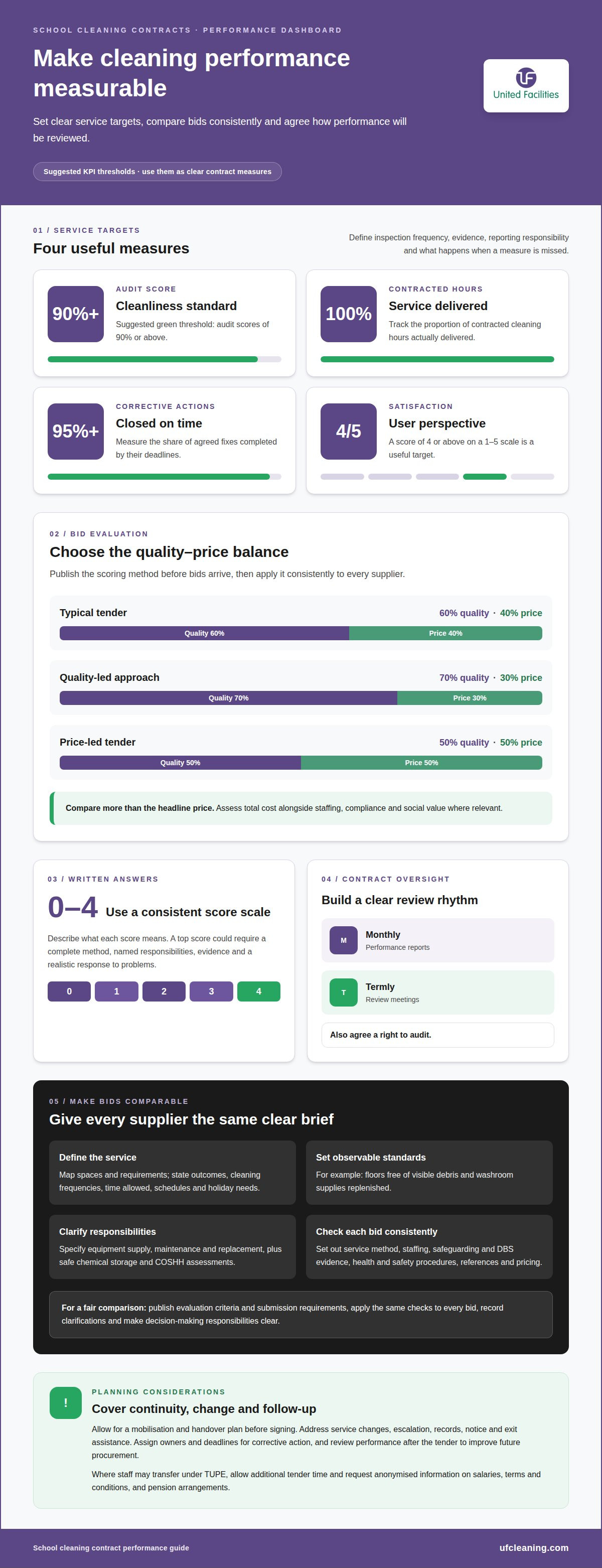
A school cleaning contract is only as useful as the standards it makes measurable. This school cleaning contract procurement guide starts with practical KPI thresholds: aim for audit scores of 90% or above, delivery of 100% of contracted cleaning hours, and at least 95% of corrective actions closed on time. On a 1–5 satisfaction scale, a score of 4 or above is a useful target.
Price matters, but a bid must also explain how cleaning will be delivered across the school site and day. A clear specification and measurable performance standards make expectations easier to assess and manage. This school cleaning contract procurement guide explains how to review current provision, define requirements, compare bids on quality as well as price, and select KPIs that reflect the school’s priorities. It also compares in-house and contracted teams, accounting for staffing, oversight and continuity as well as cost.
Key Takeaways
- Map cleaning needs by building area, school schedule and term dates before drafting the specification.
- Set out cleaning frequencies, standards, reporting and equipment responsibilities so bids respond to the same requirements.
- Publish evaluation criteria and weigh service quality, staffing, compliance and total cost transparently.
- Compare in-house and contracted delivery with staffing continuity in mind, including whether TUPE or pension arrangements may apply.
1. Step 5: Which KPIs should a school cleaning contract include?
Build a school cleaning tender checklist before inviting suppliers to bid. For England, Scotland, Wales and Northern Ireland, establish the applicable procurement regime and assess the contract’s lifetime value; where it exceeds the public procurement threshold, use a framework or run a procurement and issue a tender through the Central Digital Platform. The Procurement Act 2023 came into force in the United Kingdom on 24 February 2025, according to UK legislation.gov.uk. A school cleaning contract procurement guide should help bursars connect that route to clear requirements and measurable outcomes.
Start by engaging suppliers: explain the site, cleaning schedule, holiday requirements and expected standards. Tender documents should include the specification, contract terms, evaluation criteria, submission deadline and response format. Tender support can help organise documents, supplier engagement and bid evaluation, but keep accountability clear and avoid requirements tailored to one supplier. Spell out the school’s decision-making responsibilities and approval process.
Set out the submission requirements in the tender pack. These may include the service method, staffing arrangements, safeguarding and DBS evidence, health and safety procedures, references and pricing. Apply the same checks to every bid, record clarifications and assess responses against the published criteria. This makes omissions and assumptions easier to spot before awarding the contract.
Choose KPIs that measure both delivery and results. Suggested green thresholds are audit scores of 90% or above, 100% of contracted cleaning hours delivered, and 95% or more of corrective actions closed on time. A satisfaction score of 4 or above on a 1–5 scale can add a user perspective. Define inspection frequency, evidence, reporting responsibility and how failed measures trigger corrective action.
Build in termly review meetings, monthly performance reports and a right to audit. Contract terms should define service changes, escalation, records, notice and exit assistance. Agree a mobilisation and handover plan before signing. Common pitfalls include vague standards, weak absence cover and unclear equipment responsibilities, so assign owners and deadlines for corrective action. Record decisions and review performance after the tender to improve future procurement.
Schools should identify the procurement regime applicable in their nation and assess the contract’s lifetime value. If it exceeds the public procurement threshold, use a framework or conduct a procurement and issue a tender through the Central Digital Platform. The Procurement Act 2023 came into force in the United Kingdom on 24 February 2025.
2. Assessing current cleaning provision and defining specifications
Start with a structured review of the existing cleaning service, using room schedules, inspection records and staff feedback. Walk the site with the caretaker, noting facilities, floor types, access points and areas with changing levels of use. Map classrooms, toilets, halls, kitchens and communal spaces, then identify where current standards or schedules fall short of operational needs. This baseline makes the specification relevant to the school, rather than a generic buying document.
For each space, specify the required outcome, cleaning frequency and time allowed for the work. Align schedules with the school day, term dates and holidays, and distinguish routine tasks from periodic deep cleans. For example, heavily used PE department showers may need a deep clean every six months. State how completed work and defects should be reported, so both parties can assess delivery against the same service-level agreement.
Describe standards in observable terms, such as floors free of visible debris and washroom supplies replenished. The page recommends that general cleaning standards across contract areas follow the British Standards Institute’s ‘Uniform Cleaning Surface Standard’ document. Specify who supplies, maintains and replaces equipment, and include COSHH assessments and safe chemical storage away from pupils. Clear responsibilities reduce ambiguity when work transfers between school staff and the cleaning team.
Changing providers can involve TUPE, the Transfer of Undertakings (Protection of Employment), under the 2006 Regulations. Where cleaning staff may transfer, allow additional tender time and request anonymised information covering salaries, terms and conditions, and pension arrangements. Include transition responsibilities in the specification, alongside site inductions, key handover and continuity of cleaning during the change. Clear assumptions help bidders plan staffing and give the school a more comparable response.
3. Evaluating bids on quality as well as price
Publish the scoring method before bids arrive, then apply it consistently to every supplier. A typical school cleaning tender gives quality 60% and price 40%; a quality-led approach may use 70% and 30%, whilst a price-led tender may split both at 50%. Choose weightings that reflect the school’s priorities, and assess total cost alongside staffing, compliance and social value where relevant.
Use a 0-to-4 scale for written answers, with a clear description for each score. For example, a top score could require a complete method, named responsibilities, evidence and a realistic response to problems. Assess the proposed cleaning schedule, absence cover, supervision and arrangements for a deep clean. ISO 9001:2015 may help assess a supplier’s quality management approach, but evaluate the evidence behind its proposed delivery too.
Safeguarding and safety evidence should form part of pre-shortlisting checks. Schools must complete DBS checks to the appropriate level for staff involved in the cleaning service. The Health and Safety at Work etc. Act cited for school cleaning tenders is the 1974 Act, according to UK legislation.gov.uk. Review each bidder’s safeguarding procedures, DBS processes and health and safety documentation for relevance to the school site.
For references, seek comparable cleaning contracts and examine their scope, service issues and how problems were resolved. Check that the named supervisors and staffing plan in each bid align with its method statement. Record clarifications and score final responses against the same published criteria, rather than relying on presentation quality alone.
After award, use monthly monitoring assessments and performance reports to measure delivery against the contract standards. Combine inspection findings with complaints, missed tasks and corrective actions, and record decisions in a dated document. Termly reviews can identify recurring issues, while trend checks show whether improvements are sustained. Treat each inspection as evidence for action, not merely a score, and record follow-up responsibilities and deadlines.
4. In-house cleaning versus external contractors
In education, the split between in-house and contracted cleaning is about 50/50. Neither setting is automatically the better choice: compare the school’s capacity to recruit, supervise and cover absence against the management required for a contract. In-house teams offer direct day-to-day oversight; an external arrangement places delivery within agreed service standards and contract controls.
Base the decision on evidence from actual operations. Review staffing levels, absence cover, inspection findings, equipment responsibilities and term-time or holiday workloads. Then establish who handles recruitment, training, supervision and performance records under each model. For example, a school with strong facilities management may be able to oversee an in-house team, while a trust seeking a single service structure may prefer a contracted model.
Changing the delivery model also raises employment and pension questions. UK schools should consider whether TUPE, the Transfer of Undertakings (Protection of Employment) Regulations 2006, or the Local Government Pension Scheme will apply, particularly when outsourcing or moving away from local-authority provision. If staff may transfer, allow extra time and build staff information, consultation and transition planning into the procurement timetable.
Compare evidence, not assumptions. Use inspection records, staffing continuity, absence arrangements and references from comparable education settings to assess each option against the school’s specification. For a contractor, examine the proposed supervision and reporting structure; for in-house provision, assess whether named managers can sustain those controls. Include mobilisation, equipment and exit arrangements: clear ownership can help reduce disruption when service begins or ends.
The decision should follow the school’s operational priorities, available management capacity and employment implications. Record the reasons for the chosen model, its risks and the controls that will address them. For schools considering contracted delivery, discuss your school’s cleaning requirements as part of planning a suitable service arrangement.
UF Cleaning
UF Cleaning can help schools move from procurement decisions to a clearly scoped cleaning arrangement. Once priorities, standards and the preferred staffing model are defined, its team can discuss how cleaning requirements may be shaped around the school’s facilities and schedule. This is a practical next step when a school is considering contracted delivery and wants its operational needs reflected in the service plan.
Bursars can start with the specification, site requirements and expected outcomes to establish how the cleaning service should operate. UF Cleaning also provides commercial services including housekeeping and Office Hard Floor Cleaning, alongside other cleaning support for organisations.
To discuss your school’s cleaning requirements, contact UF Cleaning.
Turn your procurement plan into a practical next step
Use this school cleaning contract procurement guide as a starting point, then shape the decision around your school’s priorities, site demands and preferred level of oversight. A clear brief turns operational expectations into a service arrangement staff can understand and manage. It also provides a foundation for planning the transition and maintaining accountability after award.
UF Cleaning supports organisations with commercial services including Office Cleaning London, Housekeeping and Hotel Management. For schools considering cleaning provision, request a free, no-obligation quote to discuss site requirements and how they can inform a tailored cleaning arrangement.
Contact UF Cleaning to discuss your needs, and take the next step with a plan shaped around your setting.
Frequently Asked Questions
Step 5: Which KPIs should a school cleaning contract include?
Choose KPIs that link a defined standard to evidence, an owner and a response. An audit measure, for example, should specify which rooms are sampled, how findings are recorded and who signs them off. Add measures for complaints, missed tasks, staffing continuity and time to resolve defects where they affect school operations. Set the reporting period and escalation route, so poor results prompt tracked action rather than an unexplained score.
Why are so many school cleaning tenders out of date?
Outdated tender documents can persist when schools reuse templates without revisiting their standards or site requirements. A legacy reference such as withdrawn ISO 9002 or BS 5750 signals that the quality section needs review. Changes to buildings, timetables, access and cleaning priorities can also make old schedules unsuitable. Refresh the document against current operational needs and replace obsolete references before inviting bids.
How do I write a winning proposal for a school cleaning contract?
A strong proposal answers each requirement directly and makes the evidence easy to assess. Use a response matrix linking specification clauses to methods, staffing responsibilities, supervision and contingency arrangements. State site assumptions and explain how delivery will change during exams or holidays. References should demonstrate comparable work and describe outcomes, rather than rely on generic praise. Present pricing in the requested format, with the scope and exclusions clearly stated.
How do schools procure cleaning services?
Schools procure cleaning by defining the requirement, estimating lifetime value, selecting the applicable route, and documenting competition and award. Procurement rules vary across UK nations and depend on the school or trust’s status and contract value, so establish the route before publishing a tender. Set evaluation criteria in advance, issue consistent documents, record clarifications and decisions, then plan mobilisation and contract management.
Should a school outsource its cleaning or manage it in-house?
There is no universally best model. Base the decision on management capacity, workforce continuity and the school’s need for direct oversight. In-house provision suits settings with the capacity to recruit, supervise and coordinate staff. Contracted delivery may suit schools seeking defined responsibilities and external service management. Compare each option against operational evidence, including who handles absence cover, training, equipment and daily accountability.
Step 2: How should you weight price and quality?
Set weightings according to the school’s priorities and publish them before bids are submitted. Give quality enough influence to distinguish credible staffing plans, compliance evidence and service methods from unsupported claims. Assess price consistently, using the same scope and assumptions for every bid. A sensitivity check can show whether a small change in scoring would alter the preferred bidder, helping the evaluation panel understand its decision.