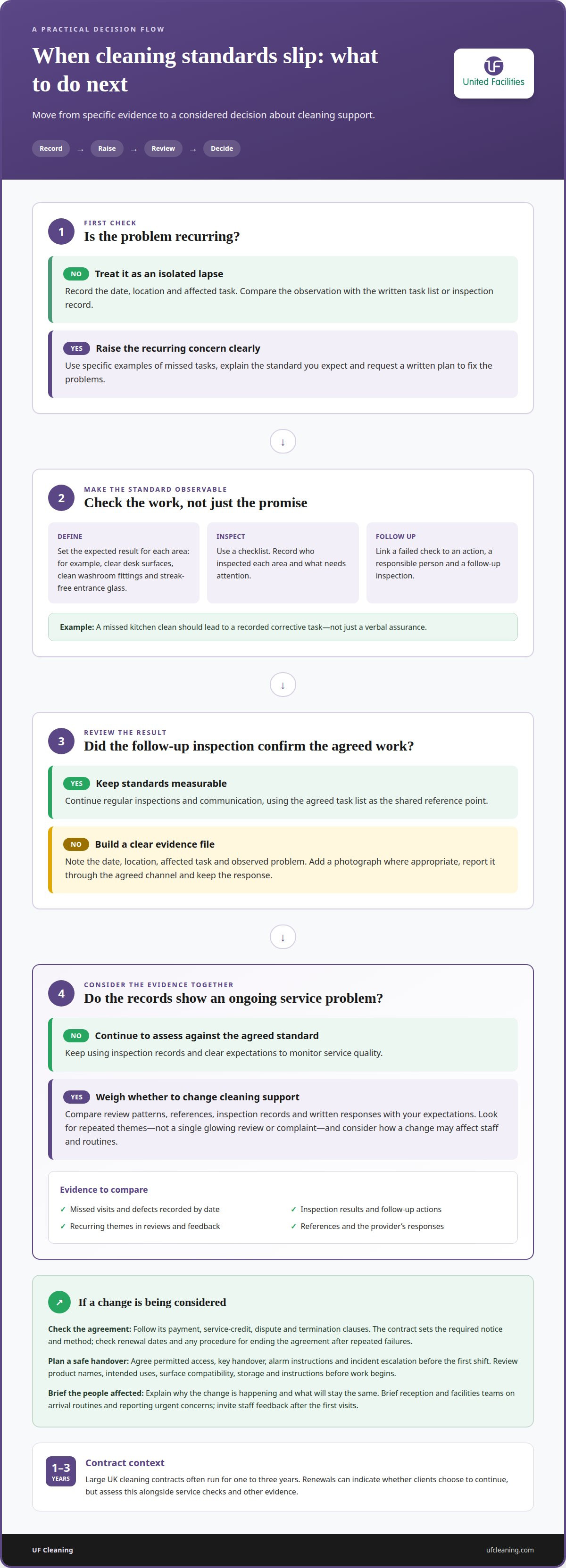
Repeated cleaning failures call for a clear conversation and a considered decision about what happens next. To understand how to deal with unreliable commercial cleaners, record specific missed tasks, explain the standard you expect and request a written plan to fix the problems. Then review the results before deciding whether to change cleaning support.
It’s reasonable to feel frustrated when cleaning standards slip, particularly when staff notice or the working environment is affected. A structured approach helps you raise concerns clearly, distinguish a recurring problem from an isolated lapse and consider how a change could affect staff morale.
This guide explains what to say to your cleaner, how to assess reviews and inspect cleaning quality, and what to consider when choosing replacement support. It also shows how to look beyond promises and assess the systems, communication and consistency that support dependable cleaning.
Key Takeaways
- Raise recurring problems calmly, using specific examples and a clear description of the standard you expect.
- Look for patterns in reviews and feedback, rather than relying on a single comment or overall rating.
- Use a written task list and regular inspections to make cleaning expectations measurable and consistent.
- When choosing replacement support, weigh staff continuity alongside the provider’s communication, supervision and quality systems.
1. Can switching cleaners disrupt staff morale?
Changing cleaning teams can introduce health and safety risks. Unfamiliar products, wet floors or poor storage can create hazards. Safeguarding and keyholder risks include access to restricted rooms, untracked keys and unclear alarm procedures.
Before the first shift, agree which areas staff may enter, how keys will be handed over, the alarm instructions and how to escalate incidents. Staff may welcome better standards, but an unfamiliar team can unsettle routines and raise concerns about privacy or access. Explain why the change is happening, what will stay the same and whom staff should tell about missed tasks. Brief reception and facilities teams on the new team’s arrival routine and how to report urgent concerns. A clear introduction helps everyone understand who is on site and how to raise an issue.
Where specialist expertise matters, match training to the site. Hard-floor care and cleaning in a manufacturing setting can involve different equipment, surfaces and procedures. Ask how supervisors brief staff on site requirements and communicate temporary changes to routines. Agree who is responsible, what will be inspected and how missed tasks are recorded, so follow-up does not rely on verbal assurances.
Review cleaning products before work begins. Ask for product names, intended uses and surface compatibility, since a washroom and a polished floor may need different products. Agree how products will be stored, labelled and used, and make sure staff understand the instructions and escalation process. These steps make cleaning services easier to monitor.
Staff continuity helps build familiarity with site routines, while frequent changes may require repeated introductions and access briefings. Ask how cleaners are trained for your site and how supervisors address performance concerns. Employee background checks can help businesses assess staff reliability. Consistent pay and training can support staff retention and safe, consistent work. Clarify cover and handover arrangements so absences do not leave staff guessing, then invite feedback after the first visits.
2. Checking client reviews and reputation
Look for recurring themes rather than relying on a single glowing review or complaint. Record comments about missed visits, inconsistent standards, slow replies and unresolved issues. Repeated negative feedback deserves closer investigation. Compare each pattern with your written expectations and service records, then ask how the provider responded. A specific explanation of corrective steps is more informative than a generic apology.
Ask for recent client references and specific examples of similar sites. Discuss what went wrong during the first three months of service, and how the contractor resolved it. For larger contracts, compare testimonials, case studies, retention rates, audit results and customer satisfaction scores. These measures show whether service quality continues beyond the initial handover. Large UK cleaning contracts often run for one to three years, so renewals can reveal whether clients choose to continue.
Compare providers against the same criteria: reference quality, consistency of communication, documented service checks and relevant insurance. Ask each reference how quickly questions receive a response, whether supervisors act on feedback, and whether expectations remain clear when site needs change. Prompt replies and proactive communication can influence whether a contractor wins a contract. Assess the evidence together, rather than treating polished reviews as proof of reliable day-to-day service.
Can a business withhold payment or terminate a cleaning contract for unreliable service in the UK? Follow the contract’s payment, service-credit, dispute and termination clauses. Keep dated records of missed visits and reported defects, notify the provider through the agreed channel and use any stated remedy before changing payment arrangements.
How much notice is required to cancel a commercial cleaning contract in the UK? There is no single notice period for every agreement. The contract’s termination clause sets the required notice and method; check renewal dates and any procedure for ending the agreement after repeated failures.
Before deciding, compile a short evidence file with review patterns, reference feedback, inspection records and written responses. This helps you compare performance with the agreed service expectations and explain the decision clearly to colleagues affected by a change.
3. Cleaning quality assurance and inspections
Effective quality assurance turns cleaning standards into observable tasks. Define the expected result for each area, such as clear desk surfaces, clean washroom fittings and streak-free entrance glass. A checklist gives cleaners and supervisors the same reference point. Inspections show whether agreed work was completed, rather than relying on general impressions. Record who inspected each area and what needs attention.
Ask the provider to explain its inspection process, how findings are reported and who handles problems. A useful system links each failed check to an action, a responsible person and a follow-up inspection. Regular communication, staff training and prompt issue resolution help maintain consistent service. For example, a missed kitchen clean should lead to a recorded corrective task, not just a verbal assurance.
To document missed or poor work, note the date, location, affected task and observed problem. Add a photograph where appropriate, send the record through the agreed reporting channel and keep the response. Specific evidence, such as an untouched washroom bin after a scheduled visit, makes follow-up clearer.
A commercial cleaning contract should describe service standards, task frequencies, priority areas, inspection methods and how missed visits are reported. It should also explain how complaints are handled and what corrective steps apply when agreed work is incomplete. Clear terms help both parties assess performance against the same expectations.
Set response times and remedies out in the contract, with separate routes for urgent hygiene concerns and routine defects. Specify when the provider must acknowledge an issue, arrange corrective work and confirm completion. Remedies might include a revisit, a documented improvement plan or another response agreed in the contract.
Review performance monthly during the first quarter, then quarterly thereafter. Use inspection records, repeat defects and unresolved reports to identify patterns. If a written checklist shows the same task failing across visits, revise supervision or training and check the next inspection for improvement. A scheduled review also creates a consistent opportunity to discuss changing site priorities.
4. Choosing replacement cleaning support
Choose a replacement by assessing its working systems, not its size. Ask how supervisors allocate tasks, record inspections and resolve missed work. A smaller supplier with clear checks may provide better oversight than a larger operation with unclear responsibilities. Request a service plan that reflects your work schedule, busy areas and access arrangements. For example, reception and shared kitchens may need different attention from low-traffic storage rooms.
Review compliance before agreeing a start date. For a larger contract, assess insurance, health and safety procedures, COSHH compliance, risk assessments, staff training, quality assurance and employee vetting. Ask which cleaning products the team uses and whether they suit your facility’s safety standards and surfaces. A suitable plan should explain product use and supervision, not simply list tasks.
Use references to test claims. Ask current or recent clients how the provider manages communication, cover and corrective work. Ask what went wrong during the first three months of service and what happened next. Their answers can show whether problems are acknowledged, assigned and resolved, or left to recur. Compare those examples with your priorities before choosing.
Where possible, arrange a trial before making a long-term commitment. Set clear expectations for the trial, including priority areas, visit arrangements and how feedback will be handled. This gives both sides a practical way to assess whether the service fits before extending the arrangement. Confirm how the plan accommodates high-traffic areas and operational changes, rather than assuming one schedule suits every site.
Clarify the staffing model and cover arrangements. If engaging self-employed cleaners, you can request evidence of public liability insurance before work begins. Their working arrangements should reflect genuine independence; employees, by contrast, have employment rights and benefits. Agree who supervises the work and communicates changes, so responsibility stays clear during handovers or absences.
To establish dependable support around your site’s priorities, discuss replacement cleaning support and the standards you need from the outset.
UF Cleaning
UF Cleaning can help organisations seeking more dependable commercial cleaning support, with flexible schedules and real-time quality controls. If recurring issues have left cleaning standards unclear, a defined service plan and clear quality checks can make expectations easier to manage.
Its services include Office Cleaning London, Office Hard Floor Cleaning, Housekeeping and Hotel Management. The right support depends on your premises, priorities and required cleaning tasks, rather than a one-size-fits-all arrangement. Discuss the areas that need attention, the standards you expect and how quality should be monitored, so the proposed support reflects your site’s needs.
If you’re considering a change or want to establish clearer cleaning expectations, contact UF Cleaning to discuss your requirements.
Set a clear standard for the next chapter
Changing cleaning support is an opportunity to reset the working relationship, not simply replace one team with another. Decide what a successful arrangement should make easier for staff, then use that priority to guide the transition. A considered handover can preserve useful routines while addressing persistent concerns.
Knowing how to deal with unreliable commercial cleaners also means recognising when repeated disruption is taking attention away from your core work. Make the next step purposeful by choosing support that reflects your site’s needs and setting expectations from the outset. Clear priorities give everyone a practical reference as the new arrangement takes shape.
For organisations ready to discuss support suited to their requirements, contact UF Cleaning to discuss support. A steady, well-considered change can help create a cleaner environment and a more settled working day.
Frequently Asked Questions
What should you say to your cleaner?
State the problem, the location and the result you need, then request a clear action plan. For example: “The meeting-room floors were still marked after the last visit. Please explain how this will be corrected and prevented next time.” Keep your tone factual and invite a response. This makes it easier to discuss how to deal with unreliable commercial cleaners constructively, without making the conversation personal.
Can switching cleaners disrupt staff morale?
Yes, particularly if staff are used to familiar cleaners or have concerns about access and privacy. Explain the reason for the change before the new team starts, and tell employees who will handle questions. For example, brief reception staff on the arrival routine and tell teams how to report a concern. Clear communication helps maintain confidence as new routines take shape.
How can businesses reduce disruption?
Plan a handover that protects essential routines. Give the incoming team clear site instructions, access arrangements and priority areas before its first visit. Tell staff what is changing and what will remain the same, such as cleaning times or how to report concerns. If possible, arrange the transition for a quieter operating period and assign one workplace contact to coordinate questions.
Is it better to use a large company or a local operator?
Size alone is a poor measure of reliability; the provider’s systems matter more. Assess how responsibilities are assigned, how service issues are handled and whether quality checks are built into delivery. A smaller operator may offer a suitable structure, while a larger company may have established processes. Compare the actual arrangements with your site’s needs rather than assuming scale determines performance.