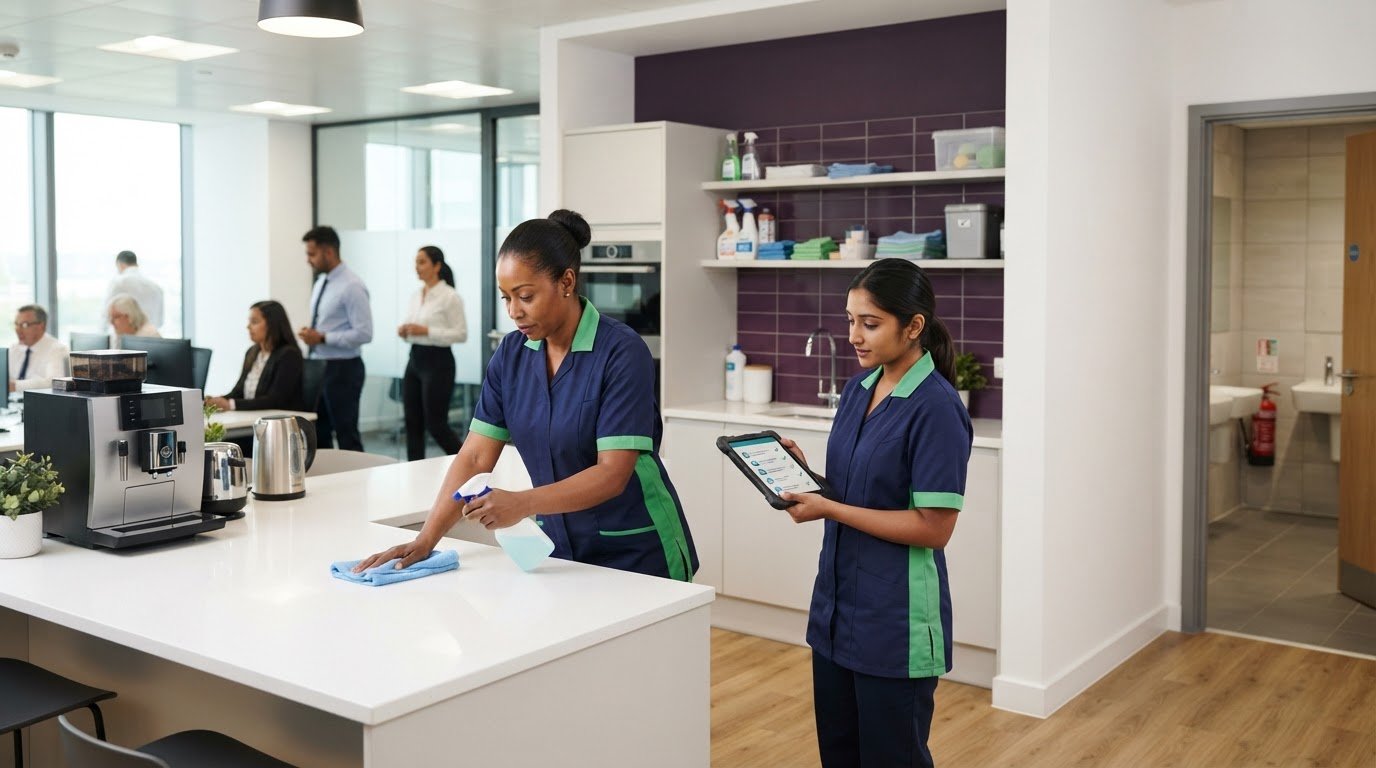
A familiar cleaner can help keep workplace cleaning consistent, but the same person will not necessarily attend every visit. With office sanitation services, continuity depends on the agreed staffing arrangements, including how planned or unexpected absences are covered and how replacement staff are briefed.
It is reasonable to expect clear, consistent standards. A changing team can leave you unsure whether tasks have been completed, especially in shared kitchens and washrooms. A written cleaning schedule, defined responsibilities and a reliable handover process help maintain clarity when staffing changes.
This guide explains what to look for in cleaner continuity, contract terms and pricing, and how staff vetting and hygiene routines for washrooms and kitchens contribute to a dependable service. It also covers the details that shape a cleaning plan, so you can assess whether it fits your workplace layout, usage and daily needs.
Key Takeaways
- Set out cleaning tasks, attendance arrangements and absence cover in the contract so expectations remain clear when staffing changes.
- Understand how the cleaning quote is shaped by your workplace’s layout, use and required tasks, and look for a transparent breakdown of the proposed service.
- Review how staff training, vetting and insurance arrangements support a consistent and responsible cleaning service.
- Give kitchens and washrooms particular attention when planning cleaning routines, as these shared spaces often need more frequent care than other areas.
Contracts, notice periods and payments
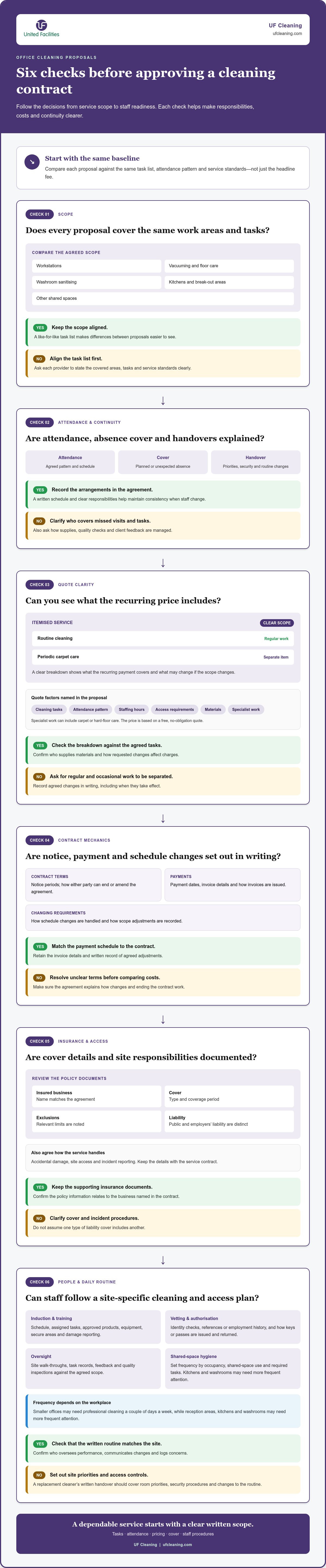
Compare office cleaning proposals against the same task list, attendance pattern and service standards. Check whether each covers workstation cleaning, vacuuming, floor care, washroom sanitising, kitchens, break-out areas and shared spaces. Ask how the provider manages cleaner continuity, absence cover, supplies, quality checks and client feedback, and missed tasks. These details reveal differences between contracts more clearly than a headline fee alone.
The agreement should clearly state notice periods, payment dates and how schedule changes are handled. Review how either party can end or amend the contract, how invoices are issued, and what happens when your requirements change. The price is based on a free, no-obligation quote, with the building size, layout, cleaning frequency and agreed tasks among the factors considered.
How often should offices be cleaned and sanitised? Set the frequency according to occupancy, shared-space use and required tasks. Smaller offices may need professional cleaning a couple of days a week, while reception areas, kitchens and washrooms may need more frequent attention.
How can businesses arrange an office sanitation service in the UK? Start by listing the rooms, surfaces and priority tasks, then agree in writing on attendance, responsibilities, reporting and payment terms. This gives everyone a clear schedule to work from.
How do office sanitation services vary by location across the UK? Requirements reflect the building, local staffing arrangements and travel involved, so a London office and a workplace elsewhere may need different schedules or contract details. State the site address and operating pattern when requesting a proposal, then compare the scope against your task list.
Insurance and pricing transparency
A clear quote separates included work from optional or occasional tasks. For example, routine cleaning and periodic carpet care should appear as separate items if both are proposed. This shows what the recurring payment covers and what could change if the scope changes. The written schedule should also identify the areas covered, planned attendance and how completed work is recorded.
Insurance arrangements should be equally clear. Review the policy documents and note the insured business name, type of cover, coverage period and relevant exclusions. Public liability and employers’ liability are different types of cover, so do not assume that one includes the other. Check how the agreement addresses accidental damage, site access and incident reporting. Keeping these details with the service contract provides a clear record for your workplace.
What factors affect the price of office sanitation services? The price is based on a free, no-obligation quote. Factors include the cleaning tasks, attendance pattern, staffing hours, access requirements, materials and specialist work, such as carpet or hard-floor care.
For a useful comparison, assess each quote against the same work areas and task descriptions. If a proposal groups several duties under one line, exclusions may be harder to spot. Look for a breakdown that separates regular tasks from periodic work, states who supplies cleaning materials and explains how requested changes affect charges. Record agreed changes in writing, including when they take effect and how the scope changes.
Before approving a proposal, match its payment schedule and invoice details to the contract, then retain the supporting insurance documents. A clearly itemised office cleaning arrangement makes it easier to understand the service being priced and track any agreed adjustments over time.
Staff training, insurance and vetting
Consistent cleaning depends on staff understanding the site, assigned tasks and access arrangements. A practical induction should cover the cleaning schedule, approved products, equipment, secure areas and how to report damage. For example, reception cleaning instructions should explain which surfaces need attention and how to avoid disrupting visitors.
Training should relate directly to each person’s duties. A team working across desks, washrooms and kitchens needs clear instructions for every area, including which cloths and equipment to use. Supervisors can reinforce those instructions through site walk-throughs, task records and feedback. When a replacement cleaner attends, a written handover helps communicate room priorities, security procedures and any changes to the routine.
Vetting is part of managing secure site access. Agree how identities are checked, how references or employment history are considered, and how access passes or keys are issued and returned. Procedures should reflect the workplace: an office with confidential records may need different access controls from a public reception area. Clearly assign responsibilities and record who is authorised to enter restricted spaces.
Insurance arrangements should reflect the work and the people carrying it out. Match the insured business details and cover documents to the contract, then agree how incidents, property damage or staff concerns are reported. A named contact and straightforward incident record help workplace managers respond consistently, without relying on informal messages.
What cleaning standards and certifications should office sanitation providers meet? Assess standards by reviewing written task procedures, staff induction records and quality inspections against the agreed scope. Ask what each relevant qualification covers rather than treating a certificate as proof of every cleaning skill.
For a useful review, compare the proposed training and vetting process with your building’s access needs. Check how changes are communicated, who oversees performance, and how concerns are logged. These steps support accountable cleaning and help maintain continuity when team members or site requirements change.
Washroom and kitchen hygiene
Reception areas, kitchens and washrooms often need more frequent cleaning than other office areas. Set routines according to how people use each space, and adjust tasks when usage changes. In a kitchen, include worktops, sink taps, appliance handles and shared tables. In a washroom, plan for basins, taps, toilet touchpoints and replenishment of soap and hand-drying supplies.
Keep cleaning equipment organised by area. For example, separate cloths for kitchen surfaces and washroom fixtures, and store them so they cannot be confused. A task sheet can identify the surface, method, responsible person and completion point. Staff should also report spills, empty dispensers and other issues promptly, so they can be addressed rather than left until the next routine visit.
What UK health and safety rules apply to workplace cleaning and sanitation? Plan cleaning around site risks, the safe handling of cleaning products, and the needs of staff and visitors. Written procedures should explain access, equipment use, spill response and how to report hazards.
Poor hygiene can leave shared touchpoints and food-preparation areas inadequately cleaned. The World Health Organization says infections that cause diarrhoea are more common when adequate sanitation and hygiene are lacking. Reduce risks with defined cleaning tasks, suitable handwashing supplies, prompt spill response and a clear process for reporting problems.
Make the routine visible with a cleaning schedule where facilities staff can record completed work and flag issues. For a busy kitchen, a simple check can cover worktops, handles and sinks; for washrooms, it can cover fixtures and supplies. Review records alongside actual usage, since a room’s needs can vary throughout the working day. This helps office cleaning services respond to real conditions rather than assumptions about each area.
Use this approach to plan cleaning for your workplace’s washrooms and kitchen, defining tasks according to the rooms and how people use them.
UF Cleaning: Office Cleaning London
UF Cleaning provides professional office sanitation services for workplaces across the UK seeking a planned approach to routine cleaning and shared areas. When the building also needs floor care, office hard floor cleaning can address hard-surface requirements as a distinct part of the cleaning plan.
Define the rooms, priorities and attendance pattern your workplace needs, then use those details to shape the service. You might prioritise shared spaces, reception or washrooms alongside regular floor care. A clear scope aligns the service with how your office is used and makes responsibilities and expectations easier to understand.
For a structured cleaning plan, contact UF Cleaning to discuss your requirements.
Set a clear standard for your workplace
Turn your workplace priorities into a practical service brief. Consider how the office is used, which areas need particular attention and what a dependable routine should achieve. With those details in hand, you can discuss office sanitation services in the context of your actual working environment, rather than relying on a generic specification.
UF Cleaning offers office cleaning, housekeeping and hotel management services. These support different workplace and property requirements; for organisations planning regular office cleaning, that is the relevant starting point. A focused conversation can help you outline the areas and priorities that matter to your team.
When you’re ready to discuss cleaning for your workplace, contact UF Cleaning about your office. A considered plan is a practical first step towards a cleaner, more welcoming environment.
Frequently Asked Questions
Will I have the same cleaner(s) every time?
Not necessarily. A regular team can support continuity, but rota changes or absence cover may mean another cleaner attends. UF Cleaning uses directly employed, vetted and background-checked in-house teams, without subcontractors. Keep site instructions current, including alarm procedures, priority rooms and access restrictions, to support smooth handovers. A shared task record helps incoming staff follow the established routine without relying on informal updates.
What is covered by office cleaning services?
Office cleaning commonly covers workstations, vacuuming, floor care, washroom sanitising, kitchens, break-out areas and shared spaces. The agreed scope determines which tasks are included and how often they are completed. For example, specify whether desk surfaces should be cleared before cleaning or left untouched, and identify shared equipment such as meeting-room tables. Clear instructions help align the service with how employees use the workplace.
What’s the difference between deep cleaning and regular cleaning?
Regular cleaning follows a recurring schedule for everyday upkeep, such as vacuuming, wiping accessible surfaces and cleaning washroom fixtures. Deep cleaning focuses on more intensive or less frequent work, such as detailed removal of built-up dirt or carpet care. A workplace might schedule routine cleaning throughout the year and add focused carpet care when the surface needs specialist attention.
What office sanitation services are available in the UK?
UF Cleaning offers office cleaning, Office Hard Floor Cleaning and Carpet & Window Cleaning. It also provides cleaning for retail, industrial and manufacturing, education, and event and venue settings. Wider UK coverage is available for organisations with sites outside London. For businesses managing several premises, define each site’s needs separately, since floor types, access arrangements and daily activity can differ.
How much do office cleaning and sanitation services cost in the UK?
UF Cleaning pricing is based on a free, no-obligation quote, rather than a fixed public rate. The quotation considers building size, required tasks, cleaning frequency, access arrangements and operating hours. Materials, equipment and consumables may be included or charged separately, as agreed in the quote. A precise task list helps ensure the proposal reflects the work your premises require.
What is typically included in an office sanitation service?
A cleaning plan can combine routine tasks with attention to shared touchpoints and facilities, according to the agreed scope. For instance, the schedule might distinguish kitchen worktops from washroom fixtures and set separate instructions for meeting rooms. Ask for a task schedule that names each area and activity. This makes it easier to see whether specific tasks, such as replenishing supplies, are included.