
A spotless-looking room isn’t, by itself, proof of consistent cleaning. Quality control in cleaning services means setting clear standards, documenting the work and checking whether it meets those standards; the International Organization for Standardization recognises ISO 9001 as a quality management standard that supports documented processes, monitoring and continual improvement. Effective quality controlled cleaning services connect staff training and written procedures with regular oversight.
It’s reasonable to expect a cleaning contract to explain what will be done and how often. But quality standards should also reflect how each space is used, which areas need particular attention and how issues will be addressed.
This article explains how training, documented procedures, tailored standards and management checks support quality controlled cleaning services. It also looks at how flexible contracts can align schedules and expectations with the needs of different workplaces and buildings.
Key Takeaways
- Use documented procedures and staff training to make cleaning tasks consistent, then use inspection findings to guide improvements.
- Define visible cleanliness standards around how each space is used, so expectations are clear and assessments are more objective.
- Match contract schedules and specifications to the building’s needs, with a clear process for responding when requirements change.
- Understand how recognised quality frameworks, including ISO 9001 and EN 13549, relate to quality management and assessing cleaning results.
Staff training and documented cleaning procedures
Written procedures turn cleaning expectations into repeatable tasks, while training helps staff carry them out correctly. UK cleaning companies inspect and quality-check work through routine area inspections, site audits and supervisor checks, recording findings against agreed checklists.
Staff Learning and Safety
Staff learning combines instruction in cleaning techniques, equipment use, cleaning-agent application and surface disinfection. It matters because a method suited to a washroom may not suit a desk or floor. Training can also cover how to use equipment appropriately and follow the site’s written procedure. ISO 9001, recognised by the International Organization for Standardization, supports documented processes, performance monitoring, risk management and continual improvement. Refresher learning helps teams apply revised procedures consistently. Clear instructions also give staff a shared reference when a task or surface requires a different approach.
Continuity and Supervision
Continuity means understanding a site’s routines, priorities and documented tasks; supervision checks that work follows them. Staff who know the building can apply the right checklist to meeting rooms, kitchens and washrooms. Supervisors can inspect these areas, compare completed tasks with the procedure and record anything missed. If findings reveal a recurring gap, managers can adjust the schedule, clarify instructions or arrange further training. This links day-to-day oversight with practical improvements, rather than treating each inspection as an isolated result.
Conduct and Work Inspections
Professional conduct means completing assigned tasks carefully, following site procedures and recording work accurately. Quality checks make this visible: a supervisor can compare an area with its checklist and note whether required tasks were completed. Performance reviews can consider task completion, cleaning frequency and checklist adherence to show where procedures are working and where staff may need support. For example, repeated omissions can prompt clearer instructions or additional coaching. Recognition can reinforce consistent attention to detail, with feedback tied to observed work.
Bespoke cleaning specifications and visual standards
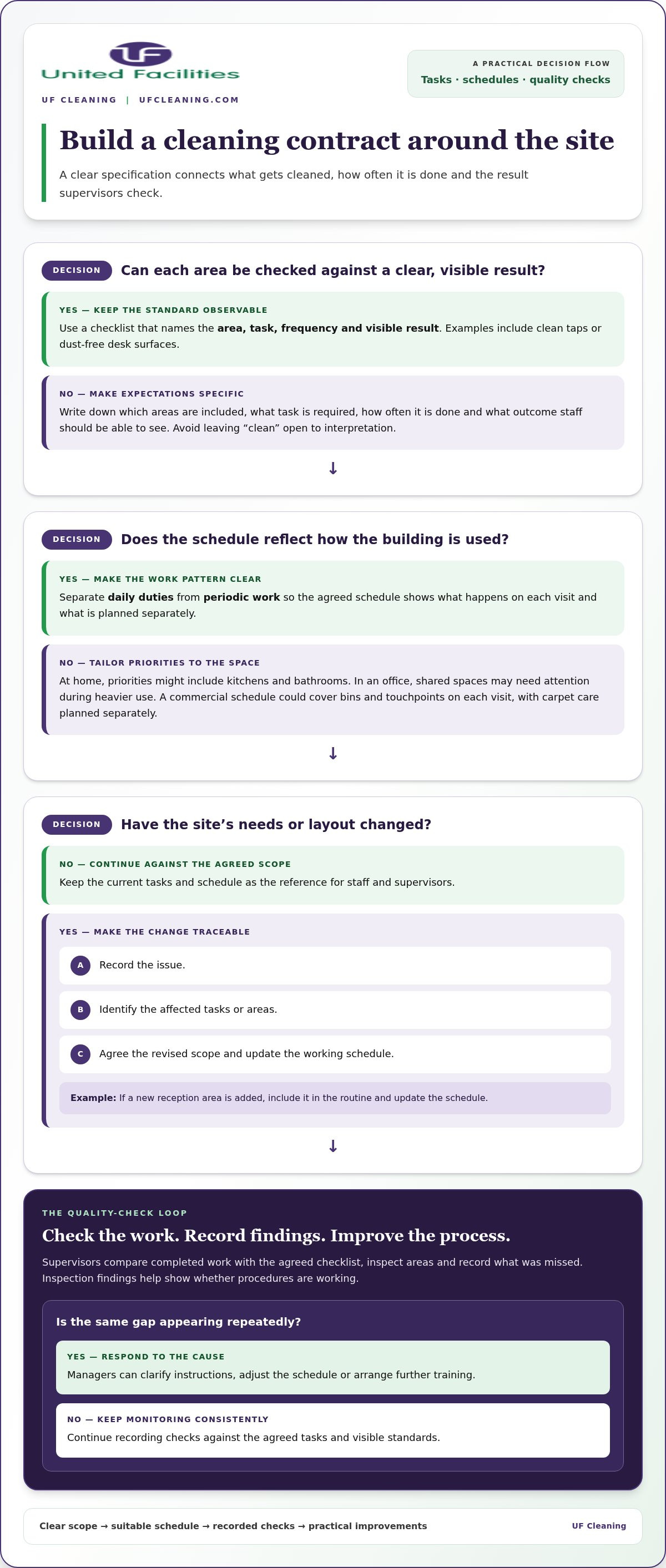
A useful specification makes cleanliness observable, rather than leaving expectations open to interpretation. A checklist for a home or business should name each area, task, frequency and visible result, such as clean taps or dust-free desk surfaces.
Tailored Specifications and Visual Checks
A bespoke specification defines the work and the standard expected in each area. It matters because a reception space, laboratory and clinical room have different uses and priorities. For healthcare and laboratory facilities, site-specific protocols can set cleaning sequences, surface requirements, equipment allocation and reporting routes. High-risk clinical areas need especially clear instructions, with monitoring focused on whether each defined task is completed. In regulated environments, documented requirements help teams work consistently within the site’s procedures. For offices, commercial cleaning arrangements can also reflect the building’s layout and daily use.
Washroom Hygiene and Maintenance
Washroom standards describe the cleaning needed to keep facilities presentable and ready to use. A practical checklist can cover basins, taps, mirrors, dispensers, floors and visible marks, as well as consumables that need replenishing. Specify which items need routine attention and how to report defects such as a leaking tap or damaged dispenser. This makes hygiene checks more consistent and separates cleaning tasks from maintenance issues. Staff can then assess agreed outcomes rather than relying on a vague impression of cleanliness.
Standards, Accreditations and Checklists
A recognised framework can support objective assessment, while a site checklist translates expectations into observable tasks. EN 13549 is identified as a standard for models used to evaluate cleaning quality objectively. For a home, a checklist might name kitchens, bathrooms, floors and touchpoints, then specify the required result. A business checklist can add reception areas, workstations, washrooms, shared facilities and task frequencies. It should also record completion and provide space for inspection findings. Clear, site-specific criteria give staff and managers a practical basis for monitoring quality and reporting recurring gaps.
Flexible domestic and commercial cleaning contracts
A flexible cleaning contract sets the agreed tasks, frequencies and quality standards, while allowing adjustments when a site’s needs change. At home, that might mean prioritising kitchens and bathrooms; in an office, it could mean focusing on shared spaces during a period of heavier use. The key is to describe both the work and its expected result. A list of tasks alone may leave different interpretations of what “clean” means.
For commercial premises, specifications can distinguish daily duties from periodic work. A schedule might cover bins and touchpoints on each visit, with carpet care planned separately. It should identify the areas included, the equipment required and how completion is recorded. If occupancy changes or a department moves, reviewing the specification helps keep the service aligned with the building. Cleaning teams can adjust task allocation while maintaining the agreed standards.
Flexibility also depends on a clear process for changes. Record the issue, identify affected tasks or areas, agree the revised scope, then update the working schedule. A new reception area, for instance, may need to be added to the routine. This keeps expectations clear for staff and managers. It also makes audits more useful: supervisors can assess work against the current agreement, not an outdated checklist.
Regular reviews connect contract terms with actual conditions. Use inspection findings, reported issues and changes in building use to decide whether cleaning frequency, task priorities or equipment need adjustment. A busier shared kitchen, for example, may need a revised schedule. Include review and change arrangements in the contract so quality standards remain relevant as needs evolve.
What cleaning quality standards and accreditations apply in the UK?
In the UK, cleaning quality can be assessed using recognised management frameworks and objective evaluation models. ISO 9001 is a quality management standard; EN 13549 is identified as a standard for models used to evaluate cleaning quality objectively. These references serve different purposes, so a certificate alone doesn’t show whether each area meets its agreed cleanliness standard.
According to the International Organization for Standardization, ISO 9001 supports documented processes, performance monitoring, risk management and continual improvement. In practice, this can mean recording procedures, reviewing inspection findings and acting on recurring issues. It concerns how an organisation manages quality, rather than prescribing a single cleaning checklist for every building. Site requirements still need to describe the work and expected result.
EN 13549 relates to models for objective quality evaluation. An assessment model can help structure inspections around defined criteria, making observations more consistent than relying solely on a general impression. For example, an audit might compare specified tasks with visible outcomes in separate areas, then document any differences. The value lies in clear criteria and records, not simply naming a standard.
When reviewing a cleaning arrangement, distinguish between a management-system standard, an evaluation model and the site’s own specification. Check that written criteria identify the areas assessed, how results are recorded and how findings lead to corrective action. This makes the relationship between standards and daily cleaning work easier to understand. Discuss cleaning quality controls for your premises to consider how documented standards can support consistent oversight.
UF Cleaning: Office Cleaning London
As part of its nationwide operations, UF Cleaning provides expert office cleaning in London for organisations seeking cleaning support aligned with their premises and schedule. Its flexible schedules and real-time quality controls help make service delivery and oversight part of the same arrangement.
For offices in the capital, this service suits organisations seeking regular cleaning with monitored standards. UF Cleaning also provides Office Hard Floor Cleaning, Housekeeping and Hotel Management across the UK, with the right arrangement shaped by the environment and its operational needs.
To discuss cleaning support for your organisation, contact UF Cleaning or visit ufcleaning.com.
Make quality part of your next decision
Before shaping a cleaning arrangement, decide what a well-maintained environment needs to support: focused work, a welcoming visitor experience or smooth daily operations. This helps separate essential outcomes from lower-priority tasks. A useful brief should also explain how feedback will be handled and how priorities may change as the space evolves.
That clarity gives you a stronger basis for discussing quality controlled cleaning services. Look beyond a list of duties: consider how the service should fit your building’s use and the experience you want staff and visitors to have. A focused conversation can turn those priorities into a practical arrangement with expectations that are easier to communicate and review.
UF Cleaning can discuss an approach shaped around your organisation’s needs. Contact UF Cleaning to explore the next step, and move towards a cleaning arrangement that supports your premises with confidence.
Frequently Asked Questions
What does quality-controlled cleaning services mean?
Quality-controlled cleaning services connect agreed work with checks that show whether it meets the expected standard. For example, a service record can identify a missed task, who reported it and whether the area was revisited. This creates a traceable way to address problems instead of relying on general impressions. The right measures depend on the building, its use and the cleaning tasks involved.
How do cleaning companies train, vet and supervise staff?
UF Cleaning’s cleaning staff are directly employed, vetted and background-checked. Training covers practical methods, equipment handling and correct use of cleaning agents, while a site briefing explains access arrangements and specific priorities. Quality inspections and client feedback help managers identify where instructions need reinforcing. An inspection, for example, may reveal a task that needs closer coaching or clearer guidance.
What insurance and health and safety rules should UK cleaning providers follow?
Ask how the provider explains its liability insurance and manages risks at your premises. Relevant considerations include safe equipment use, handling cleaning agents, staff instruction, incident reporting and access to occupied areas. Controls should reflect the work and environment, such as protecting visitors around a wet floor. Clear responsibilities and documented procedures help establish how safety concerns are identified and addressed.
How do I compare cleaning companies and verify their quality claims?
Compare the evidence behind each company’s claims, not just the wording. UF Cleaning holds CHAS Approved, ISO 9001 Certified, BICSc Member and Investors in People credentials. Consider how relevant credentials relate to service delivery, and whether quality inspections and client feedback inform follow-up. A useful comparison also checks that the proposed scope describes your premises, tasks and expected outcomes clearly, so the service can be assessed against practical requirements.
Are quality-controlled cleaning services available in my local area?
UF Cleaning supports organisations across the wider UK, including those with sites outside London. Its Office Cleaning London service is one option for workplace cleaning. The right arrangement depends on the premises, work required and operating needs. For organisations with several sites, a consistent specification can align expectations across locations while accounting for each building’s requirements.