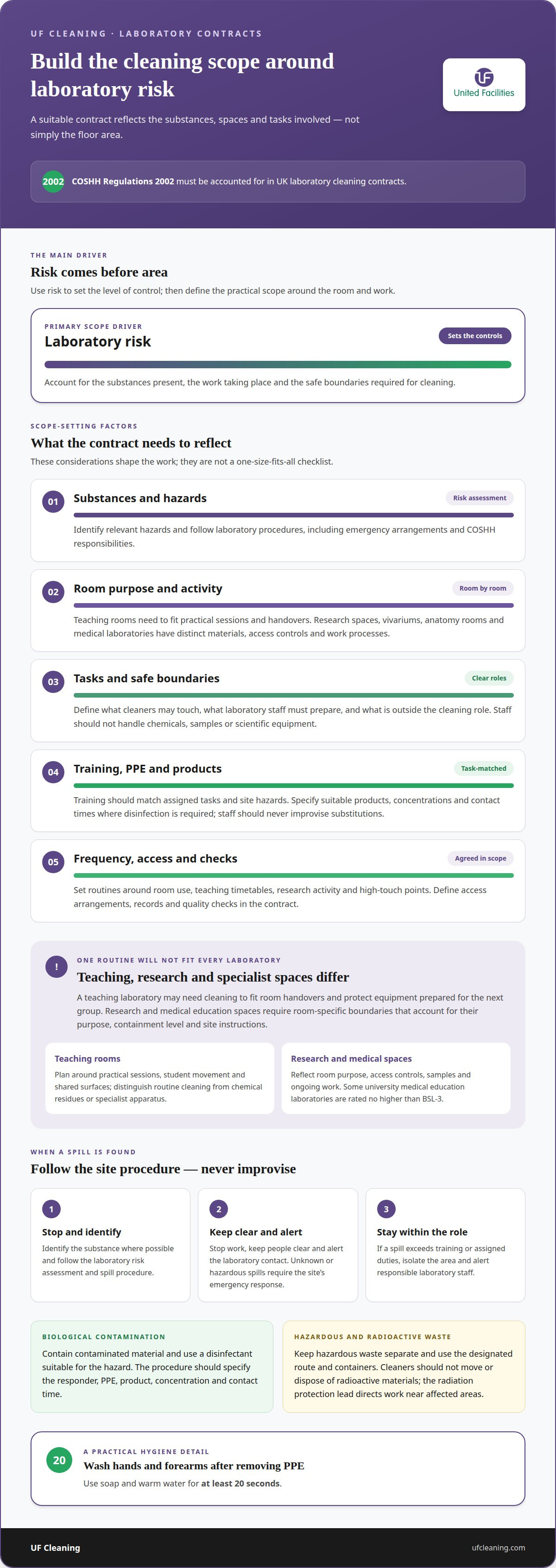
A laboratory cleaning contract is shaped by risk, not simply by floor area. For science laboratory cleaning protocols in higher education, the COSHH Regulations 2002 must be accounted for, according to The National Archives, so the scope needs to reflect the substances, spaces and tasks involved.
It’s reasonable to expect clear arrangements for staff training and the safe handling of hazardous materials, alongside firm boundaries around scientific equipment and specialist areas. The details matter: cleaning a teaching laboratory is different from working in a research space or cleanroom.
This guide explains COSHH training and safe handling, how cleaning approaches vary between laboratory settings, and what shapes costs and contract scope. It also outlines responsibilities a contract can define, from tasks and access arrangements to records and quality checks, so you can assess what a suitable service should cover.
Key Takeaways
- Set the cleaning scope around the substances and hazards present, with COSHH responsibilities clearly accounted for.
- Agree in advance how chemicals and scientific equipment are protected, and where cleaning staff must not intervene.
- Match cleaning methods and inspection needs to each laboratory’s use, rather than applying one routine across every space.
- Assess contract costs by the work involved and the controls required, then define responsibilities and quality checks in the scope.
COSHH assessments and hazardous-material handling
UK laboratory cleaning contracts must account for the COSHH Regulations 2002, according to The National Archives.
Universities can consult HSE COSHH guidance, The National Archives and their own laboratory procedures, including emergency arrangements.
How professional cleaners manage chemical spill cleaning procedures in university laboratories.
Chemical spill response starts with identifying the substance and following the laboratory’s risk assessment and spill procedure. Cleaners should stop work, keep people clear and alert the laboratory contact. An unknown or hazardous spill requires the site’s emergency response, not routine cleaning. Fume cupboards also need clear task boundaries: cleaners should not handle chemicals or alter experiments, and work around them must follow local instructions.
How professional cleaners handle biological spill disinfection and contaminated materials.
Biological spill disinfection involves containing contaminated material and treating the affected surface with a disinfectant suitable for the hazard. The laboratory procedure should specify who can respond, the required protective equipment and the appropriate product, concentration and contact time. An unsuitable method may leave contamination behind or spread it. Cleaners should isolate the area and alert the responsible laboratory staff if a spill exceeds their training or assigned role.
How laboratory cleaning providers manage hazardous waste handling and disposal.
Hazardous laboratory waste must be kept separate and handled through the site’s designated collection and disposal route. Cleaning staff should not put unknown residues, sharps or contaminated materials in general bins. They should follow the laboratory’s instructions and use its designated containers. Radioactive materials require a separate, site-specific plan: cleaners should not move or dispose of them, and the laboratory’s radiation protection lead should direct any work near affected areas.
Cleaning Chemical Compatibility Risks
Chemical compatibility risks arise when products react with each other or are unsuitable for the hazard. Mixing products can create dangerous fumes, while an ineffective disinfectant may not control the relevant microorganisms. A safe protocol names the approved product and explains its use, including concentration and contact time where required. Staff should never improvise substitutions. If a product is spilled, unidentified or incompatible with the task, they should stop and follow the laboratory’s emergency procedure.
Safe storage of chemicals and equipment
In university laboratories, cleaning staff should leave chemical containers in designated storage areas and avoid moving bottles, samples or scientific equipment. A misplaced container can disrupt work or create a hazard, so the cleaning plan should mark storage zones and identify items that only laboratory staff may handle. The same boundary applies in school science laboratories, where benches may hold equipment prepared for a lesson.
Laboratory cleaners need training matched to their assigned tasks, including site procedures, relevant hazards and the correct use of personal protective equipment (PPE). The laboratory should explain what cleaners can touch, how to report damaged containers and whom to alert if a label is unclear. After removing PPE, staff should wash their hands and forearms with soap and warm water for at least 20 seconds.
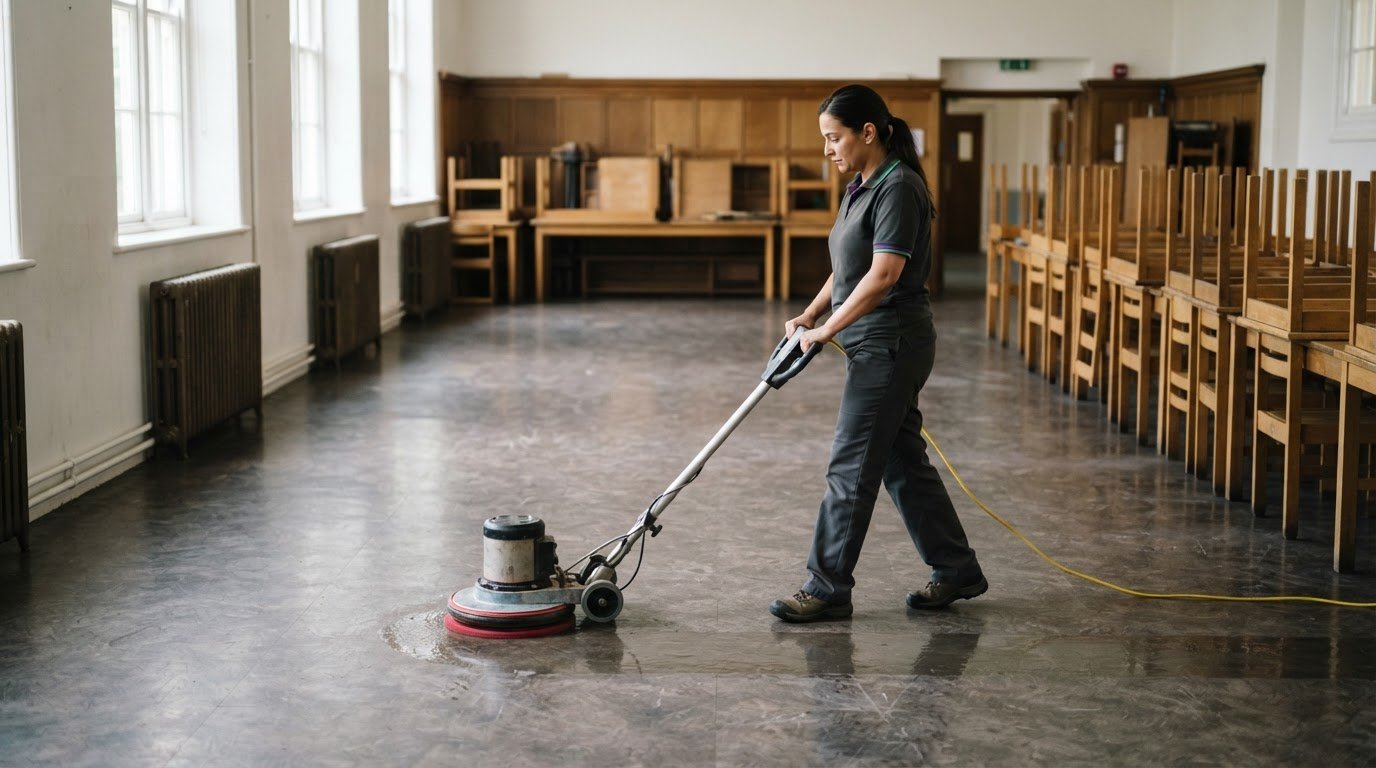
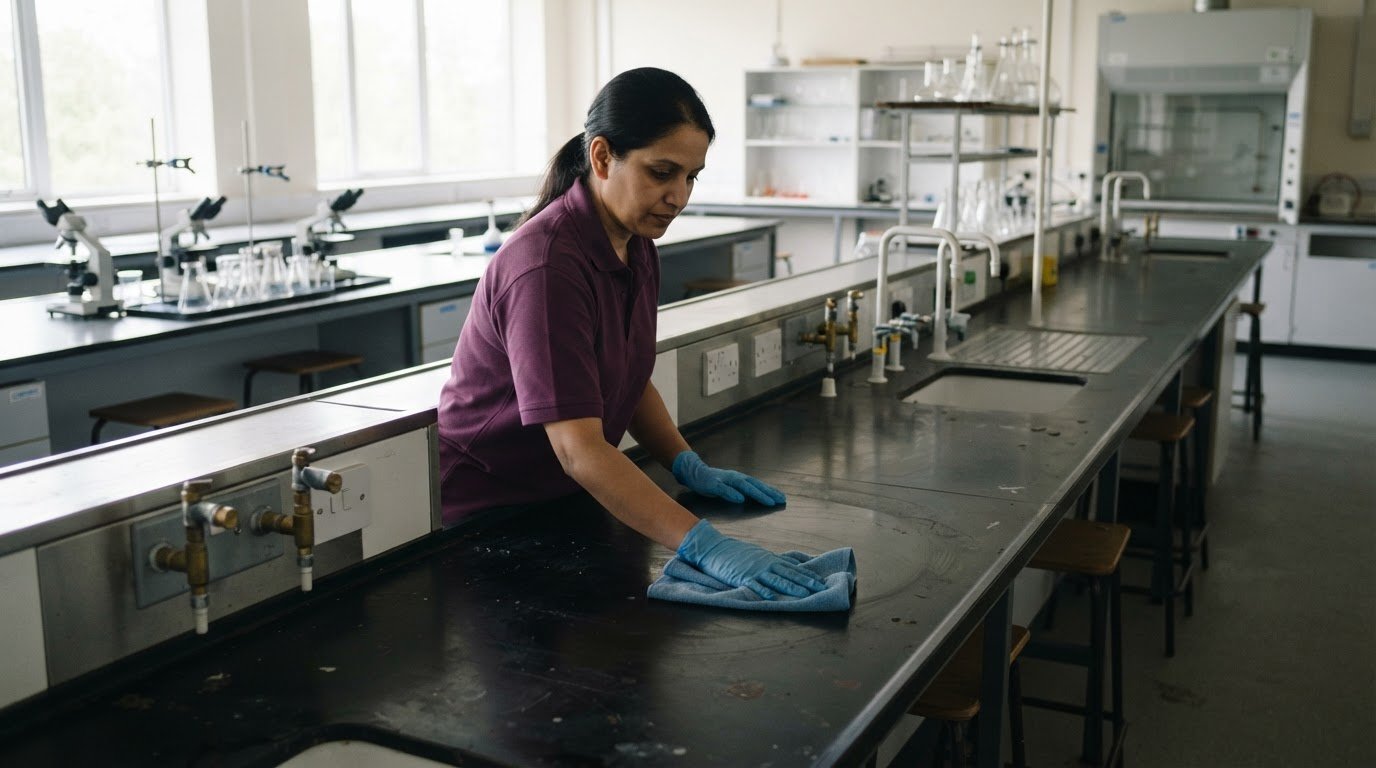
For benches and floors, the agreed method should distinguish ordinary cleaning from disinfection. Staff use products and cloths suited to each surface, following the specified concentration and contact time when disinfection is required. Shared equipment needs a clear boundary: cleaners should not operate, unplug or reposition instruments. Laboratory staff should identify which external surfaces may be wiped and prepare equipment for access.
No single cleaning frequency suits every university laboratory. Set routines around room use, teaching timetables, research activity and high-touch surfaces such as door handles and bench edges. During active use, these points may need attention more often than low-use areas. A spill or contamination event requires the site’s separate response procedure.
These boundaries can be incorporated into education cleaning arrangements, with room-specific instructions that protect stored materials and equipment.
Differences between teaching and research labs
Teaching laboratories are organised around practical sessions, student movement and shared work surfaces. A chemistry class may use benches, sinks and balances in quick succession, so cleaning plans need to fit room handovers and protect equipment prepared for the next group. The scope should distinguish routine surface cleaning from work involving chemical residues or specialist apparatus.
Research spaces have different priorities. Pathogen research labs, vivariums, gross anatomy labs and medical laboratories supporting clinic care each contain distinct materials and work processes. Cleaning boundaries need to reflect the room’s purpose, access controls and potential effect on samples or ongoing work. Some university medical education laboratories are rated at no higher than BSL-3, so procedures must account for the specific containment level and site instructions.
Medical education facilities can combine teaching and research functions, making room-by-room planning essential. APPA’s Operational Guidelines for Educational Facilities: Custodial includes a chapter on medical education and healthcare delivery facilities in Chapter 11. This is relevant to spaces such as anatomy teaching rooms, where cleaning surfaces and floors must remain distinct from handling specimens, instruments or clinical materials.
Inspection arrangements should reflect the work taking place. Inspection arrangements should reflect the work taking place, since activity and contamination risks can differ between laboratory settings. For science laboratory cleaning protocols higher education teams rely on, room-specific checks, access permissions and reporting routes help facilities teams adapt routines to teaching periods, research operations and clinical support areas.
For example, a teaching bench cleared after a practical may be ready for scheduled cleaning, while an occupied research bench may be outside the cleaner’s scope. Science laboratory cleaning protocols higher education institutions use should make this distinction clear to help protect samples, experiments and specialist equipment from disruption.
Laboratory cleaning costs and contract scope
Laboratory cleaning costs depend on the site and are set out after a quote request. Key factors include the rooms covered, cleaning frequency, access arrangements and level of control required. A teaching laboratory used for scheduled classes has different needs from a research space with restricted access. A clear scope treats these spaces separately rather than like a standard office or classroom.
Time and staffing also depend on the tasks included. A contract may cover floors, benches and shared areas, while laboratory staff retain control of specialist equipment. Fume cupboards, controlled environments and additional inspections may need distinct procedures. Clear boundaries prevent routine tasks from expanding into specialist work and help facilities teams understand what each visit covers.
Cleanrooms illustrate how standards affect scope. ISO 14644-1 classifies cleanrooms from ISO Class 1, the strictest, to ISO Class 9, the least restrictive. At Class 5, the limit is 3,520 particles of at least 0.5 µm per cubic metre; at Class 8, it is 3,520,000. These differing limits indicate why a cleaning plan must match the room’s classification and validation requirements.
Before agreeing a contract, define the spaces, tasks, visit schedules, access controls and reporting arrangements. Specify how completed work and corrective actions will be recorded, and identify tasks reserved for laboratory personnel. For example, the scope might include routine floor cleaning in teaching rooms but exclude moving samples or operating instruments. These details make responsibilities measurable and reduce ambiguity during service reviews.
For a clearly defined university environment, discuss an education cleaning scope tailored to its rooms and operational requirements.
UF Cleaning: Education Cleaning
UF Cleaning provides Education Cleaning for educational settings that need a clear, dependable approach to routine cleaning. For universities, this service can support plans for teaching spaces and shared areas, with tasks and access requirements tailored to the institution’s needs.
A clear scope separates general cleaning from laboratory activities reserved for specialist staff, such as handling samples, chemicals or scientific equipment. Education Cleaning is suited to agreed tasks in the surrounding environment, not work requiring specialist hazardous-material handling.
If your university is planning cleaning for educational spaces, contact UF Cleaning to discuss your requirements.
Set your laboratory cleaning plan in motion
The next step is to turn your university’s operational requirements into a practical working plan. Map cleaning responsibilities to each space, agree how changes in room use will be communicated, and set a review process to keep the schedule aligned with teaching and research. This gives facilities and laboratory teams a shared reference as needs change.
Well-defined science laboratory cleaning protocols for higher education can support continuity by clarifying responsibilities and service expectations. The written scope should be practical for cleaners to follow and straightforward for university teams to review, allowing adjustments as spaces, activities or access arrangements change.
If you’re ready to discuss a cleaning arrangement for your educational environment, contact UF Cleaning about lab cleaning. A considered conversation can help you define a suitable next step and move towards a well-organised plan.
Frequently Asked Questions
Do lab cleaners need COSHH training?
Yes. Cleaners working in university laboratories need training relevant to their duties and the hazards they may encounter. It should cover site access, protective equipment, chemical labels, safe work boundaries and how to raise an alarm. For example, cleaners should know whom to notify if they find an unlabelled container or a spill beyond their authorised tasks, rather than attempting to handle it themselves.
How much does lab cleaning cost in the UK?
UK laboratory cleaning costs are site-specific and set out after a quote request. They depend on the spaces included, required tasks, cleaning frequency, access arrangements and controls for each area. A teaching room requiring routine surface cleaning has a different scope from a controlled research space. A well-defined schedule and clear responsibility boundaries help establish what the quotation should cover.
How often should you perform lab inspections?
Inspection frequency should reflect laboratory use, risks and the required cleaning standard. Research and medical education laboratories need more frequent inspections than high school laboratories, while a cleanroom may need monitoring against its applicable classification. Inspections can record missed tasks, surface condition, access issues and corrective actions. This lets the schedule respond to evidence from individual rooms instead of applying one interval across a varied university estate.
What qualifications do laboratory cleaners need?
Preparation should match the cleaner’s assigned duties and the laboratory environment. Relevant instruction may include site induction, hazard awareness, protective equipment, access restrictions and reporting procedures. A cleaner assigned to public corridors has different responsibilities from one permitted to enter a controlled laboratory. The contract and site procedures should define these boundaries so staff are not asked to handle substances or equipment beyond their role.
Who is responsible for cleaning specialised scientific equipment?
The laboratory manager usually oversees scientific equipment, so cleaning staff should not move, unplug or operate instruments. The manager or designated technical staff can specify whether accessible external surfaces may be wiped and prepare equipment accordingly. This boundary protects sensitive work: accidentally disconnecting a research refrigerator, for example, could put stored samples and long-running research at risk.
What are the UK health and safety requirements for cleaning university science laboratories?
UK laboratory cleaning contracts are governed in part by the Health and Safety at Work Act 1974 and must account for the COSHH Regulations 2002, according to The National Archives. PUWER 1998 requires cleaning equipment to be suitable for its environment. In practice, the contract should reflect site hazards, access controls, appropriate equipment and agreed procedures for reporting incidents or unsafe conditions.